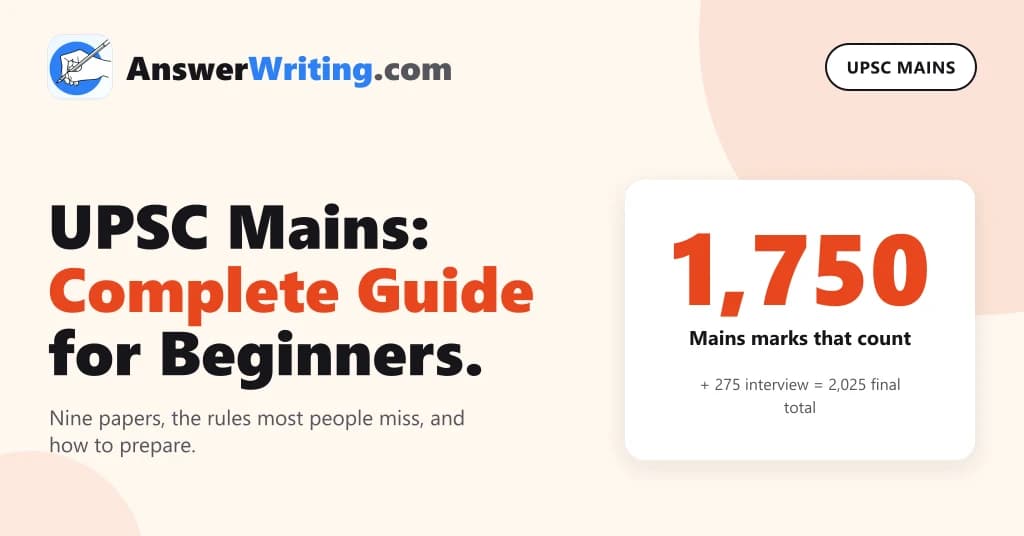
UPSC Mains is the written second stage of the Civil Services Exam. It has nine papers, each of three hours. Two language papers are only qualifying, and seven papers carry 1,750 marks that count for your rank. Add the 275-mark interview and you get the final total of 2,025 marks. Prelims only lets you in; Mains decides most of your rank.
This guide explains the papers, the rules that many beginners miss, and a simple way to prepare. All exam rules here come from the official CSE 2026 notice on upsc.gov.in.
Where Mains Fits in UPSC CSE
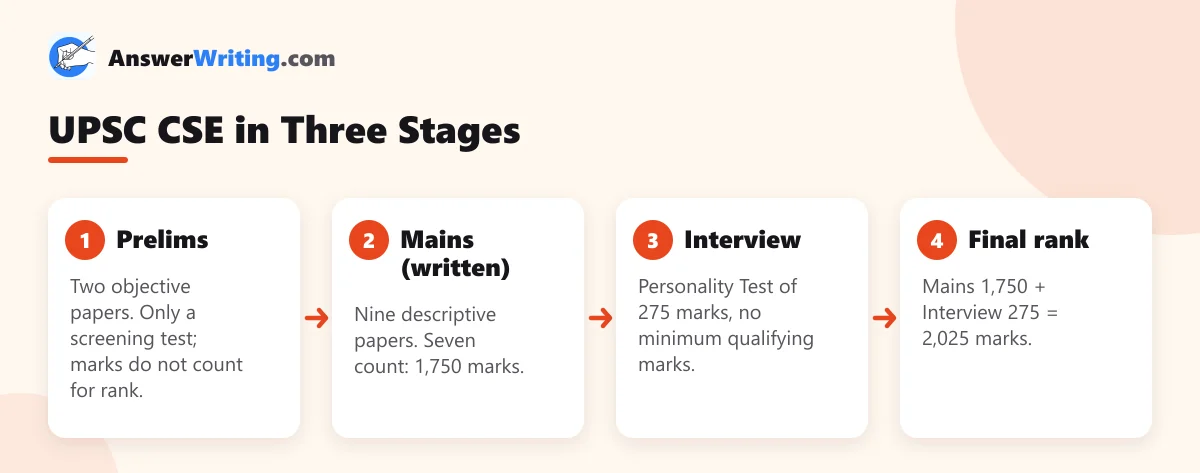
The CSE 2026 notice expected about 933 vacancies. UPSC calls about twice as many candidates as vacancies to the interview, based on Mains written marks. For CSE 2026, the Mains result was declared on 5 November 2026; see our UPSC Mains result 2026 post.
The Nine Mains Papers
| Paper | Subject | Marks | Counts for rank? |
|---|---|---|---|
| Paper A | One Indian language (Eighth Schedule) | 300 | No, qualifying |
| Paper B | English | 300 | No, qualifying |
| Paper I | Essay | 250 | Yes |
| Paper II | GS I: Heritage, Culture, History, Geography, Society | 250 | Yes |
| Paper III | GS II: Governance, Constitution, Polity, Social Justice, International Relations | 250 | Yes |
| Paper IV | GS III: Technology, Economy, Biodiversity, Environment, Security, Disaster Management | 250 | Yes |
| Paper V | GS IV: Ethics, Integrity and Aptitude | 250 | Yes |
| Paper VI | Optional Paper 1 | 250 | Yes |
| Paper VII | Optional Paper 2 | 250 | Yes |
Every paper is of the conventional (essay) type and lasts three hours. Read the paper-wise details in our posts on the UPSC Mains exam pattern and the GS1 paper pattern.
What Each Paper Tests
The syllabus for every paper is printed in the CSE notice. In simple words:
- Essay (Paper I): your ability to write long, organised and balanced essays on general topics. You choose your topics from the options given.
- GS I (Paper II): Indian heritage and culture, modern Indian history and the freedom struggle, world history, Indian society, and physical and human geography of India and the world.
- GS II (Paper III): the Constitution, Parliament and state legislatures, the executive and judiciary, governance, welfare schemes for weaker sections, and India’s international relations.
- GS III (Paper IV): the Indian economy, agriculture, infrastructure, science and technology, environment and biodiversity, disaster management and internal security.
- GS IV (Paper V): ethics, integrity and aptitude, with theory questions and case studies about real choices an officer faces.
- Optional (Papers VI and VII): one subject you choose from the list in the notice, at roughly the level of an honours degree.
Notice how much GS overlaps with what you read for Prelims. History, polity, geography, economy and environment all come back, but Mains asks you to explain, analyse and give a view, not just recognise a fact. This is why Prelims and Mains preparation should run together, not one after the other. Our post on the difference between Prelims, Mains and the interview explains this further.
How Mains Marks Turn Into Your Rank
Your final rank depends on the total of seven written papers and the interview. Small gains add up: 10 extra marks in each of the four GS papers is 40 marks, which near the top of the list can mean a jump of many ranks. The Essay and optional together carry 750 marks, not far behind the 1,000 marks of all four GS papers combined.
This is why steady answer writing matters more than reading one more book. Each paper rewards answers that are clear, structured, relevant to the question and backed by examples.
Rules Many Beginners Miss
1. The language papers can stop everything
UPSC evaluates your Essay, GS and optional papers alongside the language papers. But it takes those seven papers into account only if you score at least 25% in the Indian language paper and 25% in English. Fail either, and your other marks do not count. Candidates from Arunachal Pradesh, Manipur, Meghalaya, Mizoram, Nagaland and Sikkim do not have to take Paper A, and some hearing-impaired candidates can also be exempted. Read our post on the compulsory language papers.
2. You can write in your own language
You can answer all papers, except Papers A and B, in English or in any one of the 22 languages of the Eighth Schedule. You may add the English term in brackets for technical words. If you write the main papers in an Indian language, you may still choose to write your optional papers in English.
3. Do not write anything that reveals your identity
The notice warns that irrelevant matter, signs or marks that could reveal who you are lead to a penalty in marks. Never write your name, phone number or any personal note in the answer booklet.
4. Ties are broken in a fixed way
If two candidates have the same final marks, the one with more marks in the compulsory papers (Essay and GS I to IV) plus the interview ranks higher. If that is also equal, the compulsory papers alone are compared. If still equal, the older candidate ranks higher.
5. The interview has no pass mark
The interview carries 275 marks, with no minimum qualifying marks. Your written score usually decides more of your rank. Our post on UPSC interview marks shows how wide interview scores can be.
How to Prepare for Mains
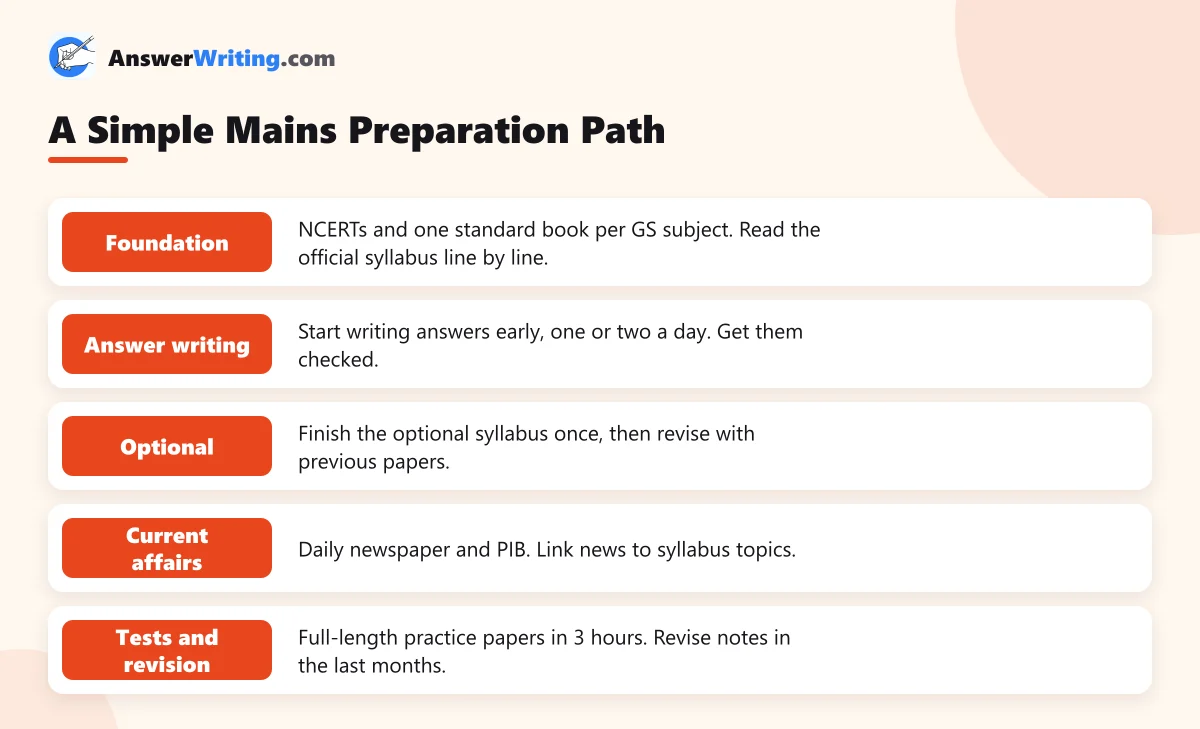
The biggest change from Prelims is that Mains rewards writing, not just reading. Many candidates know enough but cannot write a structured answer in seven or eight minutes. Practise early:
- Read each question and find the directive word, like “discuss” or “critically examine”. Our post on analysing questions and understanding their demand explains this skill.
- Write a short introduction, a body with headings or points, and a balanced conclusion.
- Add an example, a fact, a diagram or a map where it helps.
- Stay within the word limit printed with each question.
For the Essay and optional, read everything about the UPSC essay paper and our guide to UPSC optional subjects. For GS IV, start with our complete guide to GS4 case studies.
Use previous question papers from the official UPSC question paper page. They show you exactly how questions are framed.
Learn to read each question right with our post on directive words in UPSC Mains.
See the GS4 Ethics paper pattern for how Paper V is set.
Key Takeaways
- UPSC Mains has nine papers of three hours each. Seven papers count for rank: 1,750 marks.
- You must score at least 25% in both language papers, or your other papers are not counted.
- You can write in English or any of the 22 Eighth Schedule languages.
- Never write anything that reveals your identity in the answer booklet.
- Start answer writing early, and practise with previous year papers.
Get Your Mains Answers Checked
Writing without feedback is slow progress. On AnswerWriting, you can get your Mains answers evaluated by AI for GS, Essay and all optionals, with a model answer in minutes, in English, Hindi and 22 other Indian languages. Your first three evaluations are free.
Related Reading
FAQs
How many papers are there in UPSC Mains?
Nine: two qualifying language papers and seven papers that count for rank.
What is the total mark of UPSC Mains?
The seven ranking papers carry 1,750 marks. With the 275-mark interview, the final total is 2,025.
What is the qualifying mark in the language papers?
At least 25% in the Indian language paper and 25% in English, as per the CSE 2026 notice.
Can I write UPSC Mains in Hindi?
Yes. You can write all papers, except the two language papers, in English or any of the 22 Eighth Schedule languages, including Hindi.
How long is each Mains paper?
Three hours.
Do Prelims marks count in the final rank?
No. Prelims is only a screening test. Your rank comes from the Mains written papers and the interview.