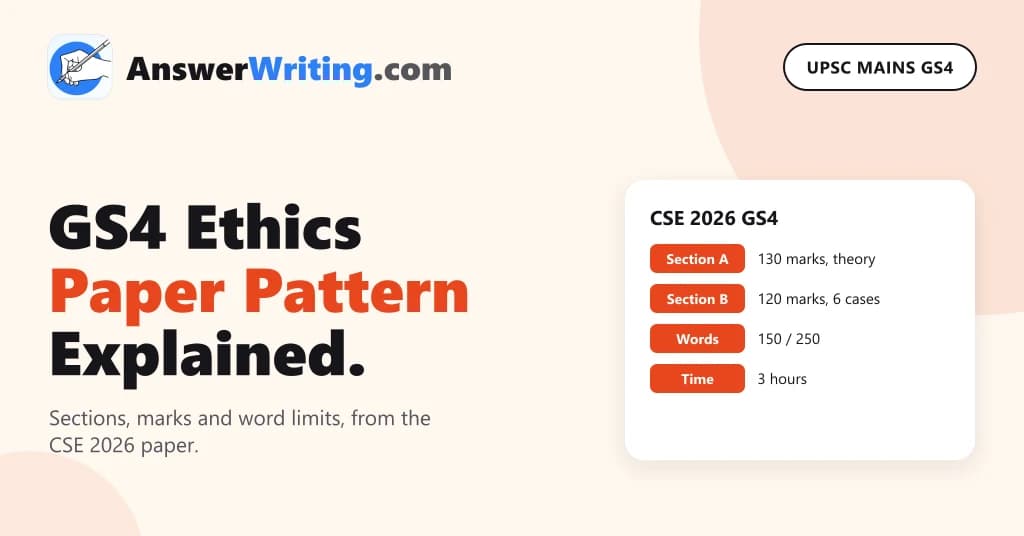
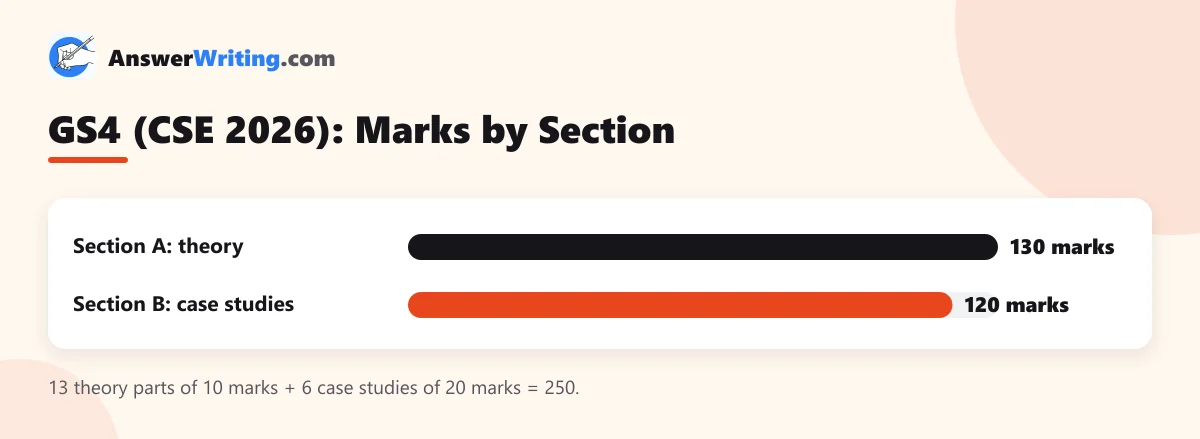
The UPSC GS4 paper, Ethics, Integrity and Aptitude, is Paper V of Mains. It carries 250 marks and lasts three hours. In the CSE 2026 paper, there were 12 compulsory questions in two sections: Section A had theory questions worth 130 marks (150 words, 10 marks each part), and Section B had six case studies of 20 marks each (250 words), worth 120 marks.
This post explains the pattern using the official CSE 2026 question paper, the syllabus and a simple time plan.
GS4 Pattern at a Glance
The table below is based on the CSE 2026 GS Paper IV, published on the UPSC question paper page.
| Feature | CSE 2026 GS4 |
|---|---|
| Paper | Paper V of Mains |
| Marks | 250 |
| Time | 3 hours |
| Questions | 12, all compulsory |
| Section A | Questions 1 to 6: 13 parts of 10 marks each (150 words) = 130 marks |
| Section B | Questions 7 to 12: 6 case studies of 20 marks each (250 words) = 120 marks |
| Language | Printed in Hindi and English; answer in your chosen medium |
Most of Section A has two parts per question, but one question in 2026 had three parts. Do not assume the exact split is fixed; read the instructions on the paper every time.
What Section A Asks
Section A tests your understanding of ethics concepts and your ability to apply them. In the CSE 2026 paper, the questions included:
- A professor using AI to write a Ph.D. evaluation report, discussed in terms of accountability and integrity.
- A business project that could displace a forest community, and the ethical challenges for a district officer.
- How national security can be balanced with human rights.
- Dr. B. R. Ambedkar’s warning about civil disobedience in a constitutional democracy.
- Gandhi’s idea of trusteeship applied to fairness in governance.
- Paternalism and beneficence, through a doctor persuading a patient’s family.
- Empathy versus following rules, through a transfer request.
Notice the pattern: very few questions ask for a pure definition. Even theory questions often come with a short situation, a quote or a thinker, and ask you to apply the idea.
What Section B Asks
Each case study is a story of a few paragraphs about an officer, doctor or professional facing a hard choice. It usually ends with two or three sub-questions, like:
- What are the ethical issues involved?
- What options are open to the officer?
- Which option would you choose, and why?
In 2026, the cases included a doctor acting on a relative’s consent during surgery, AI-based predictive policing, corruption in land-use approvals at a district office, biometric problems in the public distribution system, a district magistrate handling violence between two communities in a border district, and an officer deciding which country to sell defence equipment to. Our complete guide to GS4 case studies shows how to structure these answers.
The GS4 Syllabus in Simple Words
The official syllabus in the CSE notice lists these areas:
| Area | What it covers |
|---|---|
| Ethics and human interface | What ethics is, what shapes it, ethics in private and public life, values from leaders and reformers |
| Attitude | What attitudes are, how they affect behaviour, moral and political attitudes, persuasion |
| Aptitude and civil service values | Integrity, impartiality, non-partisanship, objectivity, dedication, empathy, compassion for weaker sections |
| Emotional intelligence | Concepts and their use in administration |
| Moral thinkers | Contributions of thinkers from India and the world |
| Public service values | Ethical dilemmas, laws and conscience as guides, accountability, ethics in international relations, corporate governance |
| Probity in governance | Transparency, Right to Information, codes of ethics and conduct, citizen’s charters, use of public funds, corruption |
| Case studies | Case studies on all of the above |
A Simple Time Plan for 3 Hours
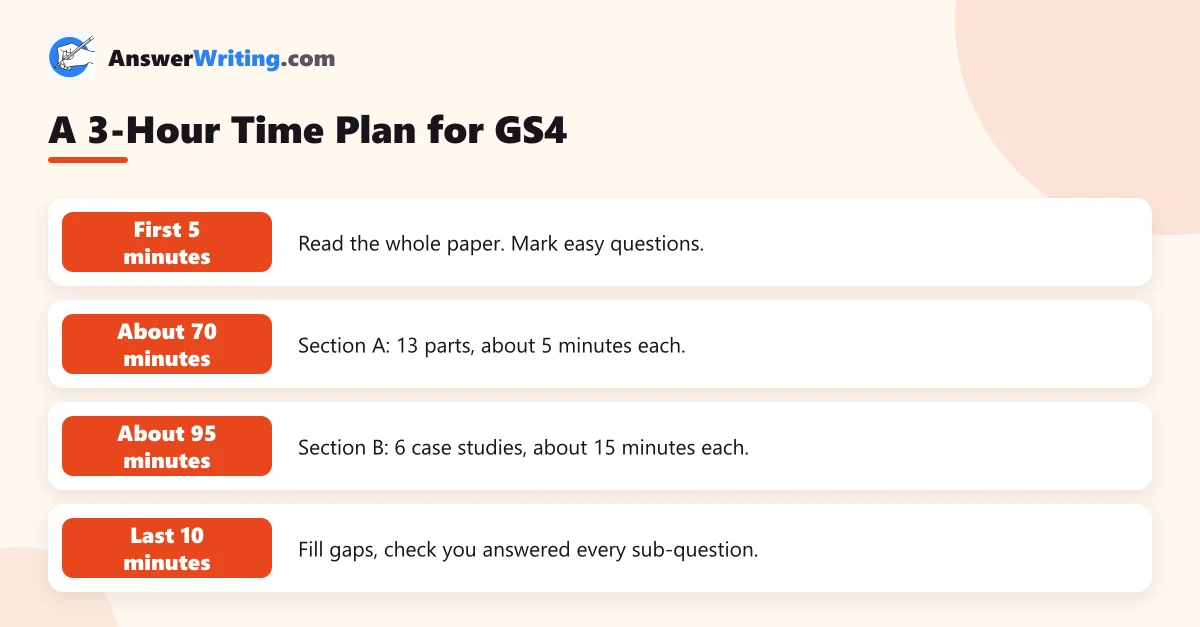
Many candidates start with Section B, because the case studies need more thinking and leaving them for the end causes panic. Try both orders in your practice tests and pick the one that suits you. For more on pacing, read our post on time management in UPSC Mains.
How to Prepare for GS4
- Read the syllabus and learn simple definitions of each term, like integrity, probity, empathy and emotional intelligence.
- Collect two or three real examples for each value, from your own life, from public servants and from news.
- Read short biographies of leaders and reformers named in the syllabus area on human values.
- Solve at least 20 case studies from previous papers, in 250 words and 15 minutes each.
- Get your answers checked, because it is hard to judge your own ethics answers.
For all nine papers and their marks, read our UPSC Mains guide for beginners.
Key Takeaways
- GS4 carries 250 marks and lasts three hours.
- In CSE 2026: 12 compulsory questions, Section A theory worth 130 marks and Section B case studies worth 120 marks.
- Theory answers are 150 words for 10 marks; case studies are 250 words for 20 marks.
- Most theory questions also ask you to apply ideas, not just define them.
- Practise case studies under time limits and get them checked.
Practise GS4 Answers With Feedback
Ethics answers improve fastest with feedback. Write a case study answer and get AI evaluation of your GS4 answer on AnswerWriting with a model answer in minutes. Your first three evaluations are free.
Related Reading
- UPSC GS1 paper pattern explained
- UPSC GS3 paper pattern explained
- GS4 answer writing tips
- UPSC Mains exam pattern
- Quoting thinkers and scholars in your answers
FAQs
How many questions are there in UPSC GS4?
The CSE 2026 GS4 paper had 12 questions, all compulsory, in two sections.
How many marks are case studies worth in GS4?
In CSE 2026, Section B had six case studies of 20 marks each, a total of 120 marks.
What is the word limit in GS4?
In CSE 2026, theory parts had a 150-word limit for 10 marks, and case studies had a 250-word limit for 20 marks.
Should I start GS4 with case studies?
Many candidates do, because case studies need more time. Try both orders in practice and choose what works for you.
Is GS4 scoring?
It can be, because the syllabus is short and fixed. Scores still vary a lot, so regular practice and feedback are important.