UPSC Prelims vs Mains vs Interview – Difference Explained
The Union Public Service Commission (UPSC) Civil Services Examination (CSE) is often described as one of the most rigorous competitive assessments globally. However, viewing it as a single examination is a strategic error. It is, in fact, a three-layered selection architecture where each stage demands a fundamentally different cognitive approach. While the syllabus remains the broad common denominator, the “mode of testing” shifts from recognition to articulation, and finally, to personality assessment.
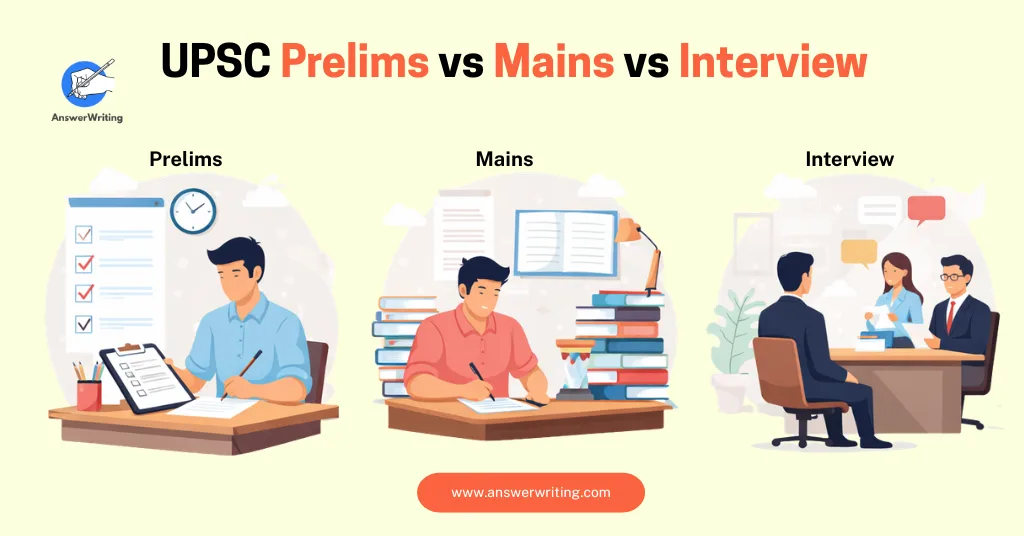
The Macro View: A Comparative Summary
Before diving into the qualitative differences, it is essential to understand the structural divergence between the three stages.
| Feature | Preliminary Examination | Main Examination | Personality Test (Interview) |
| Nature | Objective (MCQs) | Descriptive (Essay Type) | Conversational |
| Purpose | Elimination (Qualifying) | Selection (Ranking) | Suitability Assessment |
| Total Marks | 400 (Not counted for rank) | 1750 (Determines rank) | 2750 (Final score includes Mains) |
| Key Skill | Speed & Accuracy | Depth & Articulation | Presence of Mind & Integrity |
1. The Preliminary Stage: The Art of Intelligent Elimination
The Prelims stage consists of two papers: General Studies I and the Civil Services Aptitude Test (CSAT). Its primary purpose is to filter out approximately 95% of the applicant pool.
The cognitive demand here is “Recognition.” You are presented with the answer; your task is to identify it among three distractors. However, the UPSC has evolved this stage into a test of “Elimination Logic.” With the introduction of “Only one pair,” “Only two pairs” style options, the traditional method of ruling out a single wrong option is becoming obsolete.
Aspirants must possess a wide breadth of knowledge. Whether it is the technicalities of a new Bio-plastic policy or the specific location of a West Asian conflict zone, the Prelims reward the “Informed Generalist.” This stage is often the most volatile because even a minor lapse in concentration during the 120-minute window can cost an entire year of preparation.
2. The Main Examination: The Test of Academic and Analytical Depth
Once a candidate crosses the Prelims threshold, the game changes from “What” to “Why” and “How.” The Mains examination consists of nine papers, including an Essay, four General Studies papers, and two Optional subject papers.
Unlike the Prelims, where you pick an answer, in the Mains, you must construct one. This stage tests your ability to synthesize information across disciplines. For instance, a question on “Internal Security” might require you to weave in “Economic Disparity” and “Technological Vulnerabilities.”
The Mains stage is where the “Steel Frame” is truly tested. You are required to write approximately 3,000 to 4,000 words in a single three-hour session, often doing this twice a day. This requires not just knowledge, but “Structural Precision.” An answer must have a crisp introduction, a multi-dimensional body, and a pragmatic conclusion.
While the Prelims require a sharp eye for detail, the Mains require a sophisticated “Voice.” This is the stage where the evaluators look for a balanced administrative perspective: someone who can criticize a policy constructively without sounding cynical. The AI-driven evaluation tools at AnswerWriting.com are specifically calibrated to detect these nuances, helping aspirants bridge the gap between “knowing a topic” and “writing a high-scoring answer.”
3. The Personality Test: Assessing the Future Administrator
The final stage is the Personality Test, commonly referred to as the Interview. It is a 275-point assessment that can drastically alter one’s final rank and service allocation.
A common misconception is that the Interview is another test of knowledge. On the contrary, the Commission already knows you are brilliant because you cleared the Mains. The board, chaired by a UPSC member, is looking for “Administrative Suitability.” They assess your mental alertness, critical powers of assimilation, clear and logical exposition, and your ability to remain calm under provocative questioning.
The purpose here is to see if you possess the “Ethical Resilience” required for a career in the IAS, IPS, or IFS. Do you take a stand on controversial issues? Are you aware of your own “Detailed Application Form” (DAF)? The Interview is a test of your character and your connection to the reality of the Indian landscape.
The Interdisciplinary Linkage
The transition between these stages is not linear; it is integrated. A topic like “Digital Currency” can appear in the Prelims as a question on Blockchain technology, in the Mains as a question on its impact on the Fiscal Policy of the RBI, and in the Interview as a discussion on the “Financial Inclusion of the Rural Poor.”
Understanding this interconnectedness is vital. If your preparation is “Prelims-only,” you will likely struggle to develop the depth required for the Mains. Conversely, if you focus solely on deep analysis without practicing objective mock tests, the Prelims might become an insurmountable barrier.
Conclusion: The Integrated Preparation Strategy
Success in the UPSC CSE is a product of adapting your mindset as you move through these three distinct filters. The Prelims require a “Scanner” mindset (wide and sharp), the Mains require a “Architect” mindset (structured and deep), and the Interview requires a “Statesman” mindset (balanced and authentic).
To master the most critical segment, the Mains, one must develop the muscle memory of answer writing. Articulating complex geopolitical or economic doctrines within a 150-word limit is a skill that requires constant refinement. Would you like to test your current structural readiness by practicing a mock Mains question on AnswerWriting.com? Our AI evaluation provides instant feedback on your relevance and depth, ensuring you are prepared for the “Selection” phase of this journey.