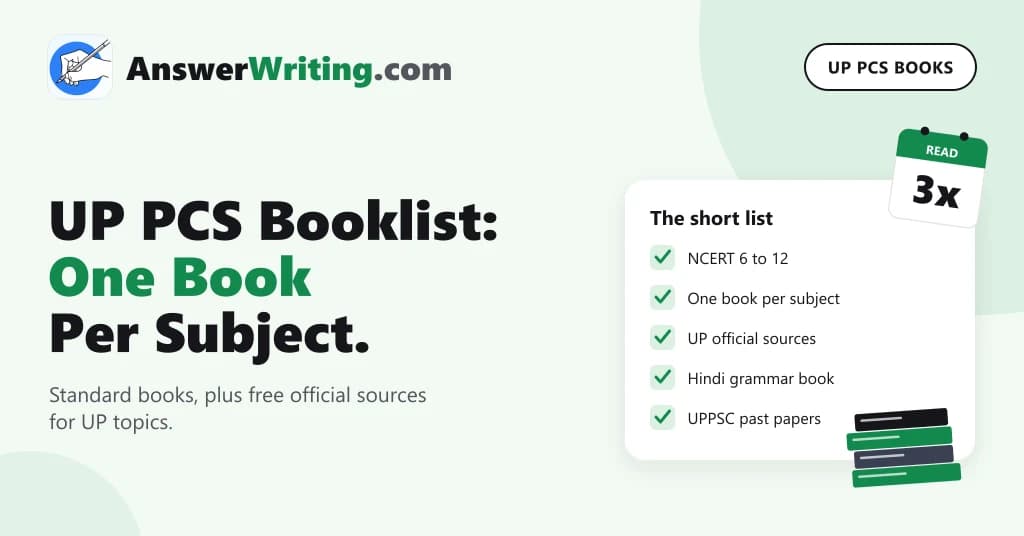
The best UP PCS booklist is a short one: NCERT books for the basics, one standard book per subject, and free official sources for Uttar Pradesh. A simple rule works best: one good book read three times is better than three books read once. This list follows that rule and tells you what each book is for, so you do not buy books you do not need.
Two things make UP PCS different from UPSC. First, GS 5 and GS 6 in Mains are both about Uttar Pradesh, so you need state sources that most UPSC lists skip. Second, General Hindi is a full 150-mark paper, so you need a Hindi grammar book.
Start Here: NCERT Books
Read the NCERT books of classes 6 to 12 for history, geography, polity, economics and science before any other book. They are free on the official NCERT website. Many old UP PCS Prelims questions come straight from NCERT-level facts.
If you are short of time, start with classes 9 to 12 and read the class 6 to 8 books only for history and science.
If You Are Just Starting
Do not buy the whole list on day one. Start with four things for the first two months: the NCERT books, M. Laxmikanth for polity, Spectrum for modern history, and the UPPSC past papers. Add the other books one at a time when you finish these.
The Standard Books, Subject by Subject
| Subject | Book | What it is for |
|---|---|---|
| Polity | Indian Polity by M. Laxmikanth | The main book for Prelims and for GS 2 |
| Modern history | A Brief History of Modern India (Spectrum) | Freedom struggle, 1857 to 1947 |
| Modern history (depth) | India’s Struggle for Independence by Bipan Chandra | Mains answers in GS 1 |
| Ancient and medieval | Old NCERTs or class 11-12 NCERTs | Enough for both stages |
| Art and culture | Indian Art and Culture by Nitin Singhania | Architecture, music, dance |
| World geography | Certificate Physical and Human Geography by G. C. Leong | Basics of physical geography |
| Indian geography | Geography of India by Majid Husain | Resources, agriculture, regions |
| Economy | Indian Economy by Ramesh Singh | Concepts for Prelims and GS 3 |
| Environment | Shankar IAS Environment | Ecology, biodiversity, climate |
| Ethics (GS 4) | The Second ARC report “Ethics in Governance” (free, official) | Ideas and examples for GS 4 |
| CSAT | Verbal and Non-Verbal Reasoning by R. S. Aggarwal; NCERT maths 6 to 10 | Reasoning and basic maths |
| Atlas | Oxford Student Atlas | Map questions and diagrams |
Most of these books also come in Hindi editions, so Hindi-medium aspirants can follow the same list.
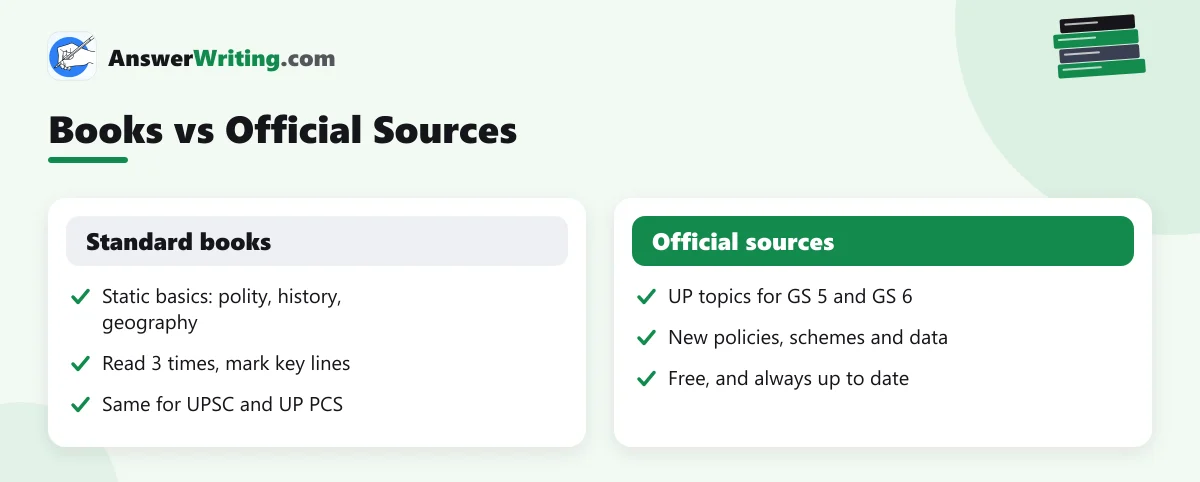
For GS 5 and GS 6: Free Official Sources
These two papers carry 400 marks, and no single book covers them well, because they ask about new UP policies every year. In 2025 they asked about the UP Science and Technology Policy 2025, the AYUSH Policy 2025, the Green Hydrogen Policy 2024 and Drone Didi Yojana. Use official sources:
| Need | Source |
|---|---|
| UP history, culture, geography, profile | The official Uttar Pradesh state portal |
| UP polity and legislature | The Constitution and the UP Legislative Assembly website |
| UP economy | The UP Budget speech and budget papers of the state finance department |
| State policies and schemes | Websites of the concerned UP departments |
| Central schemes | PIB |
| District products | The official ODOP portal of the UP Government |
Make your own notes from these, one page per topic. Our UP GK guide for UP PCS gives the list of UP topics to cover, and our UP divisions and districts list gives the map basics.
For General Hindi and Essay
- General Hindi: a standard grammar book such as Hindi Vyakaran by Kamta Prasad Guru, or Adhunik Hindi Vyakaran aur Rachna by Vasudevnandan Prasad. Practise with UPPSC past papers.
- Essay: no book is needed. Read a good newspaper’s editorial page daily and write one essay a week.
Current Affairs
- One national newspaper daily, plus the UP pages of a Hindi or English daily.
- PIB for central schemes and government decisions.
- Official UP department websites and the UP Budget for state matters.
- Make monthly notes yourself. Notes you write are easier to revise than any compilation you buy.
Previous Year Papers
The most useful “book” is free: the official question papers on the UPPSC previous year papers page. Solve the last five years of Prelims papers and write answers to the last two years of Mains papers before you buy any practice book.
Common Mistakes
- Buying many books for one subject. Pick one and finish it three times.
- Skipping NCERTs. Standard books assume you know NCERT basics.
- Using only UPSC lists. They do not cover GS 5, GS 6 or General Hindi.
- Reading without writing. For Mains, every book should lead to written answers.
To fit these books into a timetable, follow our 12-month UP PCS plan.
Key Takeaways
- Start with NCERT books from classes 6 to 12; they are free on the NCERT website.
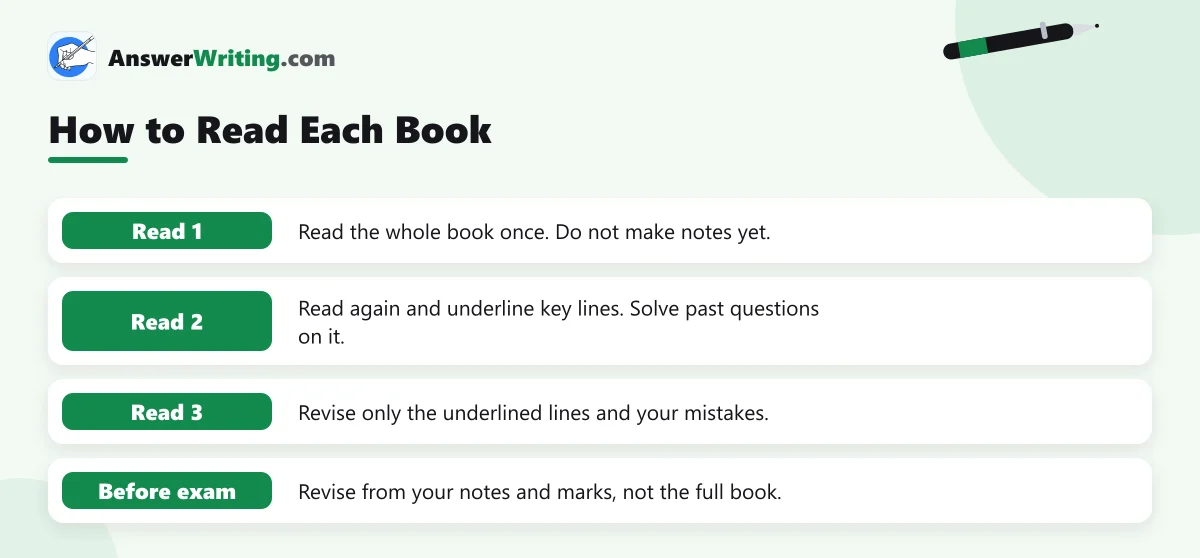
- Use one standard book per subject and read it three times.
- For GS 5 and GS 6, use free official UP sources, because they ask about new state policies.
- Use a Hindi grammar book and past papers for General Hindi.
- UPPSC’s past papers are the most useful practice material, and they are free.
Turn Reading Into Marks
Books only help if you can write what you read. On AnswerWriting’s UP PCS page you can practise previous year questions and MCQs, and write Mains answers in Hindi or English for AI evaluation with a model answer. Your first three evaluations are free.
Related Reading
FAQs
Which book is best for UP GK?
There is no single best book. Use the official UP state portal, the UP Budget and department websites, and make your own notes.
Are NCERT books enough for UP PCS?
They are enough for the basics, but you also need one standard book per subject and official UP sources for GS 5 and GS 6.
Do I need different books for UP PCS and UPSC?
The standard books are mostly the same. UP PCS also needs UP sources and a Hindi grammar book.
Are these books available in Hindi?
Most standard books listed here have Hindi editions, and NCERT books are free in Hindi too.
How many times should I read a book?
At least three times: once fully, once with underlining and past questions, and once for revision.