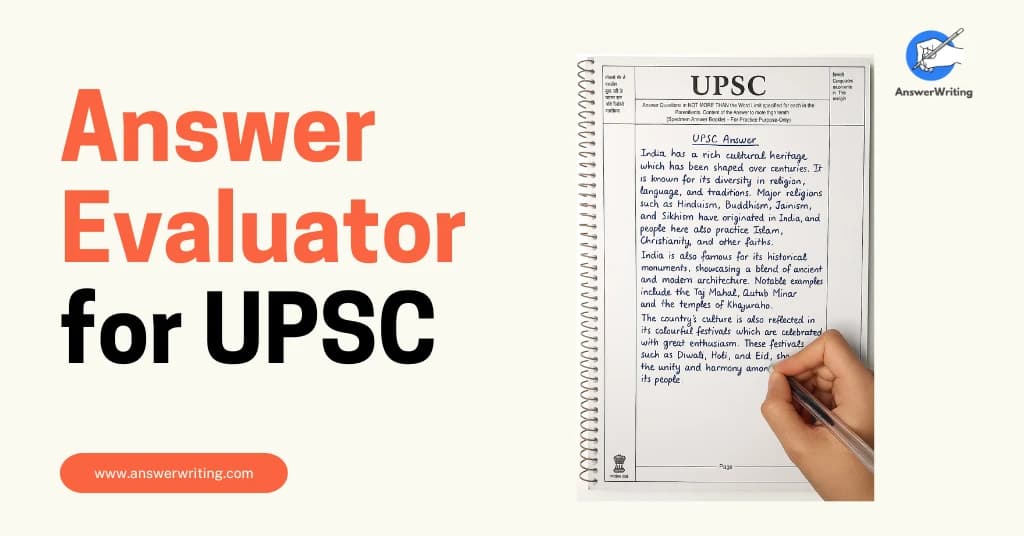
An answer evaluator for UPSC checks your Mains answer the way an examiner would and tells you what to fix. AnswerWriting’s AI answer evaluator reads your handwritten or typed answer, scores it, and gives section-wise feedback on introduction, body, conclusion, content and presentation, along with a model answer, usually in under a minute. It works for GS, Essay and optional papers, in English, Hindi and 22 other Indian languages.
This guide explains why evaluation matters, how an AI evaluator works, what to look for in one, and how to use it so your marks actually improve.

Why Every UPSC Aspirant Needs an Answer Evaluator
Mains carries 1,750 of the 2,025 marks in the final merit list, and the gap between a selected and a non-selected candidate is often a few marks per paper. Those marks are lost in ways you cannot see on your own: an introduction that does not address the question, a body that misses a dimension, a conclusion that just repeats. Writing without feedback means practising the same mistakes.
Traditional evaluation by a mentor helps, but it often takes days and depends on one person’s view. Regular, fast and consistent feedback is what turns practice into progress. Our guide to Mains answer writing covers the writing side; this post focuses on the checking side.
How the AnswerWriting Answer Evaluator Works
- Pick or enter the question. Use a previous year question, today’s daily question or your own.
- Upload your answer. Take a photo or PDF of your handwritten answer, or type it.
- Get your scorecard. The AI gives a score and section-wise feedback: how well the introduction frames the demand, which dimensions the body covers or misses, the quality of examples and data, the conclusion, and presentation.
- Compare with the model answer. See how the same question can be answered within the word limit.
- Rewrite and track. Rewrite the weak parts, re-evaluate, and watch your scores in the progress tracker.
What the Evaluator Covers
| Feature | What it means for you |
|---|---|
| GS Papers I to IV | Feedback suited to each paper, including ethics case studies |
| Essay | A dedicated essay evaluator for structure, argument and coherence |
| All optional subjects | Evaluate optional answers, not just GS |
| 24 languages | English, Hindi and 22 other Indian languages |
| Model answers | A reference answer for every evaluated question |
| Full paper evaluation | Upload a complete paper for paper-level feedback |
| UPSC and State PCS | Practise for your state exam as well |
What Makes a Good AI Answer Evaluator?
If you are comparing tools, look for these qualities rather than a single score:
- It reads handwriting. You write by hand in the exam, so you should practise that way.
- It explains the score. Feedback should point to specific parts of your answer and say how to improve them.
- It follows UPSC’s demands. Directive words such as “discuss”, “critically examine” and “comment” need different answers, and the evaluation should reflect that.
- It covers your papers and language. GS, Essay, your optional, and the medium you write in.
- It helps you track progress. Improvement over weeks matters more than any one answer.
AI Evaluation vs Self-Evaluation and Mentor Feedback
AI evaluation is fast and consistent, so you can practise every day. A mentor’s review adds judgement and motivation, and self-evaluation teaches you to spot your own patterns. The best routine uses all three: AI feedback on daily answers, a self-review checklist, and occasional mentor or test series feedback on full papers. For a deeper look at checking methods, read our guide to UPSC answer checking.
How to Get the Most from an Answer Evaluator
- Write under exam conditions. 7 to 8 minutes for a 10-marker, 11 to 12 minutes for a 15-marker.
- Fix one thing at a time. If feedback says your conclusions are weak, focus on conclusions for a week.
- Rewrite after feedback. The rewrite is where learning happens.
- Be consistent. One evaluated answer a day beats ten in a weekend. Daily answer writing practice explains how to build the habit.
AI tools can also help beyond evaluation, for example with planning and doubt-solving through an AI mentor. See how in UPSC Mains preparation with AI.
Key Takeaways
- An answer evaluator shows where your Mains answers lose marks.
- AnswerWriting evaluates handwritten answers for GS, Essay and all optionals in 24 languages, with section-wise feedback and a model answer.
- Look for an evaluator that explains its score and follows UPSC’s directive words.
- Daily evaluation plus rewriting is what improves scores.
FAQs on the UPSC Answer Evaluator
Can AI evaluate handwritten UPSC answers?
Yes. Upload a photo or PDF of your handwritten answer and the evaluator reads and assesses it.
Does it work for optional subjects and Essay?
Yes. It covers GS Papers I to IV, the Essay paper and all optional subjects.
Can I write in Hindi or another Indian language?
Yes. Answers can be evaluated in English, Hindi and 22 other Indian languages.
Can an AI evaluator replace a human mentor?
It is best used alongside one. AI gives fast, consistent daily feedback; a mentor adds personal guidance. Together they work better than either alone.
Evaluate Your First Answer
Pick a previous year question, write your answer by hand, and upload it for AI answer evaluation for UPSC Mains. You will get a scorecard, section-wise feedback and a model answer to compare against.