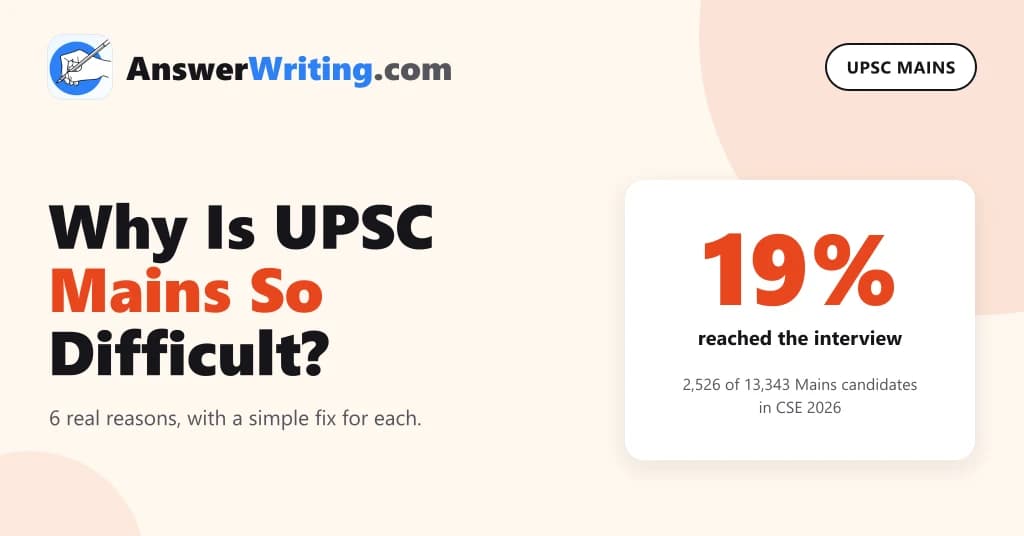
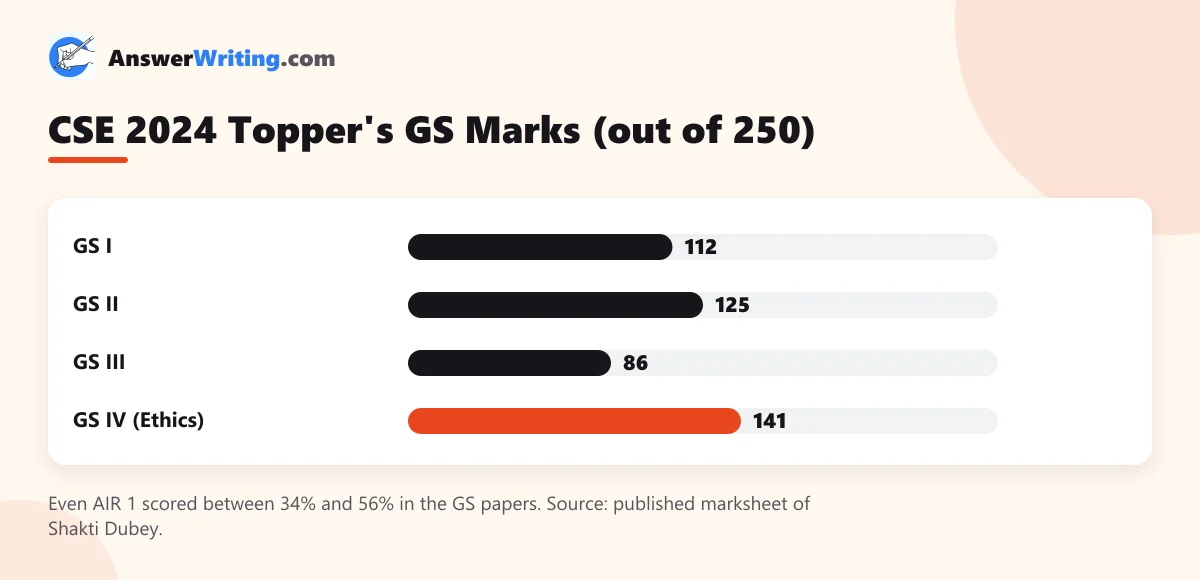
UPSC Mains is difficult mainly because of time and writing, not just knowledge. In each General Studies paper you write about 20 answers in 3 hours, which leaves around 9 minutes per answer. The marking is strict: even the CSE 2024 topper scored between 86 and 141 out of 250 in the GS papers. And only about one in five Mains candidates reaches the interview.
Here are the six biggest reasons Mains feels hard, with a simple fix for each.
The Numbers Behind the Difficulty
| Fact | Number |
|---|---|
| Candidates who wrote CSE 2026 Mains | 13,343 |
| Candidates who reached the interview | 2,526 (about 19%) |
| Papers in Mains | 9 (7 counted for rank) |
| Questions in a GS paper | about 20 in 3 hours |
| CSE 2024 topper’s GS scores (out of 250) | 112, 125, 86 and 141 |
1. Too Many Questions, Too Little Time
A GS paper usually has 20 questions: 10 of about 150 words and 10 of about 250 words. In 180 minutes, that means about 7 minutes for a short answer and 11 minutes for a long one, with no time to think slowly. Many aspirants know the content but leave questions unanswered.
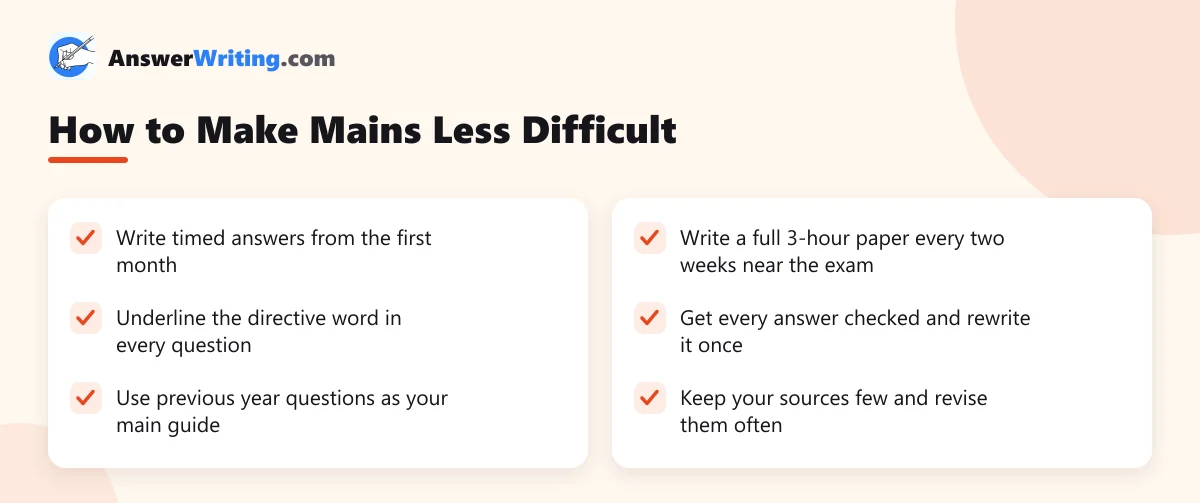
Practise timed answers from the start. Write one full three-hour paper every two weeks in the last few months. Our post on time management in UPSC Mains has a simple timing plan.
2. Nine Papers in About a Week
CSE 2026 Mains ran from 21 to 30 August 2026. Writing nine three-hour papers close together tires both your mind and your hand.
In the last two months, write two full papers on back-to-back days at least twice, so your body gets used to the load. Sleep and food matter as much as revision in that week.
3. The Syllabus Is Huge and Open-Ended
The GS syllabus covers history, geography, society, polity, governance, economy, science, environment, security and ethics, and questions often link a topic to current events. There is no fixed textbook that covers everything.
Use the syllabus and previous year questions as your guide to what matters. Read our UPSC syllabus guide and keep your sources few.
4. Questions Ask You to Think, Not Just Recall
Words like “critically examine”, “discuss” and “comment” ask for analysis, balance and a view, not just facts. An answer that lists everything you know about a topic scores poorly if it does not answer what was asked.
Before writing, underline the directive word and decide in one line what the examiner wants. Our guide on analysing questions explains this step.
5. Strict and Subjective Marking
There is no answer key. Examiners judge your structure, relevance, examples and balance, and full marks are rare. Even the topper’s GS scores above were between 34% and 56%.
Stop aiming for perfect answers. Aim for complete, well-structured answers to every question. Read how UPSC evaluates Mains answers.
6. Little Feedback During Preparation
Most aspirants read for months and write very little, or write without anyone checking. Without feedback, you repeat the same mistakes until the exam.
Write daily and get each answer checked, then rewrite it once using the feedback.
A Note on Mindset
Mains is hard for everyone who writes it, including the toppers. Treat each practice answer as a small step, not a test of your worth. Improvement in Mains is slow at first and then quick once your structure and speed settle.
For the full list of papers and marks, see our guide to the UPSC Mains exam pattern.
Key Takeaways
- About one in five Mains candidates reaches the interview.
- GS papers give you around 9 minutes per answer, so writing speed matters.
- Even the CSE 2024 topper scored around half marks in GS, so aim for complete, not perfect, answers.
- Use the syllabus and previous year questions to control the huge syllabus.
- Daily writing with feedback is the most reliable way to improve.
Get Daily Feedback on Your Answers
On AnswerWriting, you get a new daily answer writing question every day and can upload your handwritten answer for AI evaluation with a model answer within minutes. Your first three evaluations are free.
FAQs
Why is UPSC Mains so difficult?
Because you must write around 20 analytical answers in 3 hours in each GS paper, across nine papers, with strict marking and a very wide syllabus.
What percentage of Mains candidates clear it?
For CSE 2026, 2,526 of 13,343 Mains candidates (about 19%) qualified for the interview.
How many marks do toppers score in GS papers?
Usually around 40% to 55%. The CSE 2024 topper scored between 86 and 141 out of 250 in the four GS papers.
How much time do I get per answer?
About 7 minutes for a 150-word answer and 11 minutes for a 250-word answer in a GS paper.
Is Mains harder than Prelims?
They are hard in different ways. Prelims tests recall and elimination under negative marking; Mains tests writing, analysis and speed. Most aspirants find Mains harder to improve in without regular practice.