Everything About UPSC Optional Subjects
500 marks. That is what the optional subject is worth in UPSC Mains. Out of a total of 1750 marks in the written examination, optional papers carry more weight than any single General Studies paper. Yet most aspirants spend months on GS and treat optional as something they will “figure out later.”
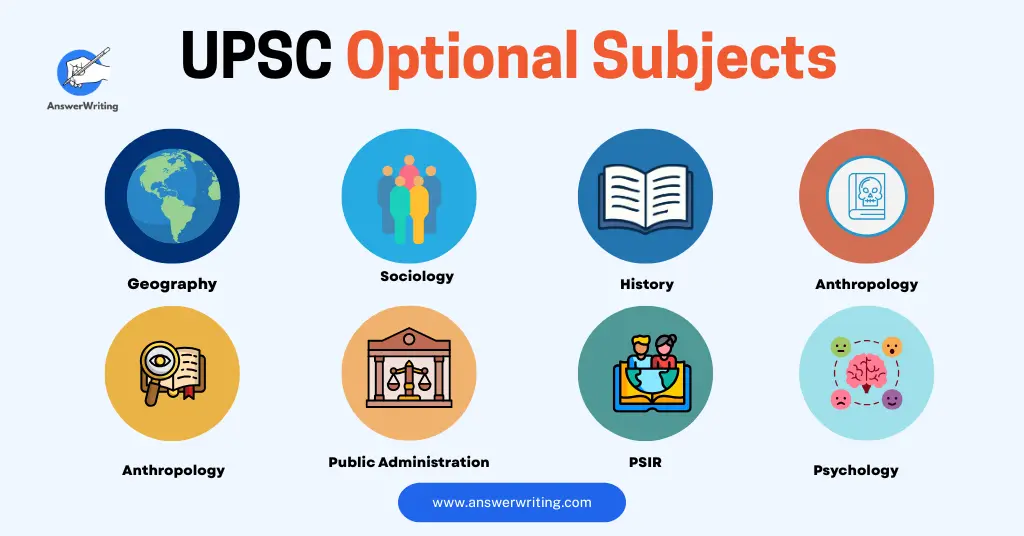
That decision costs ranks. Sometimes it costs selections.
This guide covers everything: how to choose your optional, how to prepare it, how to write answers, how to revise, and how to avoid the mistakes that silently sink candidates who were otherwise well-prepared.
What Is the UPSC Optional Subject? Understanding Its Weight
The UPSC Civil Services Mains examination has two optional papers: Paper I and Paper II. Each paper carries 250 marks, totalling 500 marks.
These 500 marks are added directly to your final merit list score. The interview carries 275 marks. Your rank depends on the combined total of Mains written (1750) and interview (275).
In simple terms: a strong optional performance can compensate for a slightly weaker GS performance. A weak optional can destroy an otherwise solid attempt.
How Optional Marks Influence Final Rank
Look at toppers’ scorecards from recent years. The difference between Rank 1 and Rank 50 is often not in GS. It is in optional and essay.
A candidate scoring 310 out of 500 in optional versus one scoring 260 out of 500 has a 50-mark advantage entering the interview. At the final merit stage, 50 marks is a massive gap.
UPSC publishes subject-wise marks after each cycle. Candidates who check these numbers understand quickly that optional is not a side chapter. It is a main chapter.
How to Choose the Right Optional Subject
This is the most consequential decision of your UPSC preparation. Most aspirants overthink it. Some underthink it. Both are dangerous.
The right optional sits at the intersection of three factors: genuine interest, manageability of syllabus, and availability of good resources. No optional is universally “best.” The best optional for you is specific to you.
Interest vs Scoring Trend: The Real Debate
Many aspirants look at toppers’ optional subjects and copy them. This is one of the most common early mistakes.
Interest matters because optional preparation is a long game. You will spend 6 to 12 months going deep into this subject. You will revise it 3 to 5 times. You will write 40 to 60 answers in practice. If the subject bores you, your answers will show it.
Scoring trends matter too. But they are secondary. A genuinely interested candidate who prepares deeply will outperform a disinterested candidate chasing marks every single time.
The honest approach: shortlist 2 to 3 subjects that genuinely interest you. Then compare their scoring trends, syllabus length, and resource availability. Pick the one where interest and practicality both align.
Graduation Background vs Optional Subject Choice
Your graduation background gives you a head start, but it does not obligate you.
A history graduate choosing History optional starts with contextual familiarity. A science graduate choosing Geography or Anthropology still does well if they prepare sincerely.
That said, if you have a strong academic background in a subject and genuinely enjoyed studying it, that background reduces your learning curve significantly. This matters when time is limited.
Do not force yourself into your graduation subject if you disliked it. UPSC optional answers require genuine analytical engagement, not just memorised facts.
Most Scoring Optionals: Myth vs Reality
Every year, a new myth circulates: “Geography is the safest.” “Anthropology is the easiest.” “Public Administration gives free marks.” These claims are almost always oversimplified.
Here is what the data actually shows:
| Optional Subject | Approx. Candidates (2023) | Typical Topper Score Range | GS Overlap | Syllabus Size |
|---|---|---|---|---|
| Geography | 8,000+ | 280-320/500 | High (GS1, GS3) | Moderate |
| History | 6,000+ | 260-310/500 | High (GS1) | Large |
| Political Science & IR | 5,000+ | 270-320/500 | High (GS2) | Moderate |
| Sociology | 5,000+ | 280-330/500 | Moderate (GS1) | Small-Moderate |
| Anthropology | 4,000+ | 290-340/500 | Low | Small |
| Public Administration | 3,000+ | 250-300/500 | High (GS2) | Moderate |
| Philosophy | 2,000+ | 270-320/500 | Low | Small-Moderate |
| Mathematics | 1,500+ | 330-420/500 | Very Low | Technical |
| Literature (various) | Varies | 280-350/500 | Low | Moderate |
(Note: These are approximate ranges based on publicly available UPSC data and topper interviews. Verify current data from UPSC’s official mark sheets.)
High average scores in a subject can reflect two things: either the subject genuinely rewards preparation, or the subject self-selects highly motivated candidates who were already strong. Both matter.
Is a Low-Popularity Optional a Risk or Advantage?
Low-popularity optionals (like specific literature subjects, Law, or Medical Science) have fewer candidates. This means fewer evaluators, potentially less standardised marking, and less peer competition data available.
The risk is inconsistency in evaluation. The advantage is less crowd competition and, in some cases, very high scores for well-prepared candidates.
If you choose a low-popularity optional, go in with thorough preparation and excellent answer presentation. You cannot rely on evaluation being forgiving.
Why Do Some Optionals Have Higher Average Marks?
Three reasons explain this pattern consistently.
First, subjects with a smaller, more defined syllabus (like Anthropology or Philosophy) allow candidates to achieve greater mastery. Depth beats breadth in optional scoring.
Second, subjects with strong GS overlap allow better-prepared candidates to write richer, more contextual answers.
Third, some subjects attract candidates with strong academic backgrounds in that field (like Mathematics or specific sciences), which raises the average.
High average marks in a subject do not mean the subject is “easy.” They often mean it rewards serious preparation more visibly.
Optional Subject Overlap with GS and Other Papers
GS overlap is one of the most underrated factors in optional selection.
Geography optional overlaps heavily with GS Paper I (Indian geography, world geography) and GS Paper III (environment, disaster management). Preparing Geography optional effectively means your GS geography becomes much stronger.
Political Science and IR overlaps with GS Paper II (polity, governance, international relations). Sociology overlaps with GS Paper I (society) and GS Paper IV (ethics, social issues).
If you are choosing between two subjects you find equally interesting, pick the one with greater GS overlap. It multiplies your preparation effort.
When Should You Start Optional Preparation?
The short answer: earlier than you think.
Most toppers recommend beginning optional preparation alongside early GS preparation, not after Prelims. This is not just advice. It is a strategic necessity.
Optional Before or After Prelims?
The traditional advice says: clear Prelims first, then start optional. This advice made sense when Prelims was less competitive. Today, it is outdated for serious aspirants.
Here is why starting optional early makes sense. Optional requires multiple revisions. You cannot build conceptual depth in 3 to 4 months between Prelims results and Mains. Candidates who start optional alongside GS have 8 to 12 months of exposure before they write the exam.
A practical approach: dedicate 2 hours daily to optional from the beginning of your preparation. Do not wait for Prelims results. After Prelims, scale optional preparation up significantly.
How Much Total Time Does Optional Need?
This varies by subject size and your background. A rough benchmark:
For a moderate-sized optional (Sociology, Anthropology, Philosophy): 600 to 800 hours of total preparation.
For a large optional (History, Geography, Political Science): 800 to 1,200 hours.
For technical optionals (Mathematics, Engineering subjects): highly variable, but background matters enormously.
These hours include reading, note-making, answer writing, and revision. They are spread over 10 to 14 months of preparation.
One-Year Strategy for Optional Subjects
Months 1 to 3: Read the syllabus carefully. Read standard textbooks without making notes. Build conceptual familiarity. Understand the structure of the subject.
Months 4 to 6: Make concise notes. Cover the full syllabus once. Start solving previous year questions to understand the examiner’s expectations.
Months 7 to 9: First round of answer writing. Join a test series or practice independently. Identify weak areas. Deepen understanding of those areas.
Months 10 to 12: Second and third revision. Intensive answer writing practice. Mock tests. Final consolidation.
Building Your Optional Study Plan
Daily Study Plan for Optional Preparation
A sustainable daily allocation for optional is 2 to 3 hours during the GS-heavy phase and 4 to 5 hours during the Mains-focused phase.
A sample daily plan during Mains preparation:
Morning (2 hours): Read and revise one optional topic in depth. Afternoon (1.5 hours): Write one optional answer. Review it. Evening (30 minutes): Quick revision of the previous day’s optional notes.
Do not try to cover too much optional in a single sitting. Depth matters more than daily page count.
How to Cover the Optional Syllabus Efficiently
Map the syllabus first. Download UPSC’s official syllabus for your optional. Break it into units and sub-units. Assign reading material to each unit.
Work through the syllabus sequentially for the first reading. This builds a logical structure in your mind. In subsequent revisions, you can prioritise based on PYQ frequency.
Track coverage. A simple spreadsheet or checklist showing which topics are covered, pending, or revised is more valuable than any elaborate system.
Static vs Current Affairs Balance in Optional
Most optionals are primarily static (fixed syllabus content). But current affairs enriches answers significantly.
For example, a Geography optional answer on urbanisation becomes stronger when you cite recent Smart Cities data. A Sociology answer on social movements becomes sharper when you reference recent examples.
The rule: build your static foundation first. Then layer current affairs as enrichment. Do not try to replace static content with current affairs.
Allocate roughly 85% of your optional preparation time to static content and 15% to building contemporary examples and data points.
How Deep Should Optional Preparation Go?
Deeper than you think, but not infinitely deep.
UPSC optional questions test conceptual understanding and application, not encyclopaedic recall. The examiner wants to see that you understand a concept well enough to analyse it, not just define it.
A good benchmark: if you can write a 250-word answer on any topic in your optional syllabus without referring to notes, you have reached adequate depth. If you can do that and also link it to contemporary examples or related concepts, you are at a strong level.
Avoid the trap of reading more and more sources without consolidating. Depth comes from thinking about what you have read, not just reading more.
Choosing the Right Resources
Standard Books vs Coaching Notes: What Works?
Standard textbooks build conceptual clarity. Coaching notes summarise content efficiently. The ideal approach uses both strategically.
Use standard textbooks for your first reading. They explain the “why” behind concepts. This depth shows in your answers.
Use coaching notes (good quality ones) for revision and for understanding the UPSC angle on topics. They help you filter what is exam-relevant from what is academically interesting but unnecessary.
Never use coaching notes as your only resource. Candidates who skip textbooks often produce shallow answers that evaluators can identify immediately.
Minimal Sources Strategy
One of the most reliable strategies for optional success is also one of the least followed: use fewer sources, but master them completely.
For most optionals, 3 to 5 standard books cover the entire syllabus. Add one set of coaching notes for structuring, one PYQ compilation, and one current affairs source. That is your complete resource list.
The problem aspirants face is not lack of resources. It is resource overload. When you have 10 books for an optional, you end up with a superficial reading of all of them. When you have 3 books, you master them.
Online vs Offline Resources
Online resources (YouTube lectures, PDFs, online test series) have made quality optional content accessible to everyone, including aspirants in smaller cities and those with budget constraints.
The advantage of online resources is accessibility and the ability to pause, rewatch, and revise flexibly.
The limitation is that online resources can create passive learning. Watching a lecture is not the same as reading, thinking, and writing. Use online resources to supplement, not replace, active study.
Role of Journals, Academic Sources, and Research Material
For humanities and social science optionals, academic journals can significantly enrich your answers. The key is to use them for specific examples, data, and analytical frameworks, not for exhaustive academic reading.
For Geography: Economic and Political Weekly (EPW), National Geographic, Census data. For Sociology: EPW, NCERT Sociology, academic papers on specific movements or issues. For History: Reputed university reading lists, IGNOU study material, published historical analyses. For Political Science: Think tank reports (ORF, Gateway House), Constituent Assembly Debates.
You do not need to read full journals cover to cover. Use targeted searches for specific topics in your syllabus. Build a small “enrichment file” of examples, statistics, and quotes that can strengthen your answers.
Avoiding Resource Overload
Set a resource list before you begin and stick to it. Changing resources mid-preparation is one of the biggest time drains in optional preparation.
If someone recommends a new book after you have started, evaluate it honestly. Does it cover topics your current resources miss? Does it explain something better? If the answer is no, do not add it.
Consistency with fewer resources beats variety with many.
Making Notes and Building Conceptual Clarity
How to Make Notes for Optional Subjects
Optional notes should be your distilled understanding of a topic, not a reproduction of the textbook.
Good optional notes have: the core concept explained in your own words, 2 to 3 key thinkers or theories, 2 to 3 contemporary examples, and a note on how this topic links to other parts of the syllabus.
Write notes on paper or in a structured digital format. Keep each topic on a single page where possible. This forces you to prioritise what matters.
Avoid copying long paragraphs from textbooks into your notes. If you cannot explain a concept in your own words, you have not understood it yet. Revisit the source.
One-Page Revision Method
For each major topic in your optional, create a one-page summary. This page should contain:
The key definition or framework. The major theories or thinkers. 3 to 5 data points or examples. The UPSC angle (how has this been asked before). One linking idea to a related topic.
This one-pager becomes your primary revision tool. In the last 30 to 60 days before Mains, you revise these one-pagers rather than full notes. This saves enormous time without sacrificing depth.
Platforms that help aspirants with structured answer practice, like AnswerWriting.com, are particularly useful here because they allow students to submit handwritten answers for expert evaluation. Getting feedback on whether your one-page knowledge translates into a good written answer is something that independent self-study cannot replicate.
Building Conceptual Clarity vs Rote Learning
UPSC optional rewards understanding, not memorisation. This is especially true for humanities and social science optionals.
The test for conceptual clarity is simple: can you explain this concept using a completely different example from the one in the textbook? If yes, you understand it. If no, you have memorised it.
Build clarity by discussing topics with peers, writing explanatory paragraphs, and attempting questions on topics you have just read. Active recall builds clarity faster than passive rereading.
Optional Answer Writing Strategy
How Optional Answer Writing Differs from GS Writing
This distinction is critical and most aspirants miss it.
GS answers are generalist. They require breadth, multi-dimensional thinking, and policy awareness. A good GS answer on “challenges of urbanisation” draws from economics, governance, environment, and sociology.
Optional answers are specialist. They require depth within the subject’s framework. A good Geography optional answer on urbanisation uses geographic theories (urban morphology, rank-size rule, primate city concept), data, and subject-specific analysis.
Writing GS-style answers in optional is one of the most common reasons for unexpectedly low optional scores. The examiner for optional papers is a subject expert, often an academic. They can immediately identify when a candidate is writing general thoughts dressed up as subject knowledge.
How to Structure Answers in Optional Papers
For a 250-word optional answer (10-mark question):
Introduction (40 words): Define the concept or establish the context directly. No filler sentences. Body (170 words): 2 to 3 analytical paragraphs. Each paragraph makes one clear point, supports it with theory or evidence, and connects it to the question. Conclusion (40 words): Synthesise the key insight. Do not just summarise. Add a forward-looking or critical observation.
For a 500-word optional answer (20-mark question):
The structure is the same but each section is expanded. The body should have 4 to 6 well-developed paragraphs. Use sub-headings where they clarify structure (not as decoration).
Improving Analytical Depth in Optional Answers
Analytical depth means going beyond description. It means explaining why something happens, not just what happens.
A descriptive statement: “Urbanisation in India has increased rapidly since liberalisation.”
An analytical statement: “Post-liberalisation economic restructuring concentrated industrial and service sector growth in metro cities, creating push-pull migration dynamics that accelerated urbanisation beyond what infrastructure planning could absorb.”
The second statement shows understanding of causal mechanisms. This is what evaluators reward.
Practice converting every descriptive sentence in your notes into an analytical one. Ask “why” and “so what” after every factual claim you write.
Using Diagrams, Examples, and Case Studies
Diagrams work exceptionally well in Geography, Anthropology, Psychology, and some parts of Political Science and Sociology.
A well-drawn, labelled diagram can replace 50 to 80 words and makes the answer visually organised. Use diagrams when they genuinely clarify a concept, not as a time-saving shortcut.
Examples ground abstract theory in reality. Use a mix of Indian examples (for most topics) and international examples (for theory-based questions). A Sociology answer on stratification becomes richer when it moves from Parsons and Merton to examples from the Indian caste system.
Case studies are particularly powerful in 20-mark answers. A brief case study (4 to 5 sentences) that illustrates your argument adds a different dimension to the answer. It shows you have thought beyond the textbook.
Optional Subject Answer Enrichment Techniques
Strong optional answers have layers. Here is how to build them:
Use thinkers strategically. Do not just name-drop. Explain what the thinker argued and why it is relevant to the specific question. “Bourdieu’s concept of cultural capital explains this phenomenon because…”
Use data selectively. One or two specific statistics are more powerful than a list of numbers. Make sure your data is accurate. If unsure, use approximate figures and signal the approximation.
Show counterarguments. Acknowledge limitations of the theory or approach you are discussing. Then defend your position. This signals intellectual maturity.
Link to policy or reality. Optional answers that connect theory to real-world governance, social issues, or policy debates show applied thinking.
How to Build a Thinker/Scholar Perspective in Optional Answers
The best optional answers do not just report what scholars said. They engage with scholarly ideas.
This means: presenting a thinker’s argument, showing where it is strong, noting where it is contested or limited, and then applying it to the specific question at hand.
This approach transforms your answer from a textbook reproduction into an intellectual engagement. Evaluators, especially those from academic backgrounds, respond strongly to this kind of writing.
Build this habit early. Start by choosing one key thinker per topic and writing 100 words analysing their argument critically. Over months, this becomes second nature.
Interdisciplinary Thinking in Optional Answers
The richest optional answers draw carefully from adjacent disciplines.
A Geography answer on climate change is stronger when it incorporates economic dimensions (cost of adaptation, insurance markets) and political dimensions (international climate negotiations, UNFCCC).
A Sociology answer on religious movements gains depth from historical context and psychological frameworks.
The caution: stay rooted in your optional subject. Use interdisciplinary ideas to enrich, not replace, your subject-specific analysis. Evaluators want to see subject expertise first.
Revision Strategy for Optional Subjects
How Many Revisions Are Enough?
A minimum of three full revisions before the exam. Five revisions is ideal.
Revision is not rereading. Revision is active recall: close your notes, recall what you know, identify gaps, fill them. This is slower than passive rereading but far more effective.
First revision: after completing the full syllabus. Identifies what you have forgotten and what needs deeper work. Second revision: 6 to 8 weeks before Mains. Consolidates the full picture. Third revision: 2 to 3 weeks before Mains. Focus on weak areas and high-frequency PYQ topics. Fourth and fifth revisions (if time permits): use one-pagers only. Quick and targeted.
Long-Term Retention Strategy
Memory degrades over time without reinforcement. Build a spaced repetition habit for optional.
Every week, spend 20 to 30 minutes reviewing topics you studied 2 to 3 weeks ago. This brief review locks material into long-term memory without requiring full rereading.
For high-value topics (frequently asked in PYQs), schedule more frequent reviews. For lower-value topics, less frequent reviews are sufficient.
Connecting new concepts to concepts you already know also dramatically improves retention. Build mental maps of how your optional topics relate to each other.
PYQ-Based Optional Preparation Strategy
Previous Year Questions are the single most reliable guide to optional preparation.
Analyse the last 10 to 15 years of PYQs for your optional. Note: which topics are asked repeatedly, which are never asked, how questions are framed (descriptive vs analytical vs contemporary application), and what word count the marks typically demand.
Prioritise heavily-asked topics. Prepare a thorough answer framework for each of them. When preparing less-frequently-asked topics, maintain awareness without investing equal depth.
Attempting PYQs under timed conditions is one of the most effective forms of exam preparation. It reveals gaps in knowledge and weaknesses in answer structure simultaneously.
Optional Test Series Strategy
Should You Join an Optional Test Series?
Yes, for most aspirants. The caveat is that the quality of feedback matters more than the number of tests.
A test series with detailed, subject-expert evaluation is worth more than 20 tests with generic feedback. Before joining any optional test series, check the quality of their evaluation: do evaluators explain why an answer is weak, or do they just give marks?
Platforms like AnswerWriting.com provide structured evaluation of handwritten answers, which is closer to actual exam conditions than typed responses. For optional subjects especially, getting your handwritten answers evaluated by subject experts helps identify presentation issues, content gaps, and analytical weaknesses that self-evaluation often misses.
If a structured test series is not accessible, self-evaluation using model answers and PYQ benchmarks is a valid alternative. The key is to write answers, not just plan them.
How Many Tests to Write for Optional Papers?
Quality over quantity. Writing 15 to 20 full-length optional tests with serious self-evaluation is more valuable than writing 40 tests superficially.
A sensible structure: 2 to 3 sectional tests per paper (covering specific topics), followed by 3 to 4 full-length Paper I and Paper II simulations.
Space tests across your preparation. Testing too early (before adequate preparation) builds bad habits. Testing too late (only in the final month) leaves no time to incorporate feedback.
How to Analyse Test Feedback Effectively
Do not just note your marks. Analyse the nature of your errors.
Category 1: Content gaps. You did not know the material. Solution: go back to the source and strengthen that topic. Category 2: Structural errors. You knew the material but presented it poorly. Solution: practise structuring answers specifically. Category 3: Analytical depth missing. You described but did not analyse. Solution: practise adding “why” and “so what” to every factual claim. Category 4: Time management errors. You ran out of time. Solution: timed practice with strict word limits.
Keep an error log across all tests. Review it before each subsequent test. Recurring errors signal a systematic problem, not a one-off slip.
Why Optional Marks Do Not Improve Despite Practice
This is one of the most frustrating experiences in UPSC preparation. The cause is almost always one of three things.
First: superficial preparation. Writing more answers on weak conceptual foundations does not improve scores. Scores improve when conceptual understanding deepens.
Second: lack of quality feedback. Practising without good feedback is like training without a mirror. You reinforce mistakes rather than correct them.
Third: GS-style writing in optional. If you are writing broad, multi-dimensional answers instead of subject-specific, analytically deep answers, your optional scores will plateau regardless of how much you practise.
Diagnose which of these three applies to you. Then address that specific problem.
Balancing Optional with the Rest of Preparation
Optional vs GS Balance
A common mistake is treating optional and GS as competitors for your time. They are both necessary. The question is sequencing and proportion.
During the 10 to 12 months before Mains, a rough allocation for most aspirants: GS (including current affairs) takes 60 to 65% of study time, optional takes 30 to 35%, and essay takes the remaining 5%.
In the last 3 months before Mains, shift to roughly equal time for GS and optional, with regular essay practice.
Never neglect either. A 400-mark optional performance with weak GS is as damaging as strong GS with a 230-mark optional.
Managing Optional Alongside Current Affairs
Optional and current affairs are not in conflict. They can reinforce each other.
For socially relevant optionals (Sociology, Political Science, Geography, Anthropology): current affairs provide contemporary examples that directly enrich optional answers.
For more abstract optionals (Philosophy, Mathematics): the connection is less direct, but general awareness remains important for the interview and GS.
Build a habit of linking current affairs to your optional syllabus. When you read about a tribal displacement issue in the news, it connects to Anthropology optional. When you read about a Supreme Court judgment, it connects to Political Science and Law. This linking is effortless once it becomes habitual.
How to Avoid Optional Burnout
Optional burnout is real. It typically hits around the 6 to 8 month mark of preparation, when the initial novelty has worn off but exam success is still distant.
Prevention strategies: vary your study methods (read one day, write the next, revise the third), take a full day off from optional every 10 to 14 days, connect regularly with peers preparing the same optional (discussion rekindles interest), and track your progress visibly so you can see how far you have come.
If genuine burnout sets in, take a short 3 to 4 day break from optional. Return with a different section or a lighter topic. Do not push through burnout with more hours. It deepens the problem.
Working Professionals and Optional Strategy
Working professionals face a real constraint: limited daily study hours. The optional strategy must account for this.
Recommended approach: 1 to 1.5 hours daily on weekdays for optional, with 4 to 5 hours on weekends. Weekends become the primary optional study time.
Prioritise ruthlessly. Working professionals cannot study everything. Use PYQ analysis to identify the highest-value topics and prepare those first and deepest.
Use commute time productively: podcasts, audio lectures, and revision of mental maps are all possible without a desk.
The timeline for working professionals will naturally be longer. Plan for 18 to 24 months of preparation rather than 12 to 15.
Switching Your Optional: When and How
Switching optional is a serious decision that should not be made impulsively.
Valid reasons to switch: you have completed one UPSC attempt and genuinely scored below 220 in optional despite sincere preparation, the subject fundamentally does not suit your thinking style, or new resources and guidance have made an alternative subject clearly more suitable.
Invalid reasons to switch: peer pressure, a single poor test series performance, or social media influence.
If you decide to switch, do it early in your preparation cycle, not 4 to 5 months before Mains. A rushed switch is almost always worse than persisting with an adequately-prepared original optional.
Give yourself 3 to 4 weeks of honest trial with the new optional before committing. Read a few core chapters, attempt a few PYQs. Assess whether the subject genuinely suits your analytical style.
Self-Study vs Coaching for Optional
Coaching for optional can provide: structured content delivery, peer competition through test series, expert guidance on answer writing, and accountability.
Self-study can provide: flexibility, personalised pace, lower cost, and the depth that comes from independent reading.
Both work. The choice depends on your learning style, discipline, access to good teachers, and financial constraints.
If you choose coaching, evaluate the teacher’s subject knowledge and the quality of evaluation they provide, not just their marketing.
If you choose self-study, compensate for the lack of feedback by joining an optional answer evaluation programme, peer group, or online forum where subject experts provide structured critique.
Last-Leg Strategy
Last 6 Months Strategy
At the 6-month mark before Mains, your optional syllabus coverage should be complete or nearly complete. This phase is about deepening, not discovering.
Focus: second full revision of the entire syllabus, intensive answer writing (3 to 4 answers per week minimum), test series participation with quality evaluation, and building your one-page revision notes.
Do not add new sources at this stage. Consolidate what you have.
Last 90 Days Strategy
This is the most critical phase. Every week must be structured.
Weeks 1 to 4: Topic-wise deep revision. Cover high-frequency PYQ topics first. Weeks 5 to 8: Full-length test series. One Paper I and one Paper II test per week. Serious evaluation after each. Weeks 9 to 12: Final revision using one-pagers. Targeted practice on identified weak areas. Mental preparation.
Current affairs integration: spend 30 minutes daily linking recent events to optional syllabus topics.
Last 30 Days Approach
The last 30 days are not for learning. They are for consolidating and sharpening.
Revise all one-pagers. Attempt 2 to 3 full-length past papers under strict timed conditions. Review your error log from test series and address the most common patterns.
Do not attempt any new topics in the last 30 days. The cognitive disruption of encountering unfamiliar material near the exam outweighs any potential benefit.
Time Management During the Exam Paper
Each optional paper is 3 hours long and carries 250 marks. A typical paper has 8 questions: one compulsory (Section A) and choices within sections.
Allocate time roughly in proportion to marks. A 20-mark question deserves approximately 20 to 22 minutes. A 10-mark question deserves 10 to 12 minutes.
Reserve the first 5 minutes for reading all questions carefully. This prevents the mistake of beginning an answer and then realising a better question was available.
Write neatly and legibly. Optional evaluators are subject experts with many scripts to evaluate. A legible, well-presented answer starts at an advantage.
Order of Attempt Strategy in Optional Papers
Always start with your strongest question, not necessarily question 1. Beginning with a strong answer builds confidence and establishes a positive tone for the evaluator.
Attempt the compulsory question (if present) seriously. It is non-negotiable marks.
Do not skip questions and plan to return. Complete every question you attempt before moving on. Partial completion of many questions scores worse than thorough completion of fewer.
If time is running out, write brief but structured answers for remaining questions. Even a well-framed 100-word response with clear analysis scores better than a blank page.
Scores, Ranks, and the Optional Reality Check
What Is a Good Score in Optional Subject?
For humanities/social science optionals: 300 and above out of 500 is considered strong. 320+ puts you in a very competitive position.
For technical optionals (Mathematics, Engineering): 350+ is common among toppers because absolute scoring is higher in these subjects.
A score below 260 in optional is concerning regardless of subject. It signals either a preparation gap or an answer writing problem.
Do not benchmark yourself against topper scores in your first attempt. Benchmark against the cutoff for your category in that year’s final merit list.
How Optional Marks Impact Final Rank
The impact is direct and mathematical. Every additional mark in optional translates directly to final rank improvement.
Given that the interview range for most candidates is 130 to 170 (out of 275), the real differentiation in the final merit list happens in written Mains. And within Mains, optional is the single largest controllable variable.
GS scores among competitive candidates tend to cluster within a 30 to 40 mark range. Optional scores can vary by 60 to 100 marks between candidates of similar overall ability. This is where ranks are made and lost.
How Optional Marks Influence Interview Chances
Your optional subject often forms the basis of interview questions. The UPSC interview board may ask about your optional topic if it is intellectually interesting, connects to your work experience, or appears in your DAF (Detailed Application Form).
A candidate who has mastered their optional can turn interview questions on it into strengths. A candidate who chose optional strategically without genuine interest may struggle when the board probes beyond surface knowledge.
Strong optional marks also signal subject mastery to the interview board, which indirectly sets a positive expectation.
The Psychology of Optional Preparation
Biggest Myths About Optional Subjects
Myth 1: The right optional guarantees good marks. Reality: any optional can give good marks with deep, sincere preparation.
Myth 2: Toppers’ optionals are the best optionals. Reality: toppers succeed because of preparation quality, not because of subject choice.
Myth 3: Smaller syllabus means easier scoring. Reality: smaller syllabus means less room to hide gaps. Every topic will be tested.
Myth 4: Optional with GS overlap reduces total workload. Reality: overlap helps efficiency, but optional preparation is still separate and deep. You cannot substitute GS notes for optional preparation.
Myth 5: Changing optional before the second attempt is always a good idea. Reality: switching resets months of preparation. It is only worth it if the first optional was genuinely a wrong fit.
Common Mistakes Aspirants Make
Starting without a clear resource plan (and then panicking about resources mid-preparation).
Treating optional as a memorisation exercise rather than a conceptual one.
Writing GS-style answers in optional papers.
Not practising answer writing until the final months.
Spending months reading without ever attempting a PYQ.
Not getting answers evaluated by subject experts.
Ignoring the optional’s one-pager system and then having no revision tool near the exam.
Switching optional after one poor test series performance.
Long-Term Strategy to Master an Optional
Mastery in optional is not achieved through one cycle of preparation. Many top-ranked candidates report that their optional preparation genuinely deepened in the second or third attempt.
Build a habit of reading about your optional subject beyond UPSC. Read books, follow academic debates, watch documentaries related to your subject. This broader engagement builds the intellectual depth that distinguishes 320-mark optional answers from 270-mark ones.
Think of optional preparation as building expertise, not just clearing an exam. Candidates who approach it that way consistently outperform those who treat it as a syllabus-ticking exercise.
FAQs on UPSC Optional Subjects
Q1. Can I change my optional subject between two UPSC attempts?
Yes, you can change your optional between attempts. There is no restriction. However, switching means starting from scratch. Evaluate honestly whether your previous optional genuinely failed you or whether your preparation was insufficient. In most cases, deeper preparation of the same optional is more productive than switching.
Q2. My graduation subject is not on the UPSC optional list. How do I choose?
Start by listing subjects on the UPSC optional list that genuinely interest you. Cross-check the syllabus of 2 to 3 subjects. Attempt 5 to 6 PYQs from each subject without preparation to sense which kind of thinking they require. Your comfort with the thinking style of a subject is often more predictive than academic background.
Q3. Is coaching mandatory for optional preparation?
No. Several rank holders across UPSC history have self-studied optional. What is mandatory is quality feedback on your answers. Whether you get that through coaching or an independent evaluation platform is a secondary question.
Q4. How do I know if my optional answer writing is at the right level?
The simplest test: compare your answers against model answers for the same PYQ. Note specific differences in depth, use of subject-specific terminology, examples, and analytical framing. If your answers consistently lack in 2 or more of these dimensions, focused answer writing improvement is needed before the exam.
Q5. Should I attempt all questions in the optional paper even if I am unsure?
Yes. Leaving a question blank scores zero. An attempted answer with partial but correct content scores something. Manage time carefully so you can write at least a structured response to every question.
Q6. How important is handwriting quality in optional papers?
Very important. Optional evaluators read dozens of scripts. A clear, legible hand makes evaluation easier and creates a positive impression. This does not mean your handwriting needs to be beautiful. It needs to be readable. Practise writing at exam speed so your handwriting does not degrade under time pressure.
Closing Thoughts
The optional subject is not a gamble. It is a planned investment of time, thinking, and discipline.
Candidates who treat it seriously, choose it honestly, prepare it deeply, and write it with subject-specific analytical depth consistently outperform those who approach it as a secondary concern.
Start early. Choose wisely. Prepare deeply. Write with precision. Revise relentlessly.
The 500 marks are waiting to be earned.