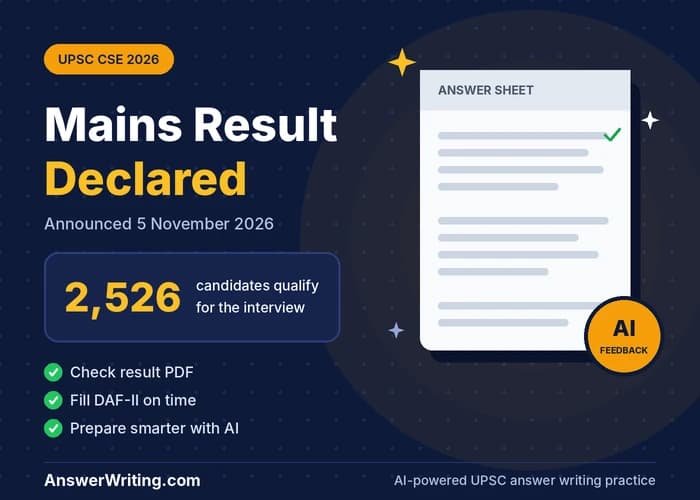
The UPSC Civil Services (Main) Examination 2026 result was declared on 5 November 2026, and 2,526 candidates have qualified for the Personality Test (interview). If your roll number is on the list, congratulations: you are one stage away from IAS, IPS, IFS and the other Group A and B services. If it is not, this post also covers how to turn this result into a stronger attempt next year.
UPSC Mains Result 2026: Key Highlights
| Detail | Information |
|---|---|
| Exam | Civil Services (Main) Examination 2026 |
| Result declared | 5 November 2026 |
| Mains exam held | 21 to 30 August 2026 |
| Candidates who appeared (Prelims qualifiers) | 13,343 |
| Candidates qualified for interview | 2,526 |
| Result format | Roll-number-wise and name-wise PDF |
| Next stage | DAF-II, then Personality Test (275 marks) |
| Official website | upsc.gov.in |
UPSC has not released individual Mains marks or cut-offs with this result. As in past years, these are expected only after the final result.
How to Check the UPSC Mains Result 2026
No login is needed. The result is a public PDF on the UPSC website.
- Go to upsc.gov.in.
- Open Examinations, then Written Results (or check the What’s New section on the homepage).
- Click the link for Civil Services (Main) Examination, 2026.
- Open the PDF of qualified candidates (roll-number-wise or name-wise).
- Press Ctrl + F (or use Find on mobile) and search for your roll number.
- Download and save a copy for your records.
Direct Download Link: https://www.upsc.gov.in/sites/default/files/WR-CSM-2026-Engl-NameList-05112026.pdf
Tip: Avoid third-party “direct links” shared on messaging apps. Always download the PDF from upsc.gov.in.
What the Numbers Say
Roughly 1 in 5 Mains candidates made it to the interview this year, slightly fewer than in 2025.
| Stage | CSE 2025 | CSE 2026 |
|---|---|---|
| Qualified for interview | 2,736 | 2,526 |
| Mains-to-interview conversion | about 19.3% | about 18.9% |
| Mains result declared | 11 November 2025 | 5 November 2026 |
The result also arrived about a week earlier than last year, roughly 67 days after the last paper. For 2027 aspirants, that is a reminder that UPSC timelines are tightening, and your preparation calendar should be too.
The bigger lesson is in the conversion rate itself. About four out of five candidates who reached Mains did not clear it. At this stage, knowledge is rarely the gap. The difference usually comes down to answer writing: structure, relevance to the question’s directive, use of examples and data, and finishing the paper on time.
What Comes Next: DAF-II and the Personality Test
Qualified candidates must submit the Detailed Application Form-II (DAF-II) online before interviews begin. The DAF-II window has been reported as 11 to 25 November 2026 (until 6:00 PM), but confirm the exact dates on upsc.gov.in and upsconline.nic.in.
- Fill DAF-II carefully. It asks for education, employment, hobbies, achievements and service preferences. Missing the deadline can cost you your candidature.
- Upload documents. Keep certificates for age, education, category and EWS/PwBD status (if applicable) ready in the required format.
- Wait for the interview schedule and e-summon letter. UPSC publishes the schedule on its website. Last cycle, interviews ran from 8 December 2025 to 27 February 2026.
- Appear for the Personality Test at Dholpur House, New Delhi. It carries 275 marks, on top of the 1,750-mark written exam.
Your DAF is the interview board’s main reference about you. Every line you write in it can become a question, so fill it honestly and know each entry in depth.
Cleared Mains? How to Use AI for Interview Preparation
AI cannot sit in front of the board for you, but it can make your daily practice sharper and faster. Here is how to use it well over the next few weeks.
- Mine your DAF for questions. Paste each section of your DAF (hometown, graduation subject, job, hobbies) into an AI tool and ask for 20 probing questions an interview board might ask. Then ask for follow-ups to your own answers.
- Practise current affairs opinions. Ask AI to summarise both sides of a current issue, then write your own balanced 60-second view. Have it critique your view for bias, missing facts and clarity.
- Rehearse spoken answers. Use voice mode to answer out loud and get feedback on length, structure and filler words. Interview answers should be short, direct and honest.
- Prepare situational questions. Ask for administrative dilemmas linked to your service preferences (for example, a law-and-order situation as an IPS officer) and practise structured responses.
- Verify everything. AI tools can be wrong on facts and dates. Cross-check with official sources, newspapers and government reports before you rely on any figure.
AI works best as a practice partner. Combine it with mock interviews before real panels, mentors and peers, because the board is assessing your personality, not your notes.
Didn’t Make It This Time? Rebuild Smarter with AI
Clearing Prelims and writing Mains is itself an achievement most aspirants never reach. Take a few days to rest, then start your next attempt with an honest review of what went wrong.
Start with these steps:
- Review your own answers. Rewrite 10 to 15 Mains 2026 questions from memory or the question papers. Note where you were short of content, structure or time.
- Wait for your marks. UPSC releases Mains marks after the final result. They will show which papers (GS, Essay or Optional) pulled you down.
- Plan around Prelims 2027. Prelims comes first, so balance daily answer writing with steady Prelims revision rather than switching between the two.
- Write every day. The Mains gap is closed by volume and feedback: writing answers regularly and having them evaluated.
How AnswerWriting.com Helps
The hardest part of answer writing practice is getting quick, honest feedback. Waiting days for a mentor to check a copy slows you down. AnswerWriting.com is built to close that loop with AI, so you can practise daily and see what to fix immediately.
- Daily practice questions in the UPSC Mains format across GS papers, Essay and Ethics.
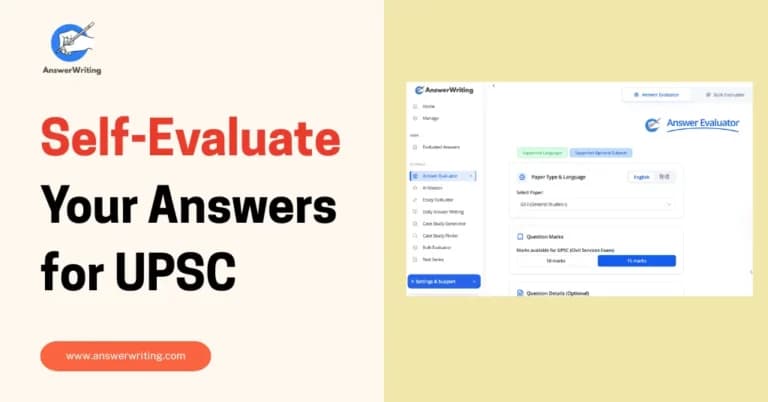
- AI evaluation of your answers, with feedback on structure, relevance to the question’s directive (discuss, critically analyse, examine), content gaps and presentation.
- Model answer approaches that show how to frame an introduction, body and conclusion within the word limit.
- Progress over time, so you can see whether your weak areas are actually improving.
One attempt is not a verdict on your ability. Use the next 12 months to build the one skill the Mains result rewards most: writing clear, relevant answers under time pressure. Start practising on AnswerWriting.com.
Frequently Asked Questions
When was the UPSC Mains Result 2026 declared?
On 5 November 2026, on the official website upsc.gov.in.
How many candidates qualified UPSC Mains 2026?
2,526 candidates qualified for the Personality Test, out of 13,343 who were eligible to write Mains.
Are UPSC Mains 2026 marks and cut-offs out?
No. UPSC typically releases marks and cut-offs only after the final result is declared.
What is DAF-II?
The Detailed Application Form-II is filled online by Mains-qualified candidates before the interview. The board uses it to frame many of its questions.
When will UPSC CSE 2026 interviews begin?
UPSC will publish the schedule on its website. Last year, interviews began in early December and ran until late February.
Can AI help with UPSC preparation?
Yes, as a practice partner. AI is most useful for daily answer evaluation, generating practice questions and mock interview drills. Always verify facts against reliable sources.