Directive words are the action words in a UPSC Mains question, like “discuss”, “examine”, “critically analyse” or “comment”. They tell you what kind of answer the examiner wants. Two questions on the same topic can need very different answers because of one directive word. Reading it correctly is one of the simplest ways to gain marks.
This post explains the common directive words in simple language, shows how your answer should change for each and gives examples from real UPSC papers.
Why the Directive Word Matters
Imagine two questions on the same topic:
- “Discuss the role of self-help groups in rural development.”
- “Critically examine the role of self-help groups in rural development.”
For the first, you explain the different ways self-help groups help, with examples. For the second, you also need to look at their limits and problems, and end with a balanced judgement. If you write the first answer for the second question, you lose marks even if every fact is correct.
UPSC does not publish official definitions of these words. The meanings below are how teachers and examiners usually read them, based on their common English meaning.
The Common Directive Words
| Word | What it asks you to do | Answer shape |
|---|---|---|
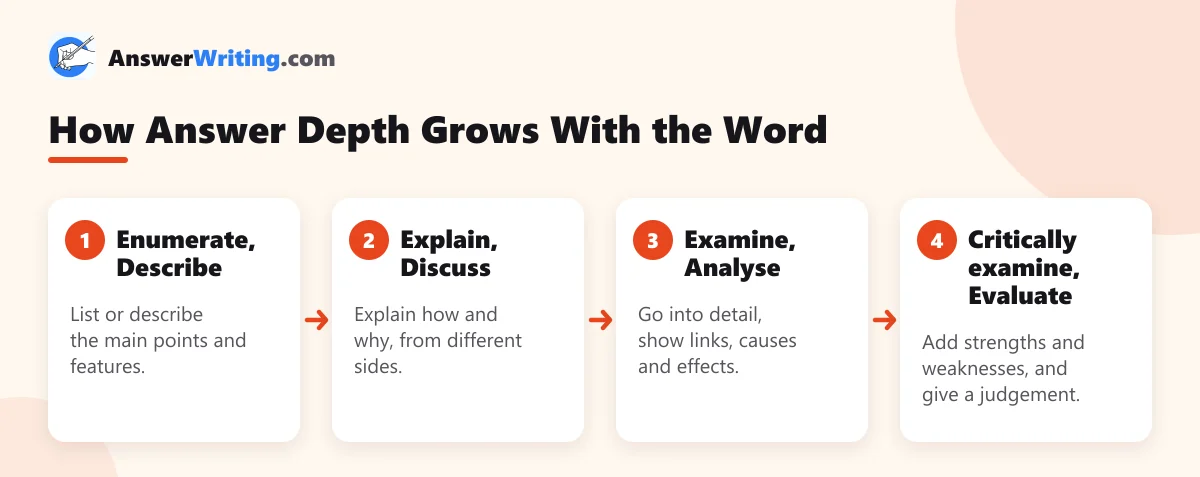
| Discuss | Explain the topic from different sides, with reasons and examples | Several points, mostly explanation |
| Explain | Make clear how or why something happens | Cause and effect, simple and clear |
| Describe | Give the main features of something | Features and facts, little opinion |
| Examine | Look at the topic closely and in detail, find out the facts and their meaning | Detailed points with evidence |
| Analyse | Break the topic into parts and show how they connect | Parts, links, causes and effects |
| Critically examine / Critically analyse | Examine or analyse, and also judge the strengths and weaknesses | Both sides, then a reasoned judgement |
| Evaluate / Assess | Judge the value or success of something | Achievements, limits, then a verdict |
| Comment | Give your view on a statement with reasons | Your opinion, backed by evidence |
| Justify | Give reasons that support a statement | Supporting arguments, mostly one side |
| Elucidate / Elaborate | Explain in more detail with examples | Expanded explanation |
| Enumerate | List the main points briefly | Clear numbered list |
| How far / To what extent | Judge how much a statement is true | Where it is true, where it is not, final view |
Examples From Real UPSC Papers
The directive words in recent papers show how often UPSC uses each one. In the CSE 2026 GS Paper IV, on the official UPSC question paper page, you can see several:
- “Discuss this from the perspective of accountability and integrity.” The question gave a situation of a professor using AI for a Ph.D. evaluation report. The word “discuss” means you explain the issue from more than one angle, for both accountability and integrity.
- “What ethical challenges are you likely to face?” There is no classic directive word here, but the question asks you to list and explain challenges. Treat it like “discuss”.
- “Justify this claim by explaining the distinction between duty and charity.” Here, “justify” tells you to argue in favour of the claim. You are not asked to criticise it.
- “Discuss the options open to Seema. Identify the recommended option and justify it.” A case study with three tasks: list options, pick one, defend it.
Look at the last example. One question has three directive parts. Missing even one, like forgetting to justify your chosen option, means losing part of the marks.
A 3-Step Habit for Every Question
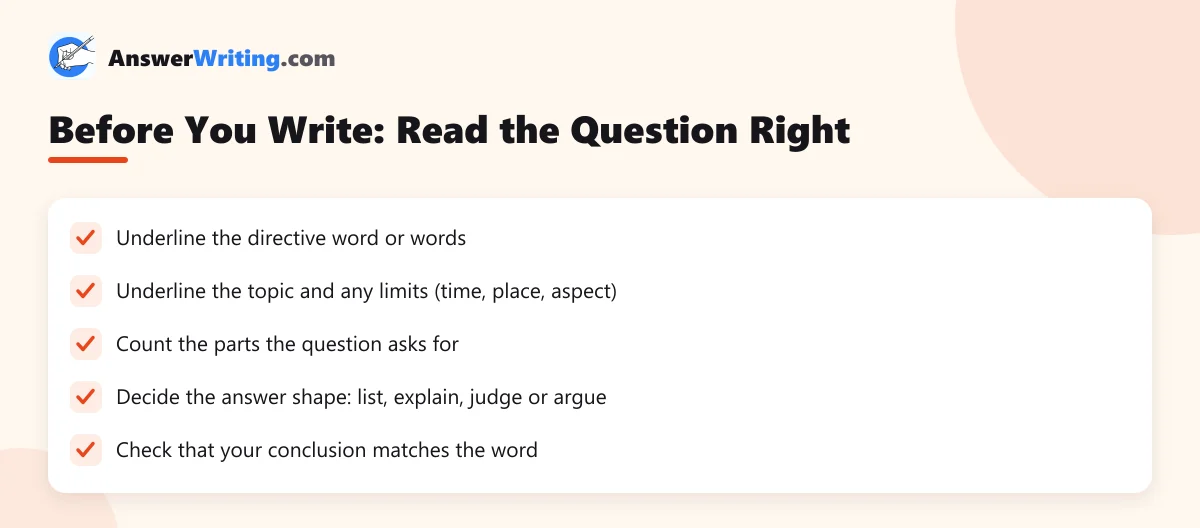
- Underline the directive word, and any second one. Some questions have two, like “discuss and evaluate”.
- Underline the topic and its limits. “In the Indian context”, “since 1991” or “in rural areas” narrow the topic.
- Plan the shape. For “critically examine”, make sure you have a part on limits and a judgement at the end.
Our post on analysing questions and understanding their demand goes deeper into this skill, and our guide to structuring your UPSC Mains answer shows how to build the answer once you know the shape.
Common Mistakes
The most common mistake is writing everything you know about the topic and ignoring the word. A long answer that does not do what the question asks scores less than a shorter one that does.
Another mistake is treating “critically” as “criticise”. “Critically examine” asks for a fair judgement, with both strengths and weaknesses, not only negatives. And with “comment”, many candidates forget to actually give their view. The examiner wants your reasoned opinion.
For all nine papers and their rules, read the UPSC Mains guide.
Key Takeaways
- The directive word tells you the shape of the answer UPSC wants.
- “Discuss” and “explain” ask for explanation; “examine” and “analyse” ask for detail and links; “critically” and “evaluate” ask for a judgement.
- “Critically” means a fair judgement with both sides, not only criticism.
- Some questions have two or three directive parts. Answer every one.
- Spend 30 seconds reading the question before you write.
Check If Your Answer Fits the Question
It is hard to judge on your own whether you answered what was asked. On AnswerWriting, AI evaluation of your Mains answers checks whether your answer addresses the question’s demand and gives a model answer in minutes. Your first three evaluations are free.
Related Reading
FAQs
What are directive words in UPSC Mains?
They are the action words in a question, like discuss, examine, analyse or comment, that tell you what kind of answer to write.
What is the difference between discuss and critically examine?
“Discuss” asks you to explain the topic from different sides. “Critically examine” asks you to look in detail at strengths and weaknesses and give a balanced judgement.
Does UPSC define these words officially?
No. The meanings used by teachers and examiners come from the common English meaning of each word.
What should I do if a question has two directive words?
Answer both parts. For “discuss and evaluate”, explain the topic first and then give a judgement.
Does “critically analyse” mean I should only criticise?
No. It means a fair judgement with both positives and negatives, ending with your reasoned view.