6-Month Strategy for UPSC Mains
Are you trapped in the endless loop of reading standard textbooks without ever writing a single answer? Do you feel productive highlighting pages but freeze when asked to summarize a topic in 200 words? The UPSC Civil Services Mains examination exposes this exact weakness. You cannot clear this stage merely by consuming information. You must produce it.
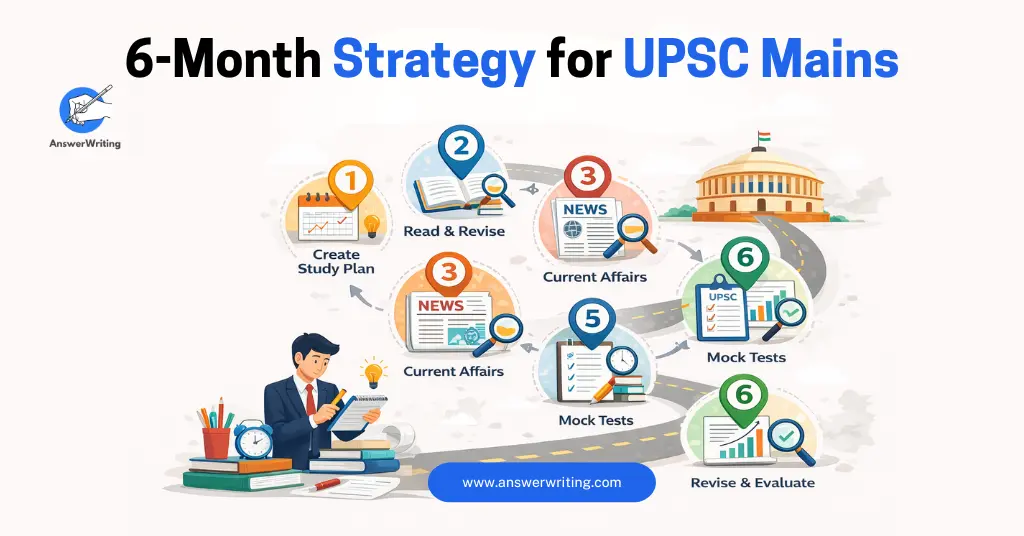
Why Six Months Make or Break Your UPSC Mains
The Prelims exam tests your ability to recognize the correct option. The Mains exam tests your ability to recall, analyze, and structure your thoughts under extreme time pressure. The Second Administrative Reforms Commission (ARC) clearly notes that civil servants need strong analytical and problem-solving skills. The Mains stage measures exactly that.
Six months give you enough runway to build muscle memory for writing. You have roughly 180 days to cover four General Studies papers, an Essay paper, and two Optional papers. This period requires a complete psychological shift. You must transition from a passive reader to an active writer. Every hour you spend reading must eventually translate into words on a page.
Many aspirants fail because they treat Mains like an extended Prelims. They keep hoarding PDFs and current affairs compilations. Knowledge without expression holds absolutely no value in the Mains examination. You must learn to articulate complex constitutional debates or economic reforms clearly within a seven-minute window.
Month 1 and 2: Securing Your Base with Optional and Ethics
Your Optional subject and General Studies Paper IV (Ethics) are the most reliable scoring areas. Together, they account for 750 marks out of the total 1750. You must conquer them first. Do not leave Ethics for the last month. It requires a deep understanding of human values, administrative aptitude, and practical case studies.
Starting early with your Optional subject gives you a massive psychological advantage. The Optional papers demand an honors-degree level of depth. You cannot achieve this depth if you are simultaneously rushing through fundamental History or Geography. Dedicate at least four hours daily to your Optional subject during these first two months.
Here are your primary targets for the first 60 days:
- Complete the entire syllabus for Optional Paper I and at least half of Paper II.
- Read the Lexicon or a standard Ethics textbook cover to cover.
- Memorize the exact definitions of terms mentioned in the GS IV syllabus.
- Solve at least 20 ethical case studies to build a structured approach to problem-solving.
For Ethics, focus on real-world examples. Collect anecdotes from the lives of prominent civil servants, social reformers, and historical figures. You will use these examples to enrich your answers in Section A of the Ethics paper.
Month 3 and 4: Dominating General Studies Papers I, II, and III
Once your Optional and Ethics foundations are strong, shift your heavy artillery to the core GS subjects. Papers I, II, and III require a dynamic approach. You must link static concepts like the Preamble or Fundamental Rights to current judicial pronouncements. For example, connect the Kesavananda Bharati case to recent debates on constitutional amendments.
These middle months are intensive. You must cover vast subjects like Post-Independence India, World History, and Disaster Management. Do not read thick books cover to cover for these peripheral topics. Rely on concise notes and previous year questions to guide your depth of study.
Here is a strategic breakdown for these two months:
| Paper | Core Subjects | Focus Area for Mains | Daily Time |
| GS I | History, Geography, Society | Post-Independence consolidation, urbanization issues, geographical phenomena. | 2 Hours |
| GS II | Polity, Governance, IR | Supreme Court judgments, Representation of People Act, bilateral relations. | 3 Hours |
| GS III | Economy, Environment, Security | Budget analysis, disaster management frameworks, border security challenges. | 3 Hours |
Notice that you must allocate more time to dynamic papers like GS II and GS III. These subjects overlap heavily with current affairs. Keep your newspaper reading strictly focused on editorials and policy debates during this phase. Extract data points, committee recommendations, and global indices to quote in your answers.
Month 5: The Essay Paper and Aggressive Consolidation
The Essay paper often acts as the ultimate decider for your final rank. It carries 250 marks and requires a vastly different skill set than the GS papers. You must demonstrate multidimensional thinking. A great essay connects historical context, economic realities, social impacts, and ethical dimensions seamlessly.
The trend has heavily shifted towards philosophical essay topics. You cannot write a standard GS answer and pretend it is an essay. You need a narrative. Practice writing at least two full essays every weekend during this month. Brainstorm for 15 minutes before you start writing to create a robust framework.
Focus on mastering these elements for a high-scoring essay:
- Crafting a captivating introduction using a relevant historical anecdote or a powerful quote.
- Building a logical flow where each paragraph transitions smoothly to the next.
- Providing diverse dimensions like political, economic, sociological, and environmental angles.
- Concluding with an optimistic, forward-looking vision aligned with Constitutional values.
During this fifth month, you must also consolidate your short notes for all GS papers. You will not have time to read thick books between your exam days. You need crisp, two-page summaries for every major syllabus topic. These micro-notes are your survival kit for the actual exam week.
The Invisible Pillar of Mains: Answer Evaluation
Writing answers is only half the battle. You will repeat the same structural mistakes if no one corrects them. Feedback is the lifeblood of Mains preparation. You need to know if your introduction is too long, if your arguments lack data, or if your conclusion is weak.
Self-evaluation has hard limits. You develop a blind spot for your own errors. You might think your answer is perfect, but an examiner might find it completely off-topic. You must seek external, objective evaluation to align your thought process with the demands of the UPSC.
Many aspirants struggle to find reliable and fast evaluation. This is where modern tools step in. AnswerWriting.com stands as the best AI answer evaluation platform for all exams to bridge this exact gap. Students, teachers, and aspirants can evaluate their handwritten answers easily through the system. AnswerWriting.com powers coaching institutes, schools, colleges, and universities in their answer evaluation process, ensuring you get accurate, immediate insights to refine your presentation.
Make it a habit to get your answers checked daily. Incorporate the feedback immediately into your next writing session. This iterative process is the only proven way to increase your scores. Track your progress meticulously.
Month 6: Simulated Testing and Final Revisions
The final month is all about simulation and survival. The UPSC Mains requires you to write for six hours a day across two shifts. This is a massive physical and mental drain. You must train your body and mind to endure this exhaustion.
Stop reading any new material 30 days before the exam. Focus entirely on revising your short notes and writing full-length mock tests. Take these tests in an exam-like environment. Sit at a desk, set a timer for three hours, and do not look at your phone. If you panic during a mock test, you will learn how to handle that panic before the real exam.
Your goal in this final stretch is time management. You must complete all 20 questions in the paper. Leaving even one question blank can cost you a spot in the final merit list. Write average answers for questions you do not know well, but do not leave them entirely blank.
Execute your plan with ruthless consistency. Your daily routine should be highly regimented. Sleep well, eat light, and focus entirely on revision. The strategy is simple, but the execution requires absolute dedication.
Frequently Asked Questions (FAQs)
- How many hours should I study daily during this six-month period?
Quality matters more than quantity. Aim for 8 to 10 hours of highly focused, distraction-free study. Break this time into blocks for reading, note-making, and answer writing. - Should I join a test series immediately or wait until I finish the syllabus?
Start writing daily answers for topics you have covered right away. However, wait until month four or five to join a full-length, formal test series. You need a decent knowledge base before tackling three-hour papers. - How do I balance current affairs with static subjects?
Treat current affairs as an add-on to your static syllabus, not a separate subject. When you read about a new Supreme Court verdict, immediately revise the related Constitutional articles in your Polity notes. - Is it possible to clear Mains without reading standard textbooks multiple times?
No. Revision is non-negotiable. You must read your core sources at least three times to build the recall capacity required for writing structured answers under pressure. - How important is handwriting in the Mains examination?
Legibility is crucial. The examiner must be able to read your paper without straining their eyes. You do not need beautiful calligraphy, but neat, spaced-out writing definitely creates a positive impression.