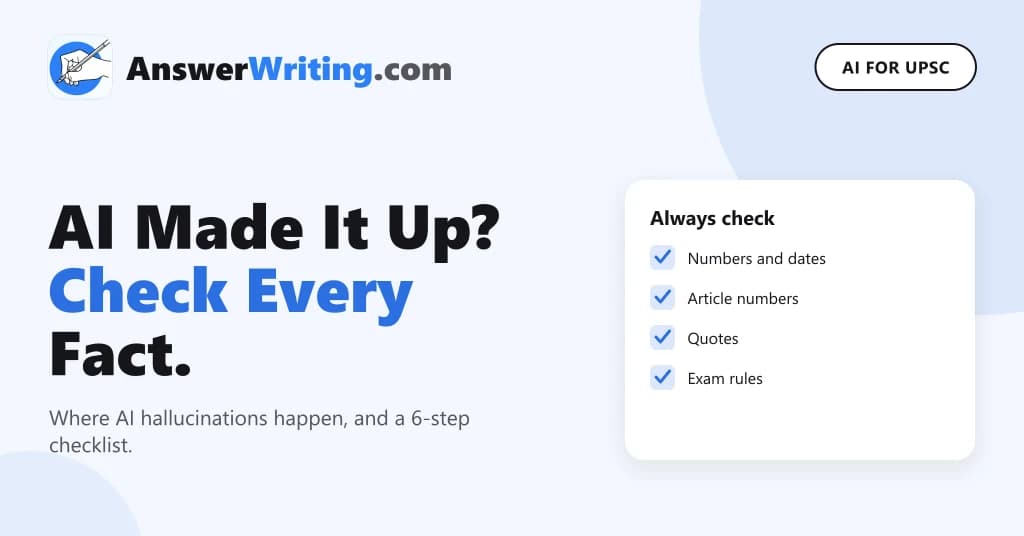
An AI hallucination is when an AI tool gives you a fact, number or quote that sounds correct but is wrong or made up. For a UPSC aspirant, this is a real risk: one wrong date in Prelims costs marks, and a made-up quote in Mains weakens a good answer. The fix is simple. Use AI to understand topics, and check every fact you plan to remember against an official source.
This post shows where hallucinations happen most, gives you a six-step checklist and lists the official sites to check against.
Why AI Tools Make Things Up
AI chat tools like ChatGPT and Gemini learn patterns from a huge amount of text. When you ask a question, they produce the answer that looks most likely, word by word. Most of the time this works well. But when the tool is unsure, it does not always say “I don’t know”. It may produce an answer that fits the pattern, with a confident tone and a wrong fact inside.
Even UPSC is aware of the ethics of relying on AI. The CSE 2026 GS Paper IV, on the official UPSC question paper page, asked candidates to discuss a professor who submits an AI-generated Ph.D. evaluation report with only some changes, from the point of view of accountability and integrity. The lesson for aspirants is the same: you are responsible for every fact you use.
Where Hallucinations Happen Most
| Type of fact | Example of a risky answer | Where to check |
|---|---|---|
| Exam rules | Wrong age limit or number of attempts | Official notice on upsc.gov.in |
| Numbers and data | A made-up GDP growth rate or literacy figure | Economic Survey, MoSPI, RBI |
| Dates | Wrong year a scheme or Act started | PIB release, the Act on legislative.gov.in |
| Articles of the Constitution | Wrong Article number for a right | The Constitution text on legislative.gov.in |
| Quotes | A quote given to the wrong leader, or invented | A book or official speech collection |
| Court cases | Wrong case name or wrong year | Supreme Court records, a reliable newspaper |
| Recent events | Old information shown as current | PIB, a reliable newspaper |
Notice the pattern: specific, exact facts are the risky ones. AI is much better at explaining a concept than at remembering exact details.
The 6-Step Fact-Check Checklist
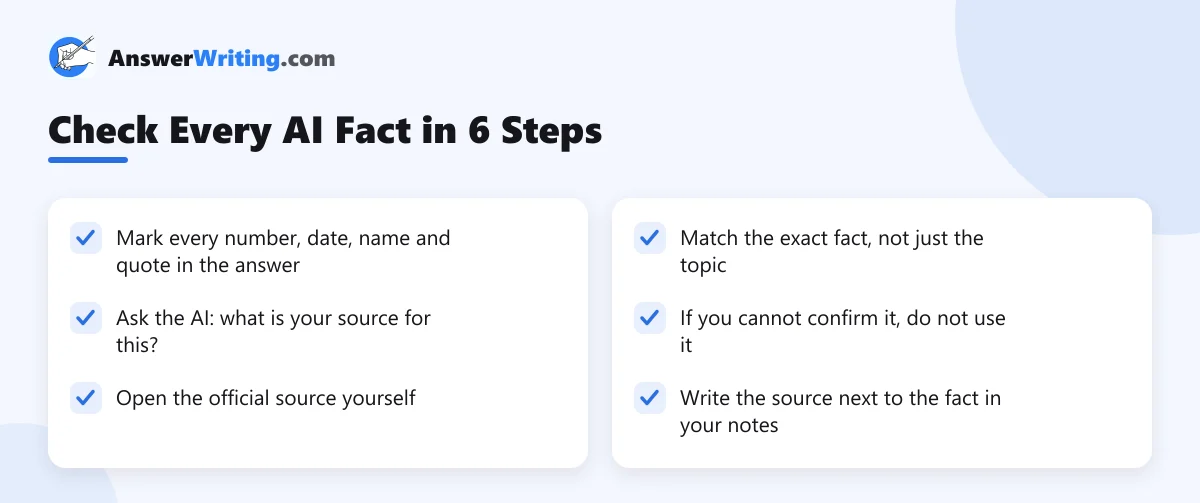
Two of these steps need a little more explanation.
First, asking for a source is only the start. An AI tool may give you a source that does not exist, or a real source that does not say what the tool claims. Open it yourself.
Second, match the exact fact. It is not enough that the official page talks about the same scheme. Check that the year, the number or the name is exactly the same.
Official Sources to Check Against
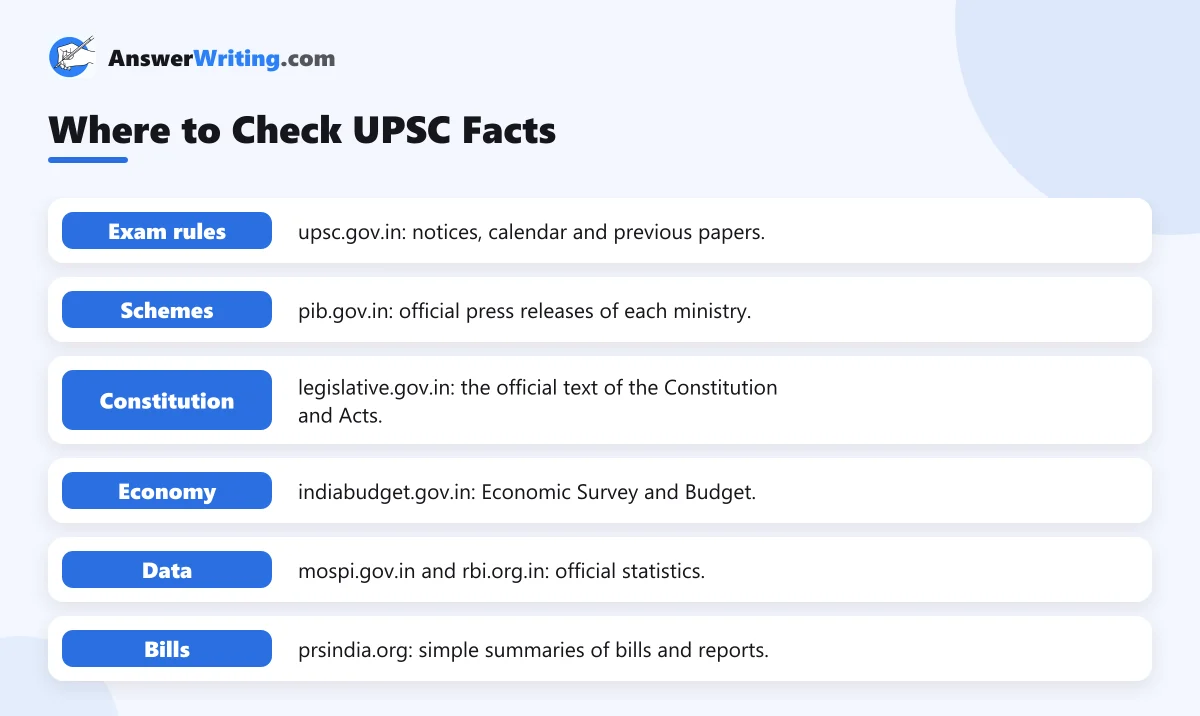
Direct links: UPSC, PIB, the Constitution of India, Union Budget and Economic Survey, MoSPI, RBI and PRS Legislative Research.
NCERT textbooks and your standard books also count as reliable sources for basic facts. Our UPSC booklist lists the standard ones.
Good Habits That Reduce the Risk
- Use AI to explain concepts, and books for facts.
- Ask the AI to say “I am not sure” when it does not know. Some tools follow this instruction better than others.
- Prefer tools that answer from your own sources, like Gemini Notebook (formerly NotebookLM), for revising facts. Our guide on where AI fits in UPSC preparation explains which tool suits which task.
- Never copy an AI-made quote into your Mains answer unless you have seen it in a reliable book or speech.
- Keep a “checked facts” notebook with the source next to each fact.
What This Means for Mains Answers
In Mains, a small number of correct facts is better than many doubtful ones. One correct figure from the Economic Survey, one real Supreme Court case and one relevant Article of the Constitution make an answer strong. Three made-up statistics make it weak, and an examiner who knows the subject will notice. Our post on how to justify arguments with data and examples shows how to use facts well.
A tool that answers from your own sources helps. Read how to use NotebookLM for UPSC.
Key Takeaways
- An AI hallucination is a wrong or made-up fact that sounds correct.
- The risk is highest for exact facts: numbers, dates, Article numbers, quotes and court cases.
- Use the six-step checklist and check every important fact on an official site.
- If you cannot confirm a fact, do not use it.
- Use AI to understand, books and official sites to confirm, and your own hand to write.
Get Feedback on Your Answers
When you write a Mains answer with facts you have checked, get it evaluated. AnswerWriting’s AI answer checking gives you feedback on structure, content and presentation, with a model answer, in minutes. Your first three evaluations are free.
Related Reading
FAQs
What is an AI hallucination?
It is when an AI tool gives a fact, number, source or quote that sounds right but is wrong or invented.
Can I trust ChatGPT or Gemini for UPSC facts?
Use them to understand topics, but check every exact fact, like a date, number or Article, on an official source.
Which facts should I always check?
Exam rules, numbers and data, dates, Article numbers, quotes, court cases and anything about recent events.
What if the AI gives me a source?
Open the source yourself and check that it really says the same thing. AI tools sometimes give sources that do not exist.
Is NotebookLM (now Gemini Notebook) free from hallucinations?
No tool is fully free of mistakes. It answers from your own sources and shows citations, which makes checking easier.