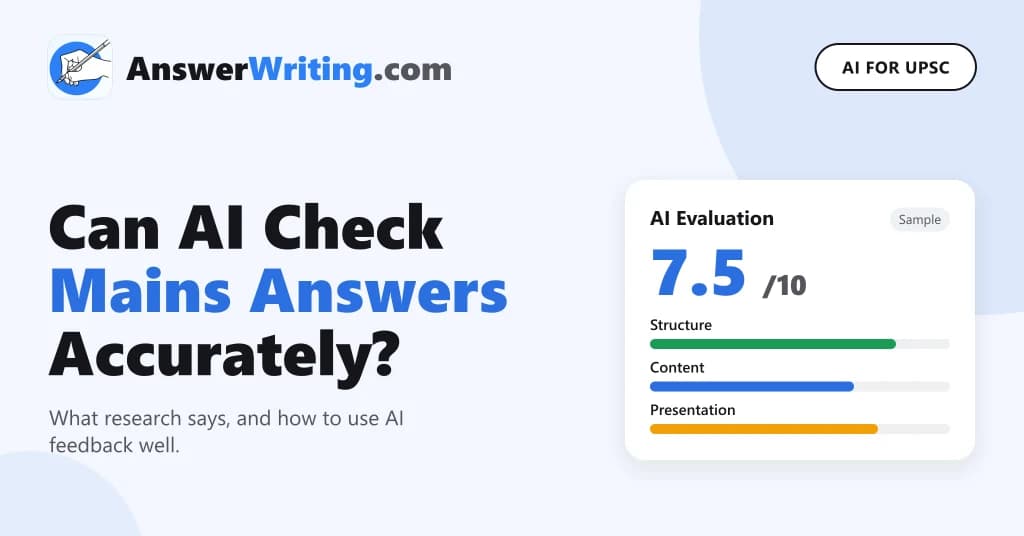
AI can evaluate UPSC Mains answers well enough to help you improve, but not well enough to predict your exact marks. Research on AI essay scoring shows that AI is good at spotting missing points, weak structure and unclear language, but its exact scores often do not match human examiners, and the same answer can get a different score on a different day. So use AI feedback to fix your writing, and look at the trend of your scores over many answers, not at one number.
This post explains what studies have found, in simple words, and how you should use AI evaluation in your daily practice.
How AI Checks an Answer
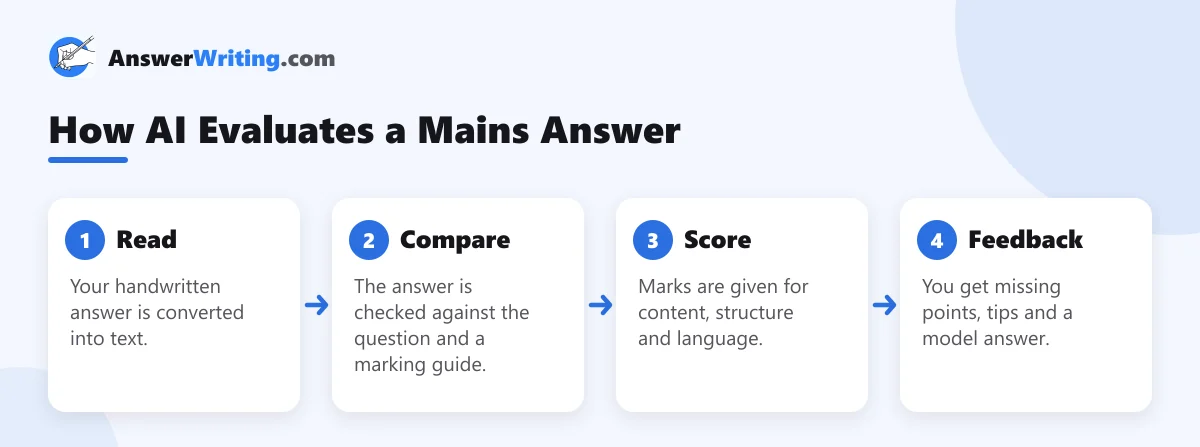
When you upload an answer, the AI reads your text (it first converts handwriting into text), compares it with what the question asks, and gives you a score and comments. Tools built for an exam also use a marking guide, called a rubric. For UPSC, a rubric usually looks at four things:
- Did the answer do what the question asked, for example “discuss”, “critically examine” or “explain”?
- Does it cover the main points, with examples, data or a case?
- Is it well arranged, with an introduction, a body and a conclusion?
- Is the language clear and within the word limit?
What Research Says
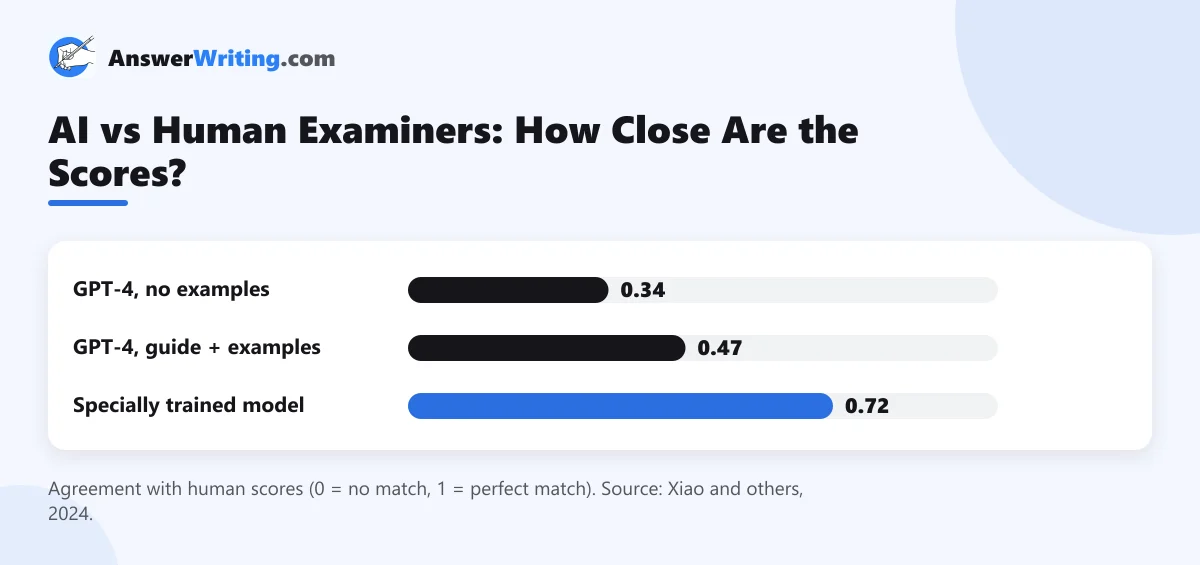
There are no public studies on AI checking UPSC answers specifically. But several studies have tested AI on essays and long answers, which is the closest comparison. Researchers usually measure “agreement”: how close the AI’s scores are to human examiners’ scores, on a scale where 0 means no match and 1 means a perfect match.
| Study | What was tested | What they found |
|---|---|---|
| Xiao and others, 2024 | GPT-4 scoring about 13,000 school essays | Without examples, agreement was low (about 0.34). With a marking guide and examples, it rose to about 0.47. Specially trained models reached about 0.72 to 0.74. |
| Lundgren, 2024 | GPT-4 grading 60 university political science essays | Average marks matched teachers, but agreement on individual essays was low. |
| Seßler and others, 2024 | Five AI models scoring school essays against 37 teachers | The best newer model matched teachers fairly well (0.74), but AI models tended to give higher scores. |
| Gaggioli and others, 2025 | Five AI models scoring 67 university essays | Agreement with humans was low, and the same model gave different scores when asked again. |
Three lessons come out of these studies:
- A general AI tool used without a marking guide is not reliable for exact scores.
- Scores get much closer to human examiners when the AI is given a clear marking guide and examples, and closer still when it is trained for the task.
- AI tends to be kind with marks and can change its score for the same answer, so a single AI score should never be taken as your final level.
Another study found that when new examiners used AI feedback while checking, their own marking became more accurate. That is the best way to see AI: as a second pair of eyes, not a final judge.
What AI Gets Right
- It usually notices missing points. If the question asks about causes and effects and you only wrote causes, AI usually notices.
- It checks structure well. It can tell when your introduction is too long, when the body has no headings, or when there is no conclusion.
- It can spot when you wrote everything you know about a topic instead of what was asked.
- You get feedback in minutes, every day, on as many answers as you want.
Where AI Feedback Can Mislead You
The studies above point to the first problem below. The others are limits of how these tools work today, so treat them as our advice rather than research findings.
- Exact marks are not reliable. In the studies, the same essay could get a different score when checked again, and AI models tended to give higher scores than teachers.
- AI may not notice when you write a wrong year or a wrong figure, and it may suggest outdated data in model answers.
- AI may favour answers that look like a standard model answer, and can miss a good point written in an unusual way.
- Very untidy handwriting can be read wrongly, which affects the feedback.
How to Use AI Evaluation the Right Way
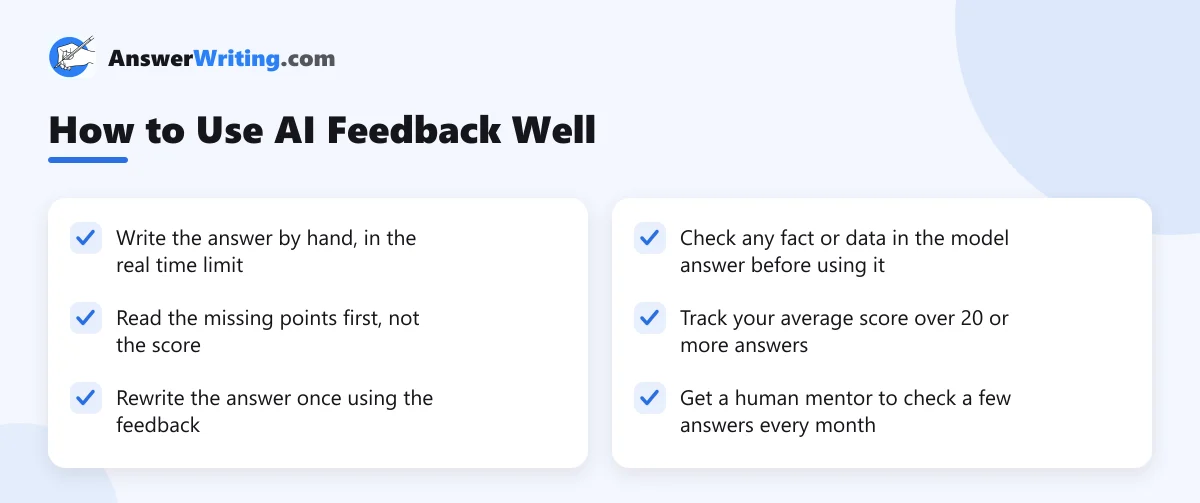
The most useful habit is to rewrite the same answer once after reading the feedback. This takes only ten minutes, and it fixes the mistake in your memory. Also, judge your progress by your average score over 20 or more answers. One high or low score means very little, but a rising average shows real improvement.
For more, see our comparison of AI evaluation and human evaluation and our guide on how UPSC evaluates Mains answers.
General Chat Tools vs Tools Built for UPSC
The research above explains why the type of tool matters. A general chat tool like ChatGPT does not use a UPSC marking guide unless you write one into your question every time, and its scores can change a lot from one try to the next. A tool built for UPSC uses the same marking guide for every answer, knows the word limits for 10-mark and 15-mark questions, and gives feedback in the same format each time, which makes it easier to compare your answers over weeks. Read ChatGPT vs AnswerWriting for answer evaluation for a side-by-side test.
For other ways to use AI in your preparation, see our beginner’s guide to AI for UPSC.
Key Takeaways
- AI can give useful feedback on UPSC Mains answers, but its exact marks are not fully reliable.
- Research shows AI scores get much closer to human examiners when the tool uses a marking guide and examples.
- AI is best at finding missing points and weak structure. It is weaker at checking facts and judging original ideas.
- Judge your progress by your average score over many answers, not by one score.
- Rewrite each answer once after reading the feedback.
Try It on Your Own Answer
On AnswerWriting, you can upload a handwritten answer for any GS paper, the essay or your optional, and get section-wise feedback with a model answer within minutes, in English, Hindi and 22 other Indian languages. Start with free Mains answer evaluation: your first three evaluations are free.
FAQs
Is AI evaluation as good as a human teacher?
Not for exact marks. Studies show AI scores often differ from human examiners on individual answers. But AI is fast and available every day, so it is very useful for regular practice, with a human check from time to time.
Why did I get different scores for the same answer?
AI tools can give slightly different results each time, especially general chat tools. This is why you should look at your average score over many answers.
Are AI scores higher than real UPSC marks?
They can be. Studies on essays found that AI models tended to give higher scores than teachers. Treat a high AI score as a sign you are on the right track, not as your expected exam mark.
Can AI check answers in Hindi?
Yes, some tools can. AnswerWriting checks answers in Hindi, English and 22 other Indian languages.
Should I stop getting my answers checked by a mentor?
No. Use AI for daily feedback and a mentor or senior aspirant for a few answers each month. The two together work better than either alone.