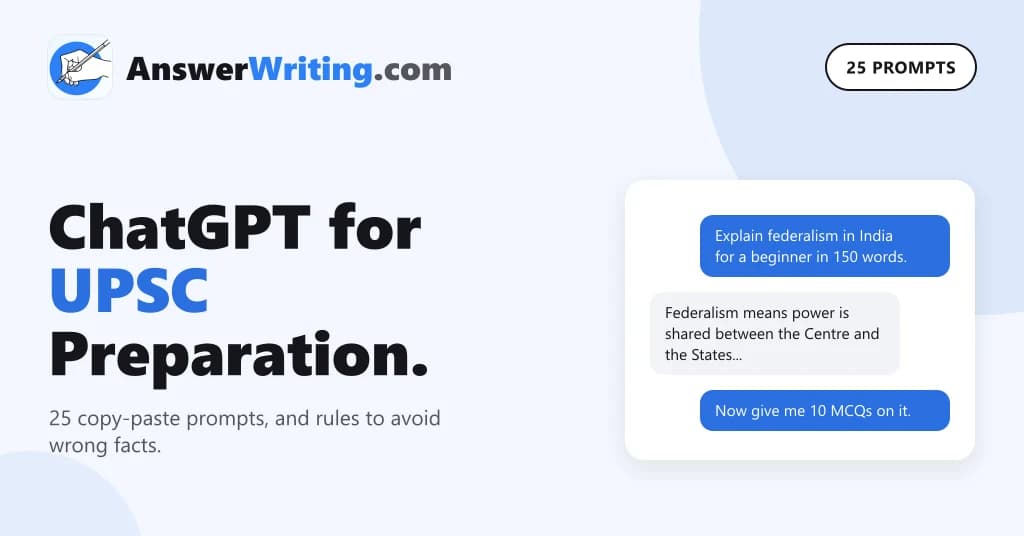
ChatGPT can help a UPSC beginner understand hard topics, revise faster, practise MCQs and get first feedback on answers. The trick is to ask clear questions, called prompts, and to check every fact it gives you. This post gives you 25 prompts you can copy, change and use today, grouped by what you want to do.
Replace the words in [square brackets] with your own topic. The prompts also work in other AI chat tools like Gemini and Claude.
How to Write a Good Prompt
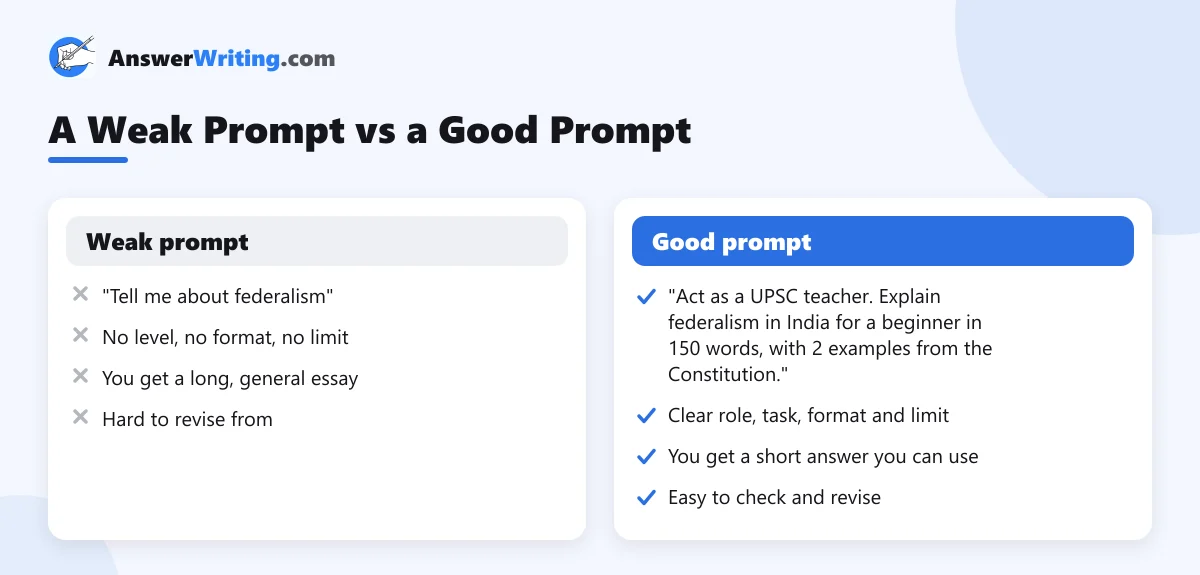
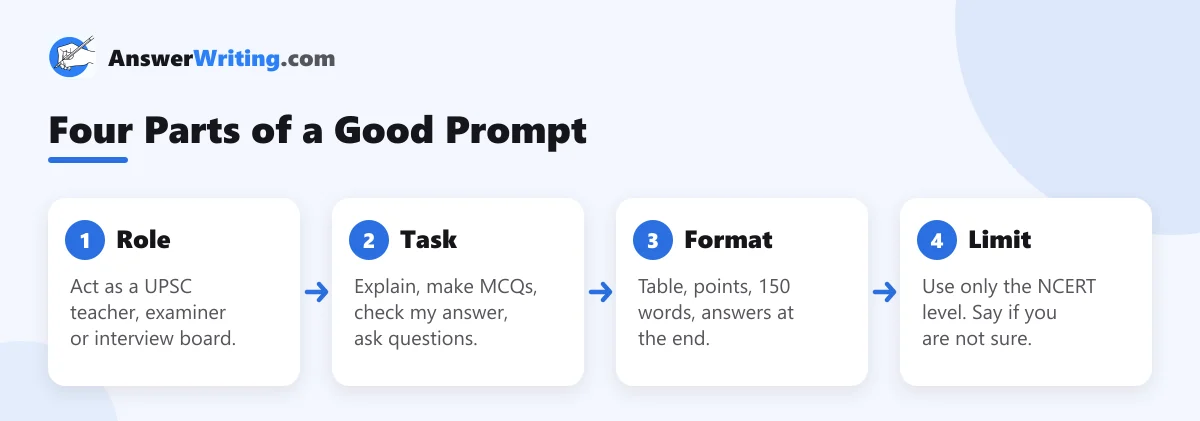
A good prompt tells the AI four things: who it should act as, what to do, how to show the answer, and any limit like word count. Compare these two:
Prompts to Understand a Topic
- “Act as a UPSC teacher. Explain [topic] to a beginner in simple English in 200 words, with one example from India.”
- “I read this paragraph from my book but did not understand it: [paste paragraph]. Explain it in simpler words.”
- “What is the difference between [concept A] and [concept B]? Give the answer as a table with 5 rows.”
- “Explain [topic] as a story with a real example, then give me 3 key points to remember.”
- “Which parts of the UPSC syllabus does [topic] connect to? List GS papers and topics.”
Prompts for Notes and Revision
- “Make short revision notes on [topic] in 10 bullet points. Mark any fact you are not fully sure about with (check).”
- “Make a one-page mind map in text form for [chapter name] of [NCERT book and class].”
- “Give me 5 important Articles of the Constitution related to [topic], with one line on each.”
- “Make a table of [list, for example national parks in Assam] with columns: name, location, known for. Say if any detail is uncertain.”
Always check the notes from step 6 to step 9 in your NCERT or standard book before you revise from them. Our guide on how to make notes for Mains explains how to keep notes short and useful.
Prompts for Prelims Practice
- “Make 10 UPSC Prelims-style MCQs on [topic]. Use statement-based questions. Give answers and explanations at the end, not after each question.”
- “Here is a question I got wrong: [paste question and options]. Explain why each option is right or wrong.”
- “Make 10 ‘match the following’ questions on [topic], with answers at the end.”
- “Make a 5-question quiz on the topics I studied today: [list topics]. Then tell me which topic I should revise again based on my answers.”
AI sometimes makes MCQs with a wrong answer key. If an answer looks wrong, check it in your book. For questions that have already been checked, use a proper question bank, and read our guide on statement-based questions.
Prompts for Mains Answer Practice
- “Break down this UPSC question: [paste question]. What is the directive word, what does it ask, and what are the 4 to 5 main points to cover?”
- “Give me an introduction of 2 to 3 lines for this question: [question]. Give 3 different styles: a fact, a definition from the Constitution, and a recent event.”
- “Here is my answer to [question]: [paste answer]. Act as a strict UPSC examiner. Tell me the missing points, the weak parts and how to improve the conclusion. Do not rewrite the whole answer.”
- “Suggest 3 examples, reports or data points I can use in an answer on [topic]. For each, tell me the source so I can check it.”
- “Give me a conclusion of 2 lines for this answer that is positive and forward-looking: [paste answer].”
Typing a handwritten answer into ChatGPT takes time, and its marks can change each time you ask. For daily practice, a tool where you can upload a photo of your handwritten answer is easier. Read why in our post on ChatGPT vs AnswerWriting for answer evaluation.
Prompts for Essay Practice
- “Give me 5 different angles (social, economic, political, ethical, environmental) to write an essay on: [essay topic].”
- “Suggest 3 quotes from Indian thinkers and 2 real examples that fit an essay on [topic]. Tell me who said each quote so I can check it.”
- “Here is my essay outline: [paste outline]. Is anything missing? Is the order logical?”
Quotes are where AI often makes mistakes. It sometimes gives a quote to the wrong person. Check every quote before you use it, as explained in our post on quoting thinkers in your answers.
Prompts for Interview Practice
- “Act as a UPSC interview board. I am [education] from [district, state], and my hobbies are [hobbies]. Ask me one question at a time and wait for my answer. After 10 questions, give feedback.”
- “Give me 10 questions an interview board may ask about my home district [district name], and the facts I should know for each.”
Prompts for Planning
- “I have [number] hours a day and [number] months before Prelims. My weak subjects are [subjects]. Make a weekly plan I can follow.”
- “I studied these topics this week: [list]. Make a revision plan for the next 7 days so I revise each topic at least twice.”
Rules to Follow Every Time
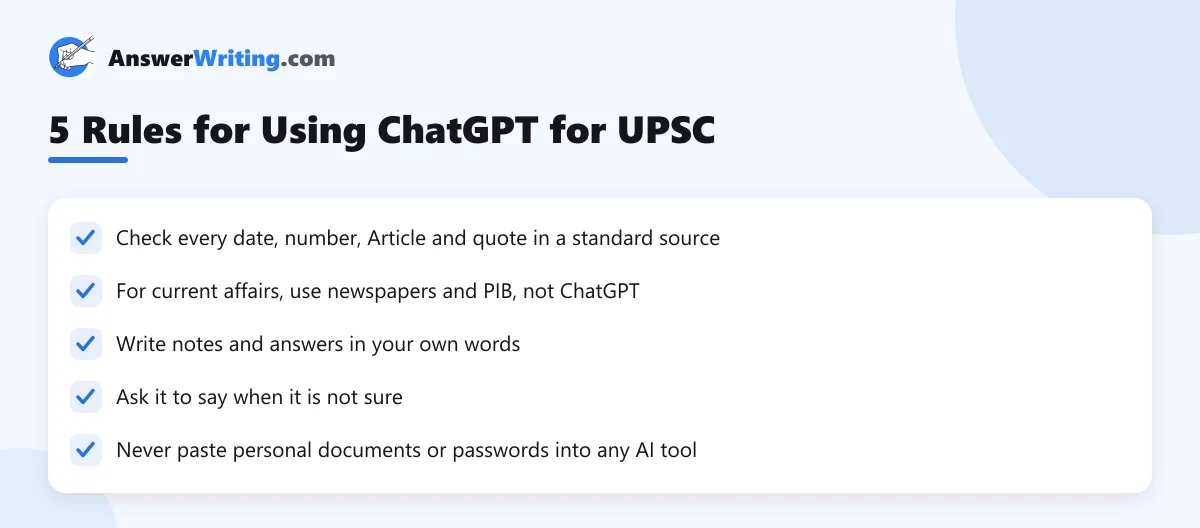
ChatGPT may not know about events of the last few months, and it can mix up names of schemes and reports. For current affairs, read a newspaper and check government news on the Press Information Bureau.
Before you trust any AI marks, read how accurate AI evaluation of Mains answers really is.
Key Takeaways
- A good prompt has a role, a task, a format and a limit.
- Use ChatGPT to understand topics, make practice questions and get first feedback, not as your source of facts.
- Check every date, number, Article and quote in your book or an official website.
- For current affairs, rely on newspapers and PIB.
- For daily Mains practice on handwritten answers, a tool built for UPSC is faster and more consistent.
Practise Mains Answers Every Day
On AnswerWriting, you get a new daily answer writing question every day. Write your answer by hand, upload a photo, and get AI evaluation with a model answer within minutes, in English, Hindi and 22 other Indian languages. You can also ask the 24×7 AI mentor about your strategy. Your first three Mains evaluations are free.
FAQs
Is ChatGPT useful for UPSC preparation?
Yes, for understanding topics, making practice questions, getting first feedback on answers and planning your study. It is not reliable as a source of facts or current affairs, so always check.
Can I make UPSC notes with ChatGPT?
You can use it to make a first draft of short notes, but check every fact in your book and rewrite the notes in your own words. Notes you write yourself are easier to remember.
Is the free version of ChatGPT enough?
For explaining topics and making practice questions, the free version is usually enough. Check the current features on the official website, as they change often.
Can ChatGPT predict my UPSC Mains marks?
No. Its marks for the same answer can change each time, and they are often higher than a real examiner would give. Use it for feedback on missing points, not for marks.
Which prompts should a beginner start with?
Start with prompts 1, 2 and 10: explaining a topic, explaining a paragraph from your book, and making MCQs. They help the most in the first months.