Best Booklist for UPSC Civil Services Preparation: The Complete Subject-Wise Guide
The average UPSC topper reads fewer books than the average UPSC failure.
That is not a motivational line. It is a consistent pattern across topper interviews spanning the last decade. Rank holders repeatedly say the same thing: “I read fewer books, but I read them more times.”
The aspirant who reads 40 books once understands 40 topics shallowly. The aspirant who reads 12 books four times understands 12 topics deeply enough to write analytical answers, handle interview questions, and connect concepts across papers.
This booklist is built on that principle. Every recommendation here comes with a reason and a usage note. The goal is not to give you the longest list. It is to give you the most useful one
The Booklist Trap: Why More Books Mean Lower Scores
Walk into any UPSC preparation forum and you will find aspirants comparing booklists the way others compare gadget specifications. “Have you read this author’s economy book?” “Should I add this new polity guide?”
This instinct comes from a genuine place: the fear of missing something important. But it produces a preparation style that is wide and shallow rather than narrow and deep.
UPSC Mains rewards depth. A question on federalism does not need you to have read six books on the topic. It needs you to have understood one or two books well enough to analyze the concept from constitutional, historical, economic, and contemporary angles.
Every time you add a new book to your list, you are making a trade-off. You are exchanging revision time on a book you already own for first-read time on a new one. At an advanced stage of preparation, that trade-off almost always hurts more than it helps.
The discipline of stopping is as important as the discipline of reading.
How to Use This Booklist
Before getting into subject-wise recommendations, here is the reading sequence that works.
Step 1: NCERTs first. For every subject, read the relevant NCERTs before picking up any standard book. NCERTs build the conceptual vocabulary you need to understand advanced texts. Skipping them and jumping to standard books is like reading a research paper without knowing the field’s basic terminology.
Step 2: One standard book per subject. After NCERTs, pick one primary standard book per subject and read it completely. Resist the urge to read two competing books on the same subject simultaneously.
Step 3: Three-pass reading method. First pass: read for understanding, no notes. Second pass: make concise notes and mark important passages. Third pass: revise from your notes only, not the book. By the third pass, your notes should be doing the work, not the book itself.
Step 4: Integrate reading with writing. After completing each chapter or topic, write one answer on that topic from memory. This forces active recall and reveals exactly what you understood versus what you merely read. Platforms like AnswerWriting.com are particularly useful at this stage, allowing you to submit those answers for structured feedback and track whether your reading is converting into marks-worthy writing.
NCERT Books: The Non-Negotiable Foundation
NCERTs are not “beginner books.” They are precision tools for building conceptual clarity. Many toppers report returning to NCERTs even in their final revision month.
| Subject | Class | Book Title | Why It Matters |
|---|---|---|---|
| Ancient History | 11 | Themes in World History (Part 1) | Covers early civilizations with analytical framing |
| Medieval History | 11 | Themes in Indian History (Part 2) | Essential for Bhakti, Sufism, Mughal administration |
| Modern History | 12 | Themes in Indian History (Part 3) | Covers colonialism, nationalism, and social reform movements |
| Indian Society | 12 | Indian Society | Direct Mains GS1 relevance: diversity, urbanization, gender |
| Physical Geography | 11 | Fundamentals of Physical Geography | Geomorphology, climatology, oceanography basics |
| Indian Geography | 11 | India: Physical Environment | Rivers, soils, vegetation, climate of India |
| World Geography | 12 | Fundamentals of Human Geography | Population, migration, economic geography |
| Indian Economy | 11 | Indian Economic Development | Planning, agriculture, industry basics |
| Macro Economy | 12 | Introductory Macroeconomics | GDP, inflation, monetary policy foundations |
| Polity | 9 and 10 | Democratic Politics (Parts 1 and 2) | Constitutional basics, elections, federalism |
| Biology | 12 | Biology (Part 1 and 2) | Environment, ecology, health-related Prelims questions |
| Science | 6 to 10 | General Science series | Basic Physics, Chemistry, Biology for Prelims |
Read all of these in sequence before picking up any standard reference book. This investment of 6 to 8 weeks pays returns throughout the entire preparation cycle.
History: Ancient, Medieval, and Modern (Prelims + Mains GS1)
History is one of the highest-weightage subjects in both Prelims and Mains GS1. It also feeds directly into Art and Culture questions, which have become increasingly prominent in recent years.
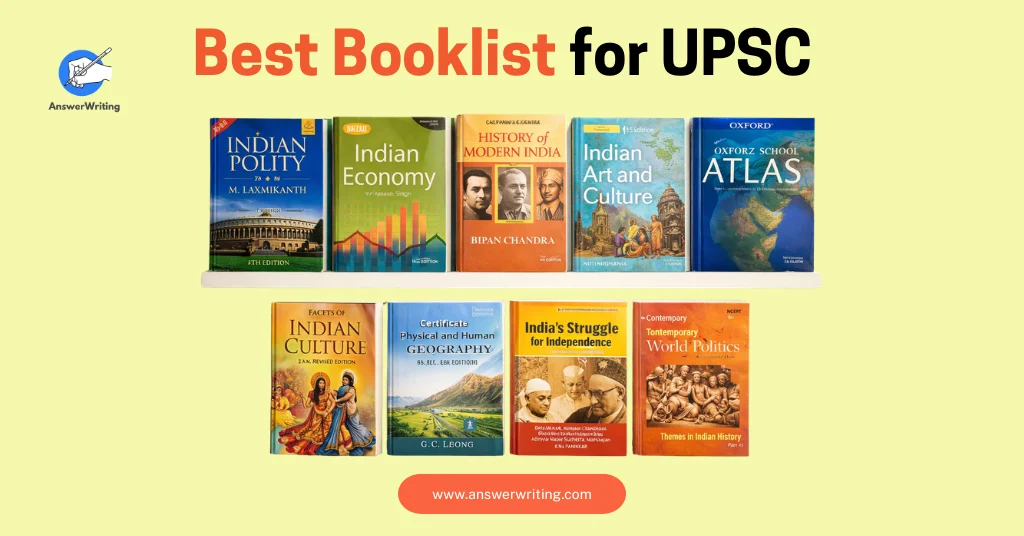
For Modern History: India’s Struggle for Independence by Bipan Chandra is the single most important book for this section. It covers the freedom movement with analytical depth, explains the ideological debates within the Congress, and contextualizes events rather than merely listing them. Read it once fully, then revise chapter summaries.
For Ancient and Medieval History: History of Medieval India by Satish Chandra and Ancient India by R.S. Sharma are the standard references. These are dense books. Do not try to memorize every detail. Focus on administrative systems, social structures, economic patterns, and cultural developments rather than chronological event lists.
For Art and Culture: Indian Art and Culture by Nitin Singhania is the most comprehensive single resource for this section. It covers architecture, painting, music, dance, and religious movements with Prelims-friendly format and Mains-relevant depth. This book has become practically mandatory given the increasing frequency of Art and Culture questions.
For the Prelims specifically: Supplement with previous year questions (PYQs) on History. Pattern analysis of the last 10 years reveals that UPSC increasingly tests conceptual and analytical understanding over factual recall.
Geography: Physical, Indian, and World (Prelims + Mains GS1)
Geography is unique because it rewards visual learning. Maps, diagrams, and spatial understanding matter as much as textual knowledge.
For Physical Geography: After NCERT, Certificate Physical and Human Geography by G.C. Leong is the standard reference. It is clear, well-illustrated, and covers all major physical geography concepts tested in Prelims and Mains. Read it with a good atlas open alongside.
For Indian Geography: Geography of India by Majid Husain covers Indian physical, economic, and human geography comprehensively. Focus particularly on rivers, climate patterns, soil types, and natural vegetation, as these are high-frequency Prelims areas.
For the Atlas: Oxford Student Atlas for India is the recommended atlas. Use it actively, not passively. Every time you read about a river, mountain range, or region, locate it on the map. Geographic visualization significantly improves both Prelims accuracy and Mains answer quality.
For Mains map-based answers: Practice drawing outline maps of India from memory. Mark major rivers, passes, biosphere reserves, and national parks. A well-drawn sketch map in a Mains answer on a location-based question earns marks and demonstrates preparation depth.
Indian Polity (Prelims + Mains GS2)
Polity is the backbone of GS Paper 2 and one of the most rewarding subjects if studied with conceptual clarity rather than rote memorization.
Indian Polity by M. Laxmikanth is the definitive reference for this subject. There is genuinely no substitute. It covers the Constitution, institutions, political processes, and governance with comprehensive detail. The book is long but well-organized. Read it chapter by chapter and make margin notes on important articles and landmark judgments.
A few specific usage tips for Laxmikanth:
Do not skip the chapters on Union-State relations, Emergency provisions, and Constitutional bodies. These are consistently high-weightage areas in both Prelims and Mains.
Supplement the book with landmark Supreme Court judgments: Kesavananda Bharati (Basic Structure), Minerva Mills, S.R. Bommai (Article 356), Vishaka (sexual harassment), and Maneka Gandhi (personal liberty). You do not need the full judgment text. You need the case name, year, constitutional issue, and outcome.
For Mains GS2 on governance and social justice, Governance in India by Laxmikanth is a useful secondary reference. Read it after completing the primary Polity book.
Economy (Prelims + Mains GS3)
Economy is the subject where many aspirants struggle because it requires both conceptual understanding and current affairs integration. Static knowledge without current context produces incomplete Mains answers.
For the foundation: Indian Economy by Ramesh Singh is the most widely used reference. It covers macroeconomic concepts, planning history, agriculture, industry, and external sector comprehensively. It is updated periodically, so ensure you have a recent edition.
The Indian Economy by Sanjiv Verma is a cleaner, more concise alternative that many aspirants prefer for its readability. Either book works. Do not read both.
For current affairs integration: The Economic Survey (published annually by the Ministry of Finance) is mandatory reading. Do not read it cover to cover. Focus on the first three to four chapters of Volume 1, which contain the thematic analysis. The key data points, policy observations, and economic trends from the Economic Survey appear directly in Mains questions every year.
The Union Budget is equally important. Understand the key allocations, fiscal deficit numbers, new schemes, and policy directions. Read a good summary from a reliable source rather than the full budget document.
Environment and Ecology (Prelims + Mains GS3)
Environment has become one of the most dynamic and high-weightage sections in UPSC Prelims over the last five years. Static knowledge alone is insufficient. Current environmental developments, international conventions, and India-specific policy updates are equally tested.
Environment by Shankar IAS Academy is the most popular reference for this subject. It is concise, well-organized, and covers biodiversity, climate change, pollution, environmental laws, and international agreements effectively. Use it as your primary static reference.
Supplement with NCERT Biology (Class 12) for ecology fundamentals: ecosystems, food chains, nutrient cycles, and biodiversity concepts.
For current environment affairs: track decisions from the Conference of Parties (COP) meetings, updates from the National Green Tribunal (NGT), and India’s commitments under the Paris Agreement. These regularly appear in both Prelims MCQs and Mains analytical questions.
Science and Technology (Prelims + Mains GS3)
Science and Technology (S&T) is the section that intimidates non-science background aspirants most. The good news is that UPSC does not test technical depth. It tests awareness, application, and the ability to explain implications.
There is no single definitive S&T book for UPSC. The subject is primarily current affairs driven. Your preparation should focus on:
NCERT Science (Classes 6 to 10): Covers basic Physics, Chemistry, and Biology concepts that underlie many Prelims questions on space, health, and environment.
Current S&T from reliable sources: Space missions (ISRO updates), biotechnology developments (gene editing, vaccines), defense technology (indigenization, new systems), and emerging technologies (AI, blockchain, quantum computing) as reported in The Hindu and PIB (Press Information Bureau).
PIB (pib.gov.in): The government’s official press release portal is underused by aspirants. It provides accurate, exam-relevant information on new government schemes, scientific achievements, and policy decisions.
Maintain a running S&T notes document where you add one to two new developments weekly. This document becomes your revision resource before Mains.
Ethics, Integrity and Aptitude (Mains GS4)
GS Paper 4 is the most misunderstood paper in UPSC Mains. Many aspirants treat it as a last-minute paper that needs minimal preparation. Those aspirants consistently score in the 100 to 110 range when 130 to 140 is achievable with the right approach.
Ethics, Integrity and Aptitude by G. Subba Rao and P.N. Roy Chowdhury is the most recommended primary reference. It covers the theoretical framework: values, attitude, emotional intelligence, and public service ethics, with clarity and exam relevance.
Lexicon for Ethics by Chronicle Publications is a useful supplementary reference for definitions, thinker summaries, and case study frameworks.
For thinkers and their ideas: Build a personal reference sheet of key thinkers: Aristotle (virtue ethics), Kant (deontology), Bentham and Mill (utilitarianism), Gandhi (trusteeship and non-violence), Ambedkar (social justice), and Chanakya (statecraft ethics). Know their core argument, one key quote, and one application to governance or public service.
For case studies: Practice is non-negotiable for GS4. The case study section (Section B) carries significant marks and rewards structured ethical reasoning over generic moral statements. Practice writing case study answers with a clear problem identification, stakeholder analysis, options evaluation, and reasoned decision.
Essay Preparation
The Essay paper (250 marks) is where many aspirants leave marks on the table. Most prepare for it as an afterthought. Toppers prepare for it as a distinct skill.
The Essay does not reward encyclopedic knowledge. It rewards a clear central argument, structured development of ideas, balanced perspectives, and a memorable conclusion.
Reading for Essay: Essays for Civil Services by Pulkit Khare provides a structural framework and sample essays. Use it to understand essay architecture, not to memorize content.
Beyond that, broad reading across domains builds the raw material for strong essays. Good sources include: EPW (Economic and Political Weekly) for policy analysis, Frontline for in-depth reporting, and selected TED talks or lectures for ideas on contemporary themes.
Practice over reading: Write at least 8 to 10 complete essays before Mains. Time yourself to 3 hours per essay. Get at least 4 to 5 of them evaluated externally. Essay feedback from an experienced evaluator reveals structural and argumentative weaknesses that are invisible when you review your own writing.
Current Affairs: Newspapers, Magazines, and Online Sources
| Source | Frequency | What to Extract |
|---|---|---|
| The Hindu | Daily | Editorial analysis, governance, international relations, environment |
| Indian Express | Daily (optional) | Political analysis, economy, alternative perspectives to The Hindu |
| PIB (pib.gov.in) | Daily (15 minutes) | Government schemes, policy launches, official data |
| Yojana Magazine | Monthly | In-depth government policy themes, rural development, social issues |
| Kurukshetra Magazine | Monthly | Agriculture, rural economy, and related schemes |
| Economic Survey | Annual | Macroeconomic data, thematic policy analysis |
| IPCC and UN Reports | As published | Climate, environment, and sustainable development data |
| PRS Legislative Research (prsindia.org) | Weekly | Bills, parliamentary debates, legislative summaries |
A practical current affairs routine: spend 45 to 60 minutes on The Hindu daily. Make brief notes only on topics that connect to the static syllabus. Do not note every news item. Note only items that add a contemporary dimension to a syllabus topic you have already studied.
Popular Optional Subjects: Starter Booklist
| Optional Subject | Core Books to Start With |
|---|---|
| Public Administration | M. Laxmikanth (Public Administration), Nicholas Henry (Public Administration and Public Affairs) |
| Sociology | Haralambos and Holborn (Sociology), Yogendra Singh (Modernization of Indian Tradition) |
| Geography | Majid Husain (complete series), G.C. Leong (Physical Geography) |
| History | Bipan Chandra (Modern India), Satish Chandra (Medieval), R.S. Sharma (Ancient) |
| Political Science and IR | O.P. Gauba (Political Theory), Pavneet Singh (International Relations) |
This is a starter list only. Each optional has a deeper reading requirement that develops through preparation. Begin with these foundational texts before consulting subject-specific advanced resources.
Books to Avoid (Or Use With Caution)
Credibility requires honesty. Some widely circulated books in the UPSC preparation ecosystem are overrated, outdated, or simply not worth the time investment.
Coaching institute printed materials as primary sources: Many institutes produce printed compilations that are useful for quick reference but not for deep understanding. They compress nuance out of complex topics. Use them for revision, never as your primary reading source.
Multiple competing books on the same subject: Reading both Ramesh Singh and a second economy book does not double your preparation. It creates confusion about which framework to use in answers and reduces revision time for the book you already know well.
Very old editions of standard books: Economy and Polity books more than 3 to 4 years old may contain outdated data, superseded constitutional amendments, or policy references that are no longer current. Always check edition dates before committing to a book.
“Complete UPSC in one book” compilations: These exist and they are consistently inadequate. They sacrifice depth for coverage. UPSC Mains tests depth. Avoid them.
When to Stop Reading and Start Writing
There is a point in every aspirant’s preparation where more reading produces diminishing returns and more writing produces compounding returns. Identifying that point and acting on it is one of the most important preparation decisions you will make.
A practical signal: if you can write a 250-word answer on most topics in your syllabus from memory, covering at least three dimensions with a structured conclusion, your reading foundation is sufficient. The bottleneck is now writing quality, not content knowledge.
At that point, shift your daily time allocation. Reduce new reading to current affairs maintenance only. Invest the reclaimed time in writing, evaluation, and revision.
This is where structured external evaluation becomes essential. Writing answers in isolation builds fluency but not accuracy. You need feedback that tells you which dimensions you are still missing, which keywords are absent, and whether your analytical depth matches the standard UPSC rewards.
AnswerWriting.com supports exactly this transition. As you move from reading-heavy to writing-heavy preparation, the platform allows you to submit handwritten answers regularly and receive examiner-aligned feedback that keeps your writing calibrated to the actual standard. Teachers using the platform can track your progress systematically across GS papers, helping you identify which subjects need more writing practice and which are already at a competitive level.
The reading phase builds your knowledge base. The writing and evaluation phase converts that knowledge into marks. Both are necessary. Neither alone is sufficient.
FAQs
Q1. Should I read both The Hindu and Indian Express daily?
For most aspirants, one newspaper read deeply is better than two read superficially. Start with The Hindu. If you consistently finish it with time to spare and feel you are missing perspectives on certain topics, selectively add Indian Express editorials. Do not attempt to read both fully on a daily basis during heavy preparation phases.
Q2. Is Laxmikanth enough for Polity, or do I need the Constitution text as well?
Laxmikanth covers constitutional provisions comprehensively. However, for specific articles that appear frequently in Mains answers (Articles 12 to 35 for Fundamental Rights, Articles 36 to 51 for DPSPs, Articles 352 to 360 for Emergency), reading the original constitutional text is valuable. It gives you precise language that strengthens Mains answers.
Q3. How many times should I revise each book?
Aim for a minimum of three revisions for core books (Laxmikanth, NCERT Geography, Bipan Chandra, Ramesh Singh Economy) before Mains. The first revision should happen within two weeks of completing the book. Subsequent revisions from your notes, not the full book, at monthly intervals.
Q4. I have a science background. Should I read different books for Economy and Polity?
No. The recommended books work regardless of academic background. Economy concepts can be intimidating initially for non-economics graduates, but Ramesh Singh’s writing is accessible. Take more time on the first pass if needed, but do not switch to a different book just because it seems simpler. Simpler economy books often lack the analytical depth UPSC Mains requires.
Q5. Are coaching institute test series books and printed materials worth buying?
Selectively. Printed current affairs compilations from reputable institutes (like monthly magazines) can save time during revision. Subject-specific printed notes are useful as secondary revision tools. Do not use them as replacements for standard books. Use them as supplements after you have already built your understanding from primary sources.
Q6. When should I start reading the Economic Survey and Budget?
Start with the Economic Survey after you have a solid foundation in basic macroeconomics (NCERT Class 12 Macroeconomics + first pass of Ramesh Singh). Reading the Economic Survey without that foundation makes it significantly harder to extract and contextualize the key insights. For the Budget, a good summary from The Hindu or PIB is sufficient for most aspirants. Read the full Budget document only if Economy is your Optional subject.
A well-chosen booklist is the foundation of UPSC preparation. But it is only the foundation. The structure built on top of it, through consistent writing, honest evaluation, and disciplined revision, is what ultimately determines your result. Stop searching for the perfect booklist. The one in front of you, read deeply and revised consistently, is already enough.