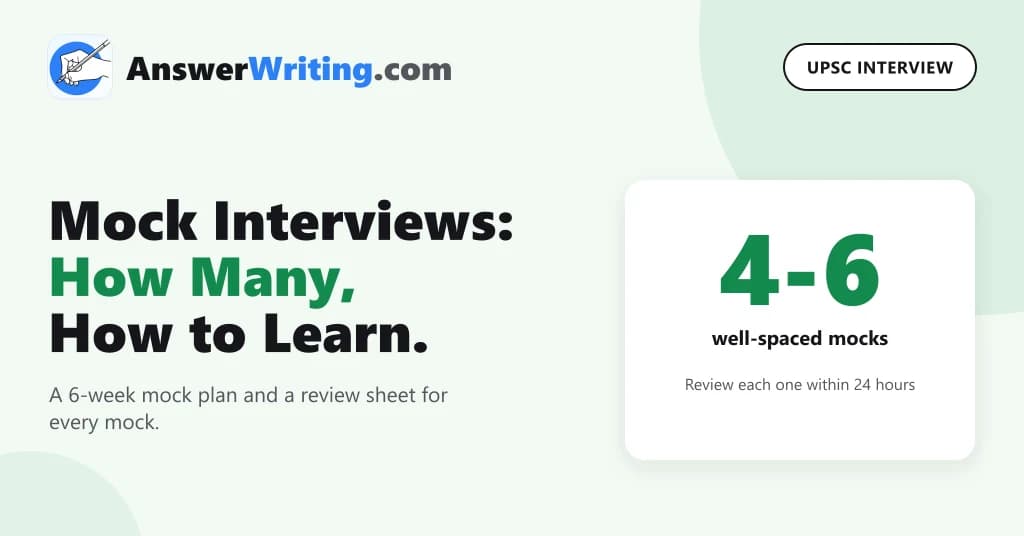
For most candidates, four to six good UPSC mock interviews are enough. Taking many more often hurts, because you start copying the views of different panels and lose your own voice. What matters is what you do after each mock: record it, review it honestly, and fix two or three things before the next one.
This post gives you a simple plan for mock interviews and a method to learn from each one.
Why Mock Interviews Help
The real interview is a conversation of about 20 to 30 minutes with a board you have never met. A mock interview lets you practise three things you cannot practise alone:
- Speaking clearly while someone watches you closely.
- Handling follow-up questions you did not expect.
- Staying calm when a panel member disagrees with you.
A mock is not a test of whether you will “pass”. It is a mirror that shows how you come across to others.
How Many Mocks to Take
There is no official number. A sensible plan for most candidates:
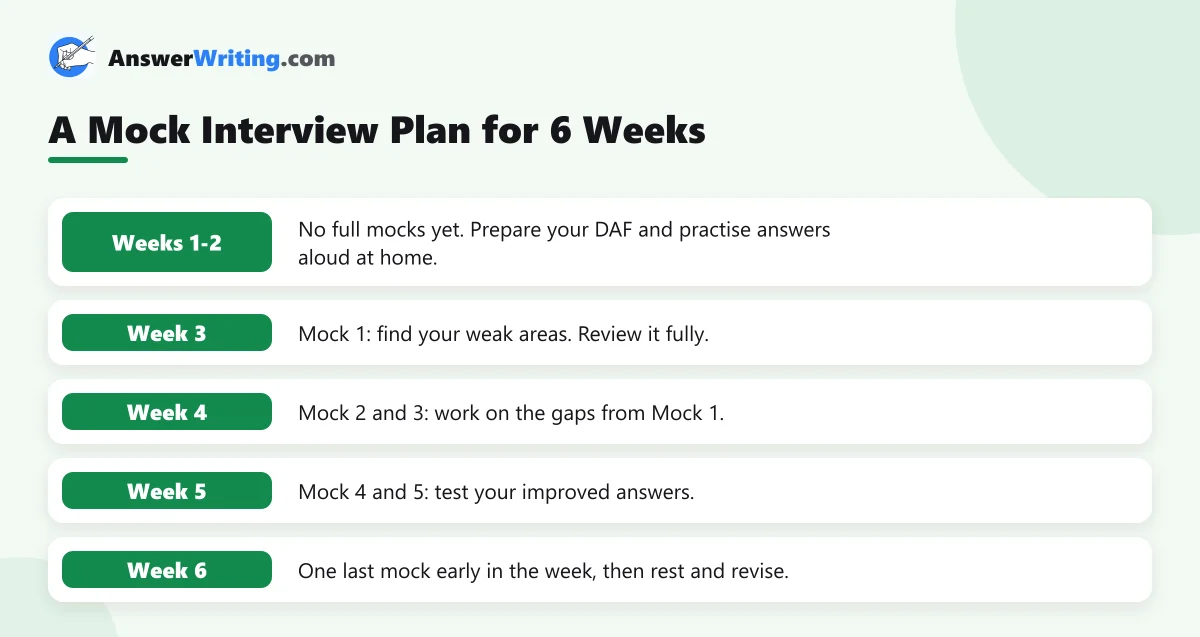
Leave at least two or three days between mocks. If you take one every day, you have no time to work on the feedback.
Signs you are taking too many mocks:
- You change your answer to a question after every mock.
- You feel more confused, not more confident.
- You are tired and spend more time travelling to mocks than preparing.
Who Should Take Your Mocks
The best mock panels have people who can be honest with you. You can use a mix of options:
- Friends who have faced the UPSC interview before, or retired officers in your family or town.
- A study group where three people act as the board and one is the candidate.
- Teachers from your college for questions on your graduation subject.
- AI-based practice for daily question-and-answer work between full mocks.
Whatever you choose, do not treat any single panel’s view as final. If one panel says your answer on a topic was weak and another says it was fine, look at the reasoning, not the verdict.
How to Review Each Mock
This is where most of the learning happens. Ask the panel for permission to record the mock, or have a friend record it on a phone. Then review it within 24 hours.
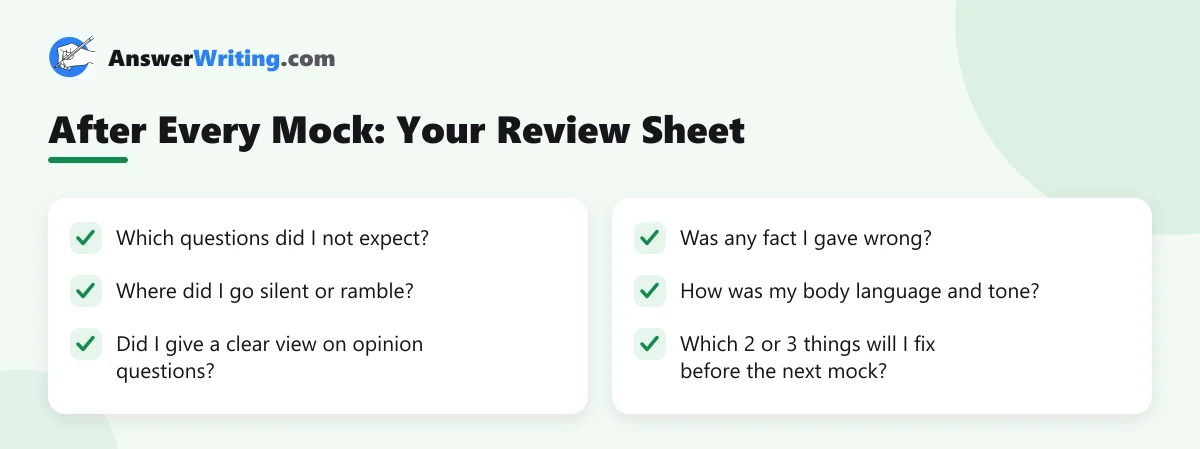
When you watch the recording, look at three things:
- Your content: were your facts right, and did you answer the actual question?
- Your structure: did you give the main point first, or start with a long background?
- Your manner: did you look at the panel, speak at a steady pace and stay polite when challenged?
Write the unexpected questions in a notebook. After four or five mocks, you will have a list of new questions from your own DAF, and you can prepare answers for each one. Our guide to DAF-based questions shows how to build this question bank.
Mistakes That Waste Mocks
- Memorising “model answers” from a mock panel and repeating them. The real board can tell.
- Taking feedback personally and arguing with the panel.
- Fixing everything at once. Pick two or three changes before the next mock.
- Skipping the review because the mock “went well”. Even good mocks have lessons.
Remember that a tough mock is a good mock. It is much better to struggle with a hard question in a practice room than in front of the real board.
Opinion questions come up in most mocks, so practise answering controversial questions with balance.
Key Takeaways
- Four to six well-spaced mock interviews are enough for most candidates.
- Leave two or three days between mocks to work on the feedback.
- Record each mock and review it within 24 hours with a fixed review sheet.
- Fix only two or three things before the next mock.
- Keep your own views. Do not copy answers from different panels.
Practise Between Mocks
Full mocks are few, but daily practice adds up. Between your mocks, use the AI mentor for UPSC interview practice on AnswerWriting: share your DAF details, answer its questions out loud and ask for feedback on your clarity and balance.
Related Reading
FAQs
How many mock interviews should I take for UPSC?
Four to six well-spaced mocks are enough for most candidates. Quality and review matter more than the number.
When should I start mock interviews?
After you have prepared your DAF and practised answers at home, usually two to three weeks after the Mains result.
Should I take a mock just before the interview?
Avoid a mock in the last two or three days. Use that time to revise your DAF and rest.
What if different panels give opposite feedback?
Look at the reasons behind the feedback and decide for yourself. Keep your own views if your reasoning is sound.
Can I practise mock interviews at home?
Yes. Ask friends or family to act as the board, record yourself, and use AI practice for daily question-and-answer work.