Controversial questions in the UPSC interview are not traps. The board asks them to see how you think when there is no single right answer. The best approach is simple: show that you understand both sides, base your view on the Constitution and facts, give a clear but moderate opinion, and suggest a practical way forward.
This post explains why boards ask such questions, gives you a 4-step method and shows it working on three examples.
Why the Board Asks Opinion Questions
UPSC’s rules list the qualities the interview judges. They include “balance of judgement”, “clear and logical exposition” and “intellectual and moral integrity”. A controversial question tests all three at once.
As an officer, you will serve people of every religion, caste, region and political view. The board wants to know whether you can stay fair when people around you hold strong opinions. It also wants to see that you are not afraid to give a view at all. A candidate who only says “both sides have a point” fails the test as much as one who takes an extreme position.
The 4-Step Method
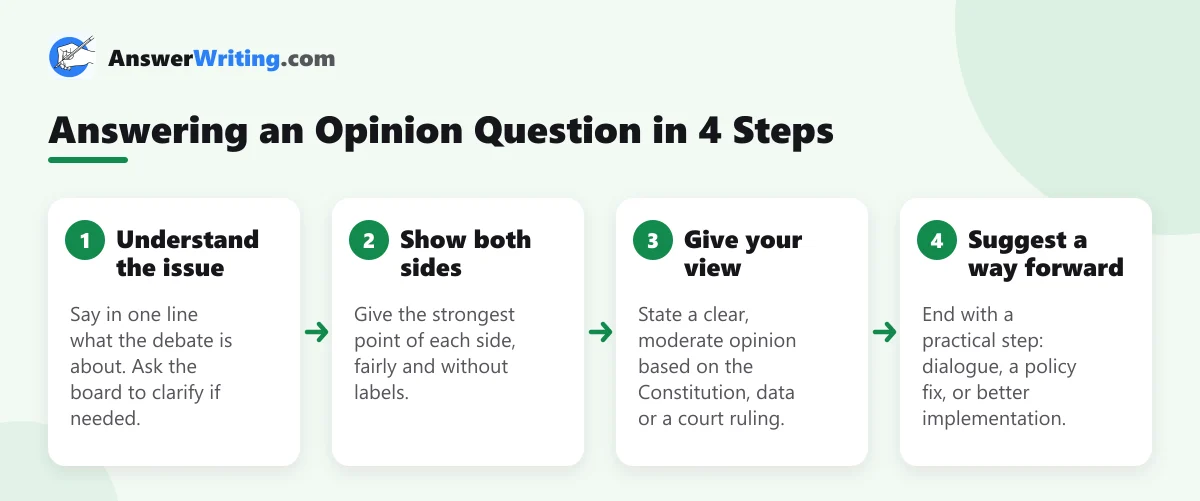
Keep the whole answer short, often under a minute. The board will ask a follow-up if it wants more.
What to base your view on
Your view should rest on something more solid than personal feeling:
- The Constitution: Fundamental Rights, Directive Principles and Fundamental Duties.
- Supreme Court and High Court judgements.
- Reports of official bodies, like Law Commission or Finance Commission reports.
- Reliable data from government sources.
This keeps your answer neutral. You are not saying “I like this side”; you are saying “our Constitution and the evidence point this way”.
Three Worked Examples
Example 1: “Should India have one nation, one election?”
A balanced answer would say: supporters argue that holding elections together saves money and reduces the time governments spend in election mode. Critics worry about the effect on federalism and on state-level issues getting less attention. Then give a view: “I feel the idea has merit for saving resources, but it needs wide agreement among states and careful changes to the Constitution, so a phased approach after broad consultation seems wiser.” End with the way forward.
Example 2: “Is reservation still needed?”
This is a sensitive question. Avoid personal stories about other people’s caste. A good answer explains the constitutional purpose of reservation, the progress made and the gaps that remain, and refers to official data where you know it. Your view might be that reservation remains a constitutional tool for equality, and that better schooling and data on who benefits can make it work better. Stay calm and avoid labels for any group.
Example 3: “What is your view on a recent protest in your state?”
Do not take sides between political parties. Talk about the issue the protesters raised, the right to protest peacefully under Article 19, the duty of the state to keep law and order, and the role of dialogue. As a future officer, your focus should be on solving the problem and keeping peace, not on who is right politically.
What Not to Do
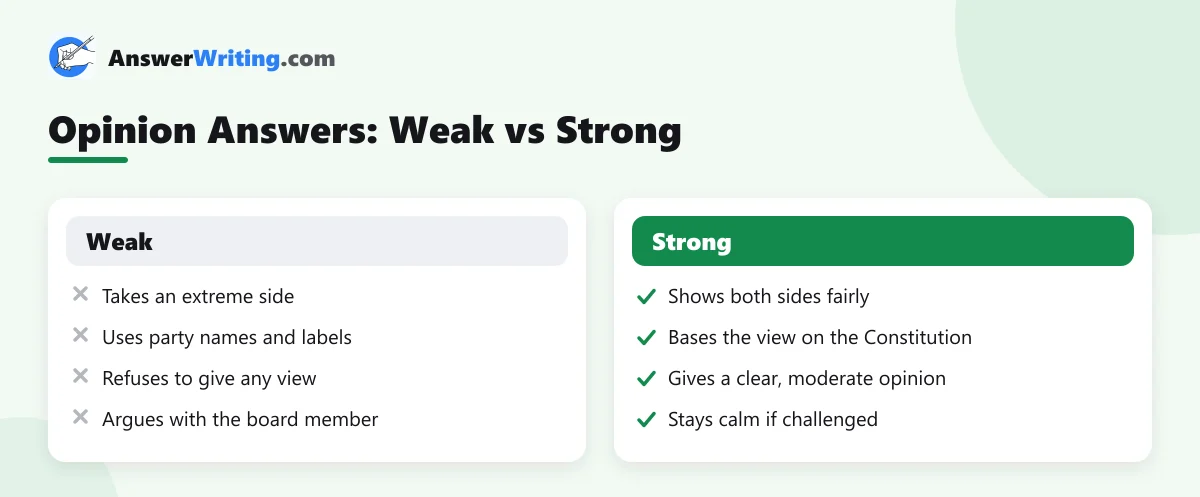
If a member disagrees with you, do not panic and do not change your view at once. Listen, accept a fair point if they make one, and explain your reasoning again politely. Sometimes members disagree on purpose to see whether you stay calm. If they give you a strong reason you had not thought of, it is fine to say, “That is a fair point, sir. I would think about it further.”
Two more mistakes are common. The first is giving a long lecture; keep to the point. The second is quoting numbers you are not sure about. A wrong statistic weakens a good answer.
How to Prepare
- List the ten to fifteen biggest debates of the last year from a good newspaper’s editorial pages.
- For each, write the main argument on each side and your own view in five or six lines.
- Link each issue to an Article of the Constitution, a court ruling or an official report.
- Practise saying the answers out loud and ask a friend to disagree with you.
Many of these debates also appear in GS Paper 2 and the Essay, so this work helps your Mains as well. Our post on how to justify your arguments with data and examples can help you build the evidence part.
Practise these answers in a few well-spaced mock interviews.
Key Takeaways
- Controversial questions test balance of judgement, clarity and integrity, which are qualities listed in UPSC’s rules.
- Use four steps: understand the issue, show both sides, give a clear moderate view, suggest a way forward.
- Base your view on the Constitution, court rulings, official reports and reliable data.
- Never take party sides, use labels or argue with the board.
- Prepare the year’s main debates in advance and practise saying your answers aloud.
Practise Your Balanced Answers
Saying a balanced answer out loud is harder than writing it. Ask the AnswerWriting AI mentor to play a board member who disagrees with you on a current debate. Practise staying calm and clear, then ask it which part of your answer sounded one-sided.
Related Reading
FAQs
Should I give my own opinion in the UPSC interview?
Yes. The board expects a clear view. Keep it moderate and base it on the Constitution and facts.
What if a board member disagrees with my view?
Stay calm, listen and explain your reasoning politely. If they make a strong point, it is fine to accept it and say you would think about it further.
Can I say “I don’t want to comment” on a political question?
You can avoid party politics, but do discuss the issue itself. Refusing to engage at all looks like you cannot handle hard questions.
How long should my answer be?
Usually under a minute. Give the main points and let the board ask follow-ups.
Do these questions affect my marks?
The whole conversation decides your marks, and opinion questions are a big part of how the board judges your balance and clarity.