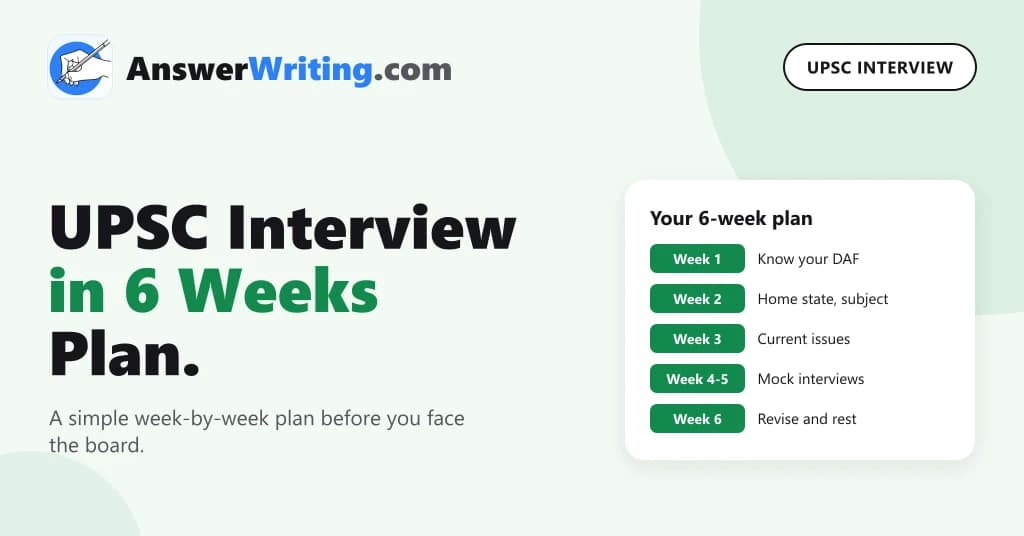
Six weeks is enough to prepare well for the UPSC interview if you follow a clear order: first your DAF, then your home state and graduation subject, then current issues, then mock interviews, and a calm final week. You do not need new books. You need to know yourself, form balanced views and practise speaking.
Here is a simple week-by-week plan. If your interview is sooner, squeeze two weeks into one but keep the same order.
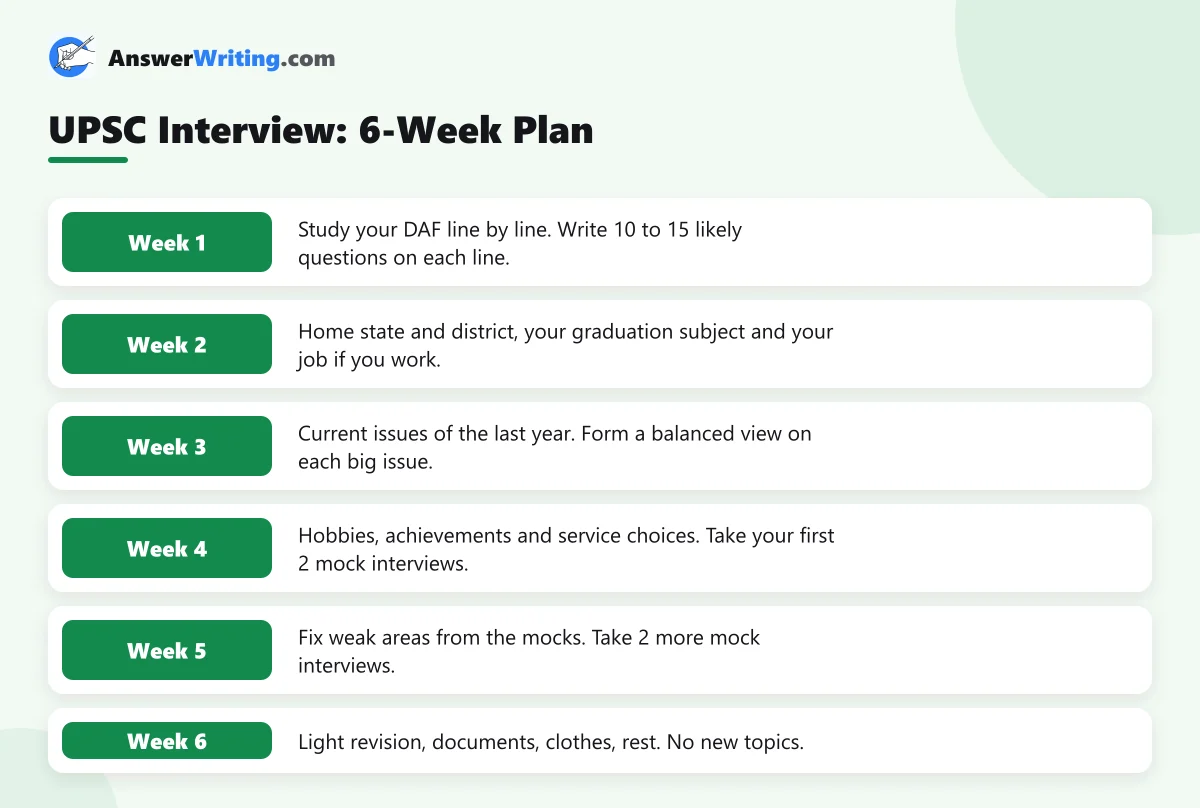
Week 1: Know Your DAF Completely
Your DAF (Detailed Application Form) is the board’s main paper about you, so most questions come from it. Print your DAF and go through it line by line.
For each line, write 10 to 15 questions the board could ask. Your name may have a meaning. Your district may be known for something. Your college subject links to many public issues. Your hobby can lead to deep questions. Then write short answer points for each question and say them out loud.
Also prepare clear answers to the three questions almost everyone faces in some form: “Tell us about yourself”, “Why civil services?” and “Why this service as your first choice?”. Keep each answer under one minute and make it honest.
Week 2: Home State, Graduation Subject and Job
Learn the basics of your home state and district: geography, history, economy, main problems, famous people and places, and recent government schemes there. Boards often ask what you would do to solve a problem in your own district.
Revise the basics of your graduation subject. If you studied engineering, medicine or commerce, expect questions on how your subject connects with public policy, for example how civil engineering links to road safety or how medicine links to public health. If you have work experience, know your company, your role and the industry well.
Week 3: Current Issues and Balanced Opinions
Make a list of 25 to 30 big issues of the last year: from the economy, foreign relations, social issues, security, environment and technology. For each issue, write four short points: what happened, why it matters, the arguments on both sides, and a practical way forward.
The board does not want extreme opinions. A good answer shows you understand different sides and can suggest a sensible middle path. Our post on the role of current affairs in UPSC explains how to read news with this in mind.
Week 4: Hobbies, Achievements and Service Choices
Hobbies are where many candidates struggle, because they list a hobby they have not followed for years. Go back to each hobby in your DAF and refresh it: if you wrote cricket, know recent tournaments, rules and players; if you wrote reading, revise three or four books you have read recently.
Be ready to explain your service and cadre preferences. Know what an IAS, IPS, IFS or IRS officer actually does, and why your order of preference makes sense for you. See IAS vs IPS vs IFS and the list of services through UPSC CSE.
Take your first two mock interviews this week.
Week 5: Mock Interviews and Fixing Weak Areas
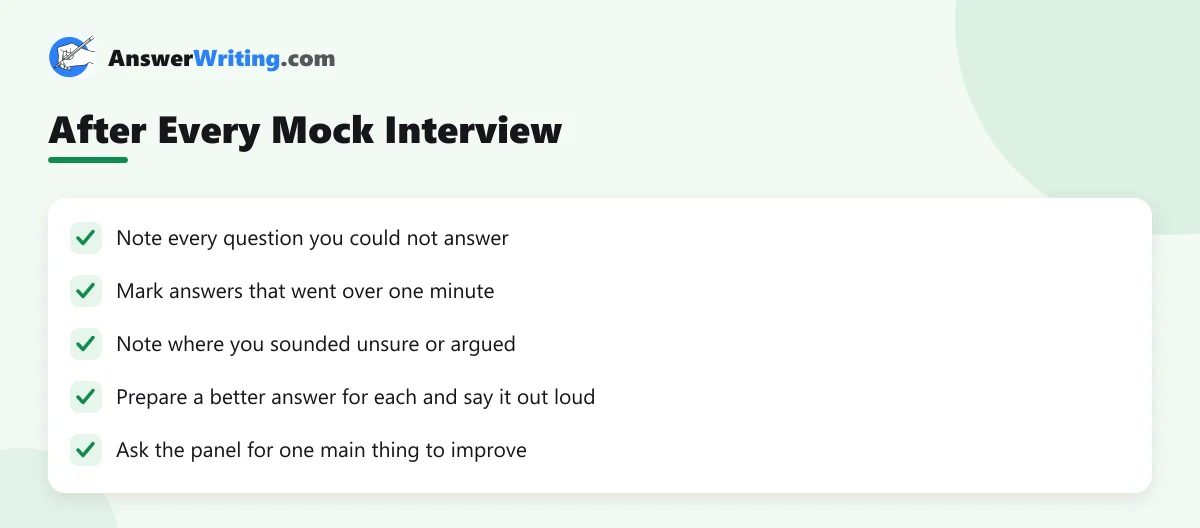
After each mock, write down three things: questions you could not answer, answers that were too long, and moments you sounded nervous or unsure. Work on these before the next mock.
Three to five good mocks are enough for most candidates. If you take too many, your answers start to sound memorised, and boards notice this. Between mocks, practise speaking with a friend or family member, or with an AI tool that asks questions one at a time.
Week 6: Final Week
Do not start any new topic. Revise your DAF notes, your list of current issues and your home state notes once more. Keep your documents ready as listed in your e-summon letter, and try on the clothes you will wear. Sleep well every night, because a fresh mind answers better than a tired one.
On the day before, read the newspaper once, revise your short notes, and rest.
A Simple Daily Routine for These 6 Weeks
- Read one newspaper and note 2 or 3 issues (1 hour).
- Work on the topic of the week from the plan (3 to 4 hours).
- Answer 10 likely questions out loud, timing each answer (30 minutes).
- Revise your DAF questions (30 minutes).
- Light exercise or a walk to stay fresh (30 minutes).
For week 1, use our method to turn your DAF into a question bank, and for week 4, see sample UPSC interview questions on hobbies.
Key Takeaways
- Follow an order: DAF first, then home state and graduation, then current issues, then mocks.
- Write 10 to 15 likely questions for every line of your DAF.
- Form balanced views on 25 to 30 big issues of the year.
- Three to five good mock interviews are enough. Learn from each one.
- Keep the last week calm: revision, documents and rest.
Practise Every Day With the AI Mentor
Mock interviews happen a few times; practice can happen every day. The AnswerWriting AI mentor can ask you questions based on your DAF details, one at a time, and give feedback on how clear and balanced your answers are. Use it between mocks to build confidence.
FAQs
Is six weeks enough to prepare for the UPSC interview?
Yes, for most candidates. The interview tests your personality and views more than new knowledge, so six focused weeks on your DAF, current issues and speaking practice are enough.
How many mock interviews should I take?
Three to five good ones are usually enough. More than that can make your answers sound rehearsed.
Should I read new books for the interview?
No. Read the newspaper daily and revise topics linked to your DAF. New books take time and add little.
What should I do if I cannot answer a question in the interview?
Say politely that you do not know. Boards respect honesty. Guessing or making up facts leaves a worse impression.
How should I prepare my hobbies for the interview?
Refresh every hobby in your DAF. Know recent events, basic facts and why you enjoy it. Expect deeper questions than you think.