Most questions in the UPSC interview come from your DAF (Detailed Application Form). The simplest way to prepare is to take every line of your DAF and ask five kinds of questions about it: a fact question, a “why” question, a link to public issues, an opinion question and a situation question. Do this for every line and you will have a question bank of 300 or more questions, most of which the board can actually ask.
This post shows the method with examples, so you can build your own question bank in a few days.
What Is in Your DAF?
You fill DAF-I after clearing Prelims and DAF-II after clearing Mains. Together, they tell the board who you are:
| DAF section | What it covers |
|---|---|
| Personal details | Name, date and place of birth, home state and district |
| Family | Parents’ occupation and background |
| Education | School, college, subjects, marks and year |
| Work | Jobs, company, role and years |
| Hobbies and activities | Hobbies, sports, NCC, NSS, clubs |
| Achievements | Prizes, ranks, publications, certificates |
| Exam choices | Optional subject, language of the interview |
| Preferences | Order of services and cadres you want |
For CSE 2026, the DAF-II window was reported as 11 to 25 November 2026. If you have just cleared Mains, read our Mains Result 2026 post and fill DAF-II carefully, because every line becomes a possible question.
The Five-Question Method
For every line of your DAF, write one question of each of these five types:
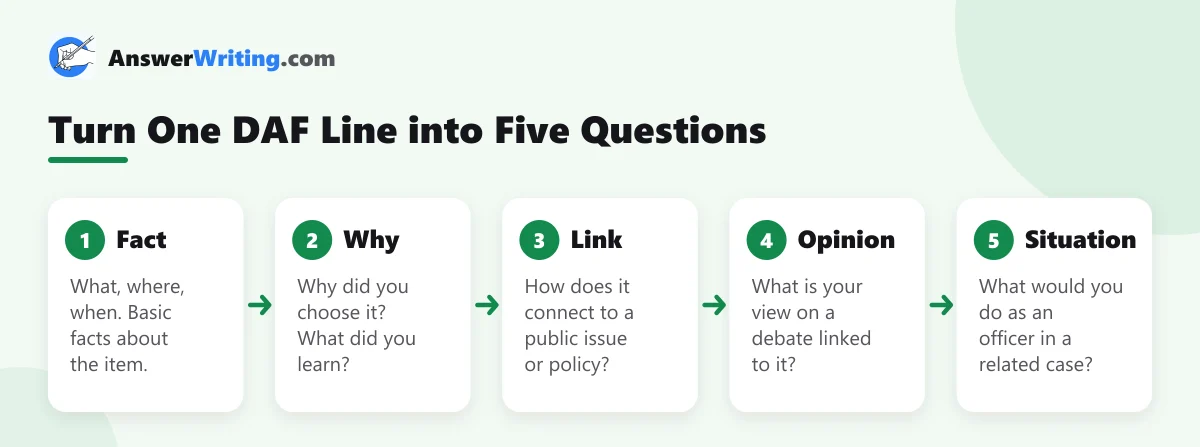
The fact questions check if you really know your own background. The “why” questions check honesty. The link questions check whether you can connect your life to governance. The opinion and situation questions check judgement, which is what the board cares about most.
Worked Examples
Example 1: Home district
Suppose your DAF says your home district is Bahraich, Uttar Pradesh.
- Fact: Which river flows through Bahraich? Which national park or sanctuary is in the district?
- Why: Many officers never work in their home state. Why do you still feel connected to it?
- Link: Bahraich shares a border with Nepal. What issues does an open border create?
- Opinion: Should border districts get special development funds?
- Situation: If you were the District Magistrate and floods hit the district, what would you do first?
Example 2: Graduation subject
Suppose your DAF says BTech in Civil Engineering.
- Fact: What is the difference between a flexible and a rigid road pavement?
- Why: Why did you leave engineering for the civil services?
- Link: How can civil engineering help reduce road accidents in India?
- Opinion: Are big infrastructure projects worth their impact on the environment?
- Situation: A bridge in your district shows cracks one year after it was built. What will you do?
Example 3: Hobby
Suppose your DAF says gardening.
- Fact: What is the difference between organic and chemical fertilisers?
- Why: When did you start gardening and what do you enjoy about it?
- Link: How can kitchen gardens help with nutrition in villages?
- Opinion: Should cities make rooftop gardens compulsory for new buildings?
- Situation: As a District Magistrate, how would you increase green cover in your town?
How to Build Your Question Bank
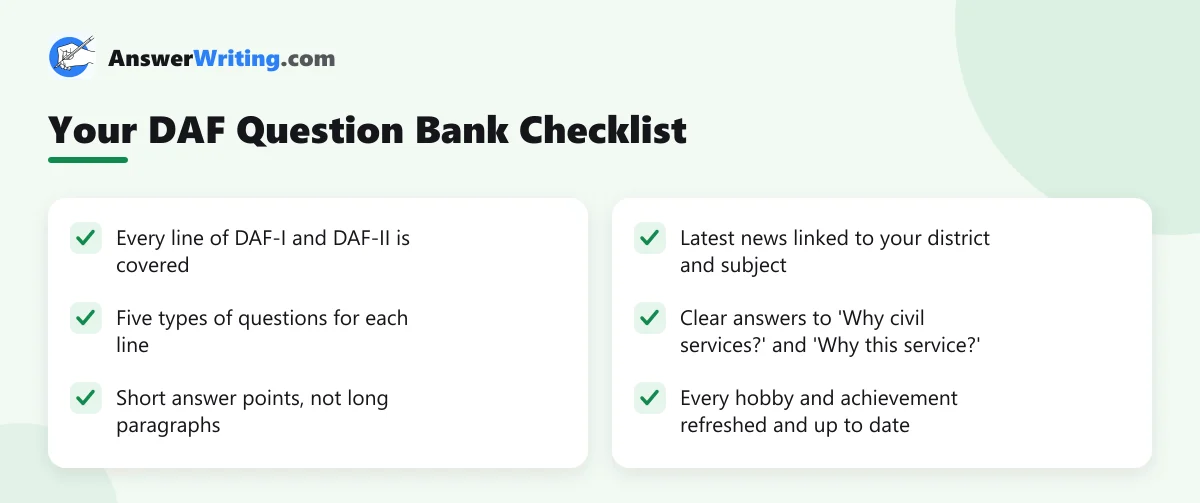
- Print your DAF and number every line.
- For each line, write the five types of questions in a notebook or a spreadsheet.
- Add questions from news linked to that line. For example, if your district was in the news this year, add a question about it.
- Write three or four short answer points for each question, not full answers.
- Practise answering out loud, keeping each answer under one minute.
- Mark questions you find hard and revise them more.
Mistakes to Avoid in Your DAF
- Listing a hobby you have not followed for years. The board may ask deep questions on it.
- Adding an achievement you cannot talk about in detail.
- Filling service preferences without knowing what each service does. Read IAS vs IPS vs IFS and the list of services through UPSC CSE first.
- Never write anything that is not true. The board can check, and honesty is one of the qualities they mark.
Your hobbies need special care, so read our sample hobby questions for the UPSC interview, and plan the rest of your weeks with this 6-week interview plan.
Key Takeaways
- Most UPSC interview questions come from your DAF, so it is the best place to start.
- For every DAF line, write five questions: fact, why, link, opinion and situation.
- Keep answer points short and practise saying them out loud.
- Add recent news linked to your district, subject and job.
- Never write anything in the DAF that you cannot explain in detail.
Practise Your DAF Questions With the AI Mentor
Once your question bank is ready, practise answering. Share your DAF details with the AnswerWriting AI mentor, and it will ask you questions one at a time, like a board, and give feedback on each answer. Practise a little every day until your interview.
FAQs
What is DAF in UPSC?
DAF is the Detailed Application Form. You fill DAF-I after Prelims and DAF-II after Mains. It contains your personal, education, work, hobby and preference details, and the interview board reads it before your interview.
How many questions come from the DAF?
Most of them. The exact share differs from board to board, but your DAF is the main source of questions about you.
Can I change my DAF after submitting it?
Follow UPSC’s instructions for your exam year, as the rules on changes are set in the notification and the DAF portal. Always fill it carefully the first time.
Should I write many hobbies in my DAF?
No. Write only the hobbies you actually follow and can talk about in depth. One or two real hobbies are better than five weak ones.
How long does it take to build a DAF question bank?
About a week if you work on it daily. It is the best use of the first week of your interview preparation.