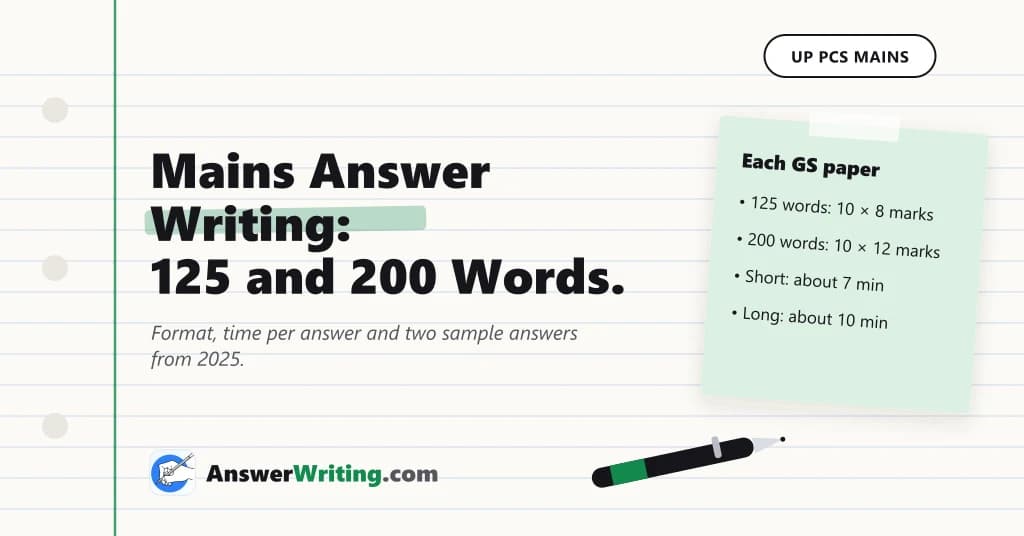
UP PCS Mains answer writing follows one fixed pattern in all six GS papers: 20 compulsory questions in 3 hours, with 10 short answers of 125 words (8 marks) and 10 long answers of 200 words (12 marks). To score well you need three things: a simple format you use every time, a speed of about 7 minutes for a short answer and 10 to 11 minutes for a long one, and a fact or example in every point.
This post explains the format, shows two full sample answers to real 2025 questions, and gives a checklist you can use on your own answers. The word limits come from the instructions printed on the official 2025 GS papers, available on the UPPSC previous year papers page.
The Rules Printed on the Paper
| Rule (from the 2025 GS papers) | What it means for you |
|---|---|
| 20 questions, all compulsory | No choice. Prepare the whole syllabus. |
| Section A: 10 questions, 125 words | 8 marks each, 80 marks in all |
| Section B: 10 questions, 200 words | 12 marks each, 120 marks in all |
| Questions in Hindi and English | You can answer in either language |
| Keep to the word limit | Long answers do not earn extra marks |
| Strike off blank pages or parts of pages | Draw a line across any space you leave empty |
Some websites still give 150 and 250 words, which are UPSC limits. For UP PCS, follow 125 and 200.
Time per Answer
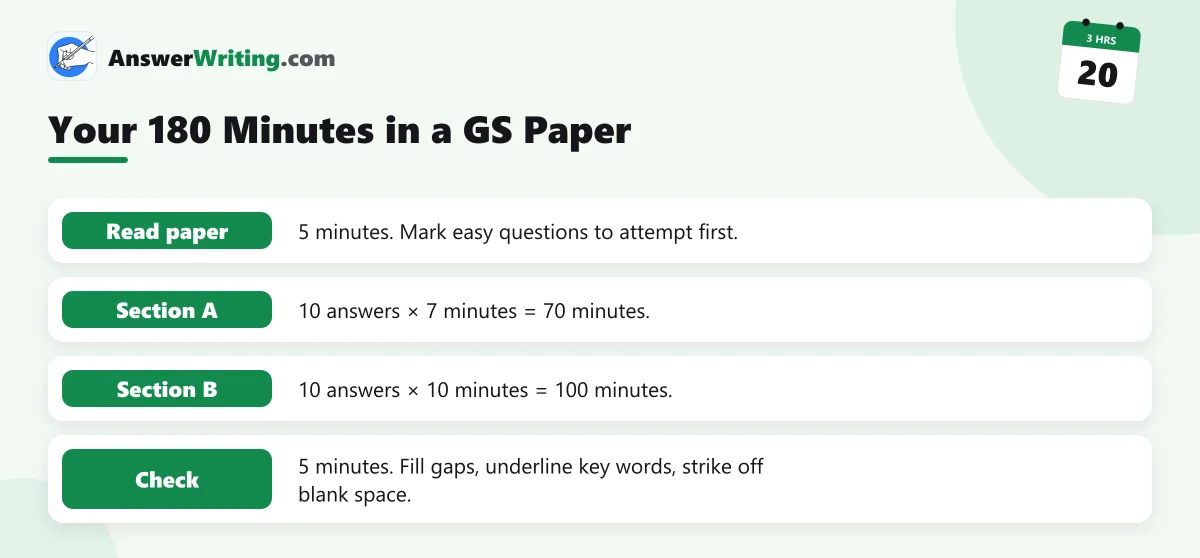
A Simple 3-Part Format
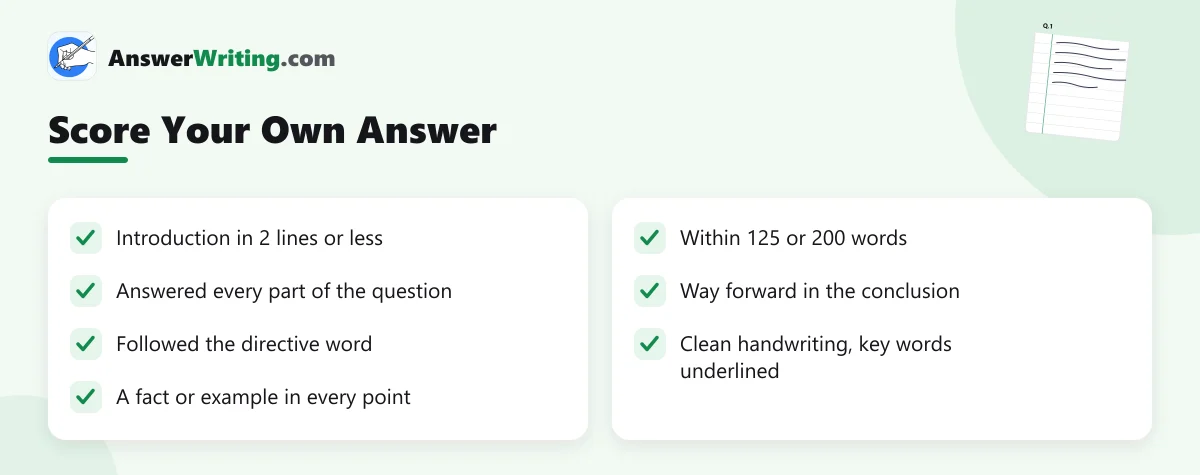
1. Introduction (1 to 2 lines, about 15 to 25 words) Start with a definition, a fact, a date or the latest news on the topic. Do not repeat the question.
2. Body (about 80% of the words)
- Use 3 to 4 points for a 125-word answer and 5 to 6 points for a 200-word answer.
- Use short headings when the question has two parts, for example “Benefits” and “Challenges”.
- Put one fact, scheme, Article, report, place or example in every point.
- Answer the directive word. “Discuss” needs both sides. “Critically examine” needs your judgment at the end. Our post on directive words in Mains explains each one.
3. Conclusion (1 to 2 lines) Give a way forward or a balanced view. In GS 5 and GS 6, make it about Uttar Pradesh.
Sample Answer 1: 8 Marks, 125 Words
Question (GS 3, 2025): How are digital payment systems promoting financial inclusion in India?
Answer: Financial inclusion means giving every person access to affordable banking, credit, insurance and payments. Digital payments have pushed this forward in four ways.
- Low cost and easy access: UPI, launched by NPCI in 2016, lets anyone with a phone and bank account pay or receive money instantly, even small amounts.
- Use of Jan Dhan accounts: accounts opened under the Pradhan Mantri Jan Dhan Yojana (2014) became active when linked to UPI and RuPay cards.
- Direct transfers: subsidies and pensions reach accounts through Direct Benefit Transfer, which builds the habit of banking.
- A record for credit: a history of digital payments helps small traders get loans.
Way forward: digital literacy for the elderly and rural women, better rural internet and protection from cyber fraud can make inclusion complete.
Count: about 125 words, four points, three named schemes and two years.
Sample Answer 2: 12 Marks, 200 Words
Question (GS 2, 2025): How does the Direct Benefit Transfer (DBT) system align with the objectives of Digital India and good governance? Analyse.
Answer: Direct Benefit Transfer (DBT), started on 1 January 2013, sends subsidies and benefits straight into beneficiaries’ bank accounts. It is built on the JAM trinity: Jan Dhan accounts, Aadhaar and mobile phones.
Alignment with Digital India
- Digital delivery: benefits move through online systems instead of cash and paper.
- Digital identity: Aadhaar-based checks remove fake and duplicate beneficiaries.
- Digital payments: it brings rural families into the banking system.
Alignment with good governance
- Transparency: the money trail can be tracked from the ministry to the citizen.
- Accountability: fewer middlemen means fewer chances of leakage.
- Efficiency: schemes like PM-KISAN pay crores of farmers at once.
- Citizen-centric service: people do not need to visit offices for each payment.
Challenges: failed Aadhaar authentication, poor connectivity in remote areas, inactive accounts and low digital literacy can exclude the very people a scheme is for.
Conclusion: DBT shows how technology can make governance faster and cleaner. Offline grievance desks and doorstep banking through banking correspondents can make sure no eligible person is left out.
Count: about 200 words. Notice the two headings that match the two parts of the question, and the challenges section that “analyse” asks for.
When to Add a Diagram or Map
- Geography and environment: a rough map of India or UP with the places in the answer marked.
- Processes: a small flowchart, for example how DBT money moves.
- Comparisons: a two-column table, for example the Legislative Assembly versus the Legislative Council.
Keep diagrams small: one diagram should take less than a minute. Practise drawing the outline of UP and India until you can do it in 20 seconds.
Writing in Hindi
Most UP PCS candidates write in Hindi, and that is fine. Use simple, correct Hindi, not difficult Sanskrit words you might misspell. Keep standard English terms like GDP, DBT or UPI as they are if you are not sure of the Hindi term. The same format and word limits apply.
How to Practise
- Weeks 1 and 2: one answer a day without a time limit. Focus on the format.
- Weeks 3 and 4: two answers a day with a timer.
- Weeks 5 and 6: five answers in one sitting, then half a paper (10 answers in 90 minutes).
- After that: one full paper a week in 3 hours.
Use the 2025 papers first, because they show exactly what UPPSC asks now. To plan all eight papers together, read our UP PCS Mains strategy after Prelims.
To apply this format to the two UP papers, read our GS 5 and GS 6 strategy.
Key Takeaways
- Every GS paper has 10 answers of 125 words (8 marks) and 10 of 200 words (12 marks) in 3 hours.
- Spend about 7 minutes on a short answer and 10 minutes on a long one.
- Use the same 3-part format: short introduction, pointwise body with facts, way forward.
- Match your headings to the parts of the question and follow the directive word.
- Practise against a timer and score each answer with a checklist.
Get Feedback on Your Answers
Writing without feedback can repeat the same mistakes for months. On AnswerWriting’s UP PCS page you can upload or type an answer in Hindi or English and get an AI evaluation with a score, a model answer and points to improve. Your first three evaluations are free.
Related Reading
FAQs
What is the word limit in UP PCS Mains?
125 words for Section A questions (8 marks) and 200 words for Section B questions (12 marks) in each GS paper.
How much time should I give one answer?
About 7 minutes for a 125-word answer and about 10 minutes for a 200-word answer.
Do I lose marks for writing more than the word limit?
The paper asks you to keep the word limit in mind. Writing much more wastes time you need for other answers, so stay close to the limit.
Should I use headings in a 125-word answer?
Short numbered points are enough. Use headings when the question has two clear parts.
Can I write Mains answers in Hindi?
Yes. Questions are printed in Hindi and English, and you can answer in either.