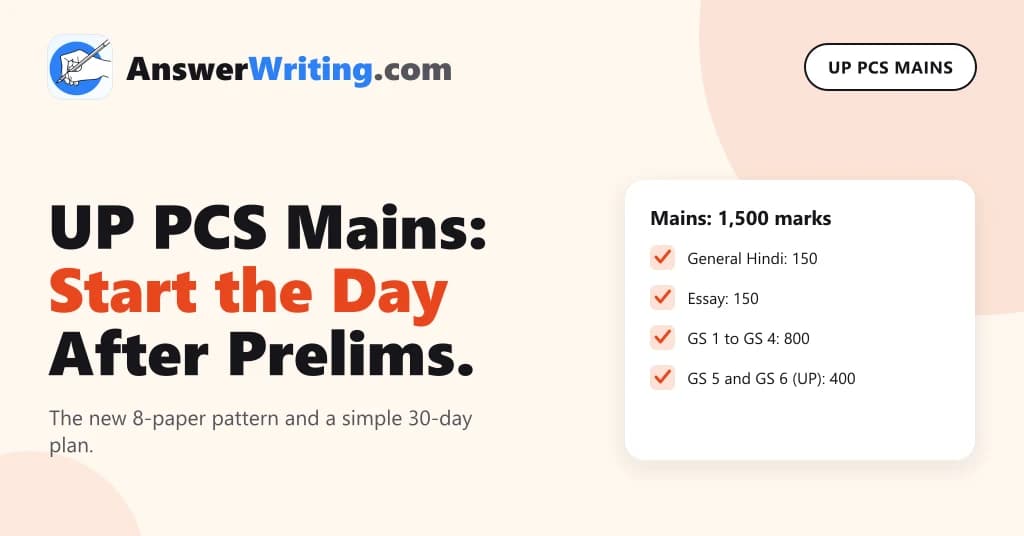
Start your UP PCS Mains preparation the day after Prelims, without waiting for the result. The Mains has eight written papers worth 1,500 marks, with no optional subject, and two of the six GS papers are only about Uttar Pradesh. Most aspirants lose the first one or two months waiting for the Prelims result, and that is time you cannot get back.
This post explains the current Mains pattern in simple words and gives you a plan for the first 30 days after Prelims.
Why Start Before the Prelims Result?
The Prelims result takes some time, and good Mains answers need months of writing practice. If you start only after the result, you lose that time and have to rush the most important part of your preparation.
If you do not clear Prelims, nothing is wasted. Mains writing practice makes your understanding of every subject deeper, which helps in the next Prelims too. And if you also prepare for UPSC or another state exam, the same answer writing skills carry over.
The UP PCS Mains Pattern
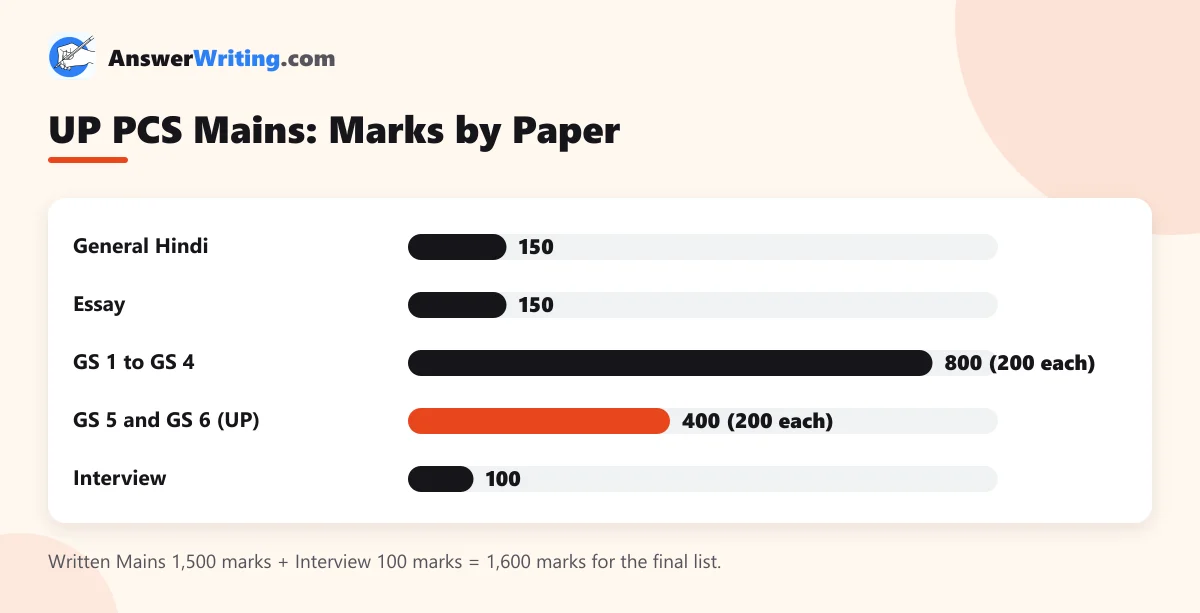
UPPSC changed the Mains pattern a few years ago (reported as from the 2023 exam). The optional subject was removed and two new GS papers on Uttar Pradesh were added. The current Mains has eight papers:
| Paper | Subject | Marks |
|---|---|---|
| Paper 1 | General Hindi | 150 |
| Paper 2 | Essay | 150 |
| Paper 3 | General Studies 1 | 200 |
| Paper 4 | General Studies 2 | 200 |
| Paper 5 | General Studies 3 | 200 |
| Paper 6 | General Studies 4 | 200 |
| Paper 7 | General Studies 5 (Uttar Pradesh) | 200 |
| Paper 8 | General Studies 6 (Uttar Pradesh) | 200 |
| Total | Written Mains | 1,500 |
After the Mains comes a 100-mark interview, so the final merit list is made out of 1,600 marks.
For the full syllabus of every paper, see our UP PCS complete guide and the UP PCS exam pattern.
What Each Part Needs From You
GS 1 to GS 4
These four papers are close to the UPSC GS papers: history, geography and society; polity and governance; economy, environment, science and security; and ethics. If you have prepared for UPSC Mains, most of your notes will work here. The main difference is that UP PCS also asks for Uttar Pradesh examples, so add one UP example to each topic in your notes.
GS 5 and GS 6: Uttar Pradesh
These two papers are worth 400 marks together, more than Hindi and Essay combined, and most aspirants have the least material for them. They cover Uttar Pradesh’s history and culture, its government and administration, its economy, agriculture and industry, its geography and environment, and state schemes and policies.
Start a separate notebook for each paper from day one. Use the UP state budget, the UP economic survey and state government websites as your main sources, along with a standard UP general knowledge book.
General Hindi
General Hindi is a scoring paper if you practise. It usually has letter and note writing, grammar, word meanings and a passage. Many English-medium aspirants lose easy marks here because they never practise. Write one short Hindi exercise every day.
Essay
The essay paper asks you to write essays from different sections, so you need both knowledge and a clear structure. Practise one essay a week from the start, and use Uttar Pradesh examples wherever they fit. Our guide on how to write a high-scoring essay works for UP PCS too.
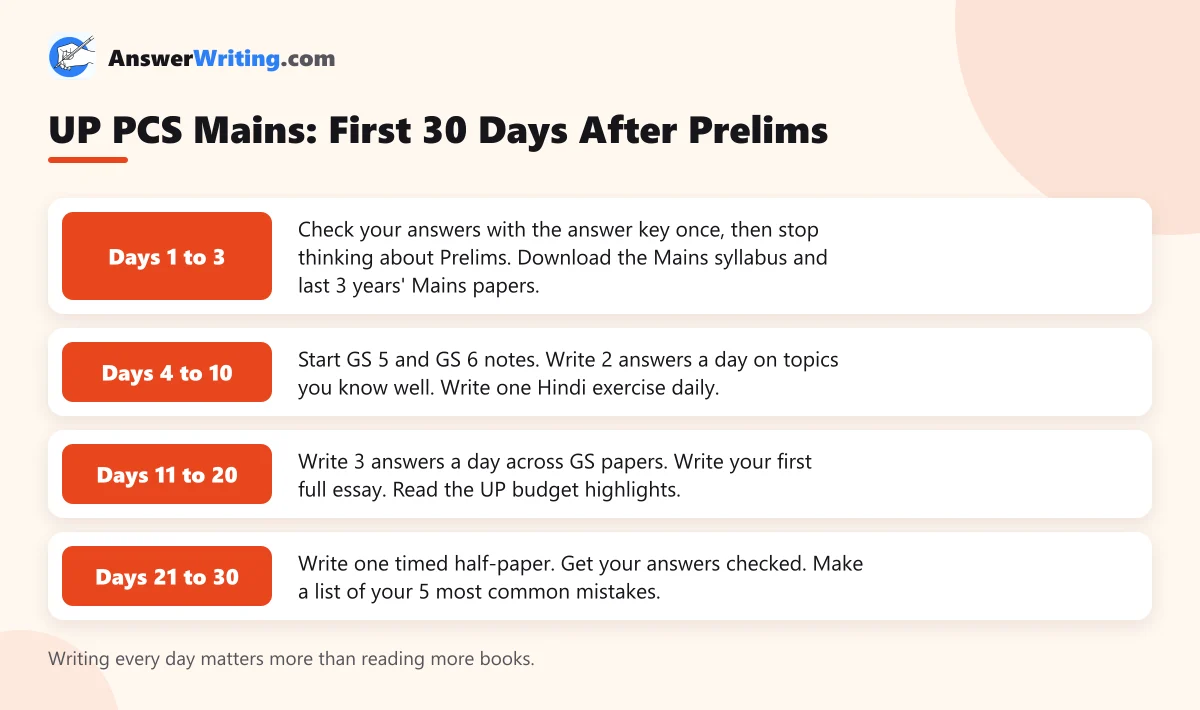
Your First 30 Days After Prelims
How to start writing answers
If you have never written a Mains answer, start small. Pick a topic you know well, read the question twice, and write 150 words in 8 to 10 minutes. Use a short introduction, three or four points in the body, and a one-line conclusion. Then compare your answer with a good model answer and note what you missed.
Our guides on how to start answer writing and structuring your Mains answer explain this step by step.
Common Mistakes After Prelims
- Waiting for the result before starting. This is the most common and most costly mistake.
- Reading for months without writing is a common trap. Mains is a writing exam, and writing speed only comes from practice.
- Leaving GS 5 and GS 6 for the end because there is less material. These two papers carry 400 marks.
- Ignoring General Hindi because it looks easy. Without practice, spelling and grammar mistakes cut marks.
- Writing answers but never getting them checked. Feedback shows you mistakes you would not notice yourself.
If Prelims is still ahead of you, follow this last 3 weeks plan for UP PCS Prelims.
Key Takeaways
- Start UP PCS Mains preparation the day after Prelims, not after the result.
- The Mains has 8 papers and 1,500 marks: General Hindi, Essay and GS 1 to GS 6. There is no optional subject.
- GS 5 and GS 6 are only about Uttar Pradesh and carry 400 marks together.
- Write answers every day from the first week, and get them checked.
- The interview carries 100 marks, so the final list is made out of 1,600.
Get Your Answers Checked Every Day
The biggest problem in Mains preparation is getting quick, honest feedback. On AnswerWriting, you can upload a handwritten answer and get AI evaluation of your Mains answers with a model answer within minutes, in Hindi, English and 22 other Indian languages. UP PCS is one of the exams covered, and your first three evaluations are free.
FAQs
Is there an optional subject in UP PCS Mains?
No. UPPSC removed the optional subject from the Mains a few years ago. It was replaced by two General Studies papers on Uttar Pradesh (GS 5 and GS 6).
How many papers are there in UP PCS Mains?
Eight: General Hindi (150 marks), Essay (150 marks) and six General Studies papers of 200 marks each. The total is 1,500 marks.
Is the UP PCS interview included in the final merit?
Yes. The interview carries 100 marks, so the final merit list is made out of 1,600 marks (1,500 Mains + 100 interview).
Can I write UP PCS Mains in English?
Yes, you can choose Hindi or English for the GS papers and essay. The General Hindi paper must be written in Hindi. Check the medium rules in the official notification.
When is UP PCS Mains 2027?
UPPSC has not announced the Mains date for this cycle yet. Check the exam calendar on uppsc.up.nic.in, and start preparing now rather than waiting for the date.