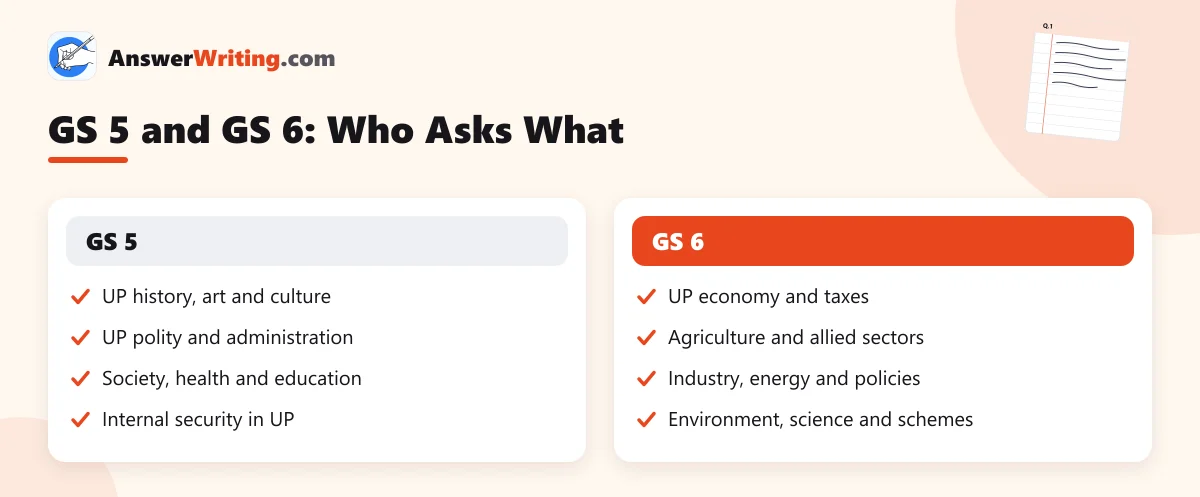
UP PCS GS 5 and GS 6 are the two Mains papers about Uttar Pradesh. Each has 20 questions for 200 marks in 3 hours. GS 5 asks about UP’s history, culture, polity, society and security. GS 6 asks about UP’s economy, agriculture, industry, environment, science and state schemes. Together they carry 400 of the 1,500 Mains marks, so they decide a large part of your rank.
Many websites still describe GS 6 as an ethics paper or an Indian economy paper. That is out of date. The official 2025 papers, which you can download from the UPPSC previous year papers page, show that almost every question in both papers is about Uttar Pradesh.
The Pattern of Both Papers
| Feature | GS 5 and GS 6 (same pattern) |
|---|---|
| Questions | 20, all compulsory |
| Section A | 10 questions, 125 words each, 8 marks each (80 marks) |
| Section B | 10 questions, 200 words each, 12 marks each (120 marks) |
| Total | 200 marks per paper |
| Time | 3 hours |
| Language | Questions printed in Hindi and English; answer in either |
So you have about 9 minutes per question. Aim for about 7 minutes on a 125-word answer and about 10 to 11 minutes on a 200-word answer, and keep a few minutes at the end to check.
What GS 5 Asked in 2025
Here are some of the 2025 GS 5 questions, put into groups. They show the kind of topics you should prepare.
History and culture
- The cultural significance of Ayodhya in ancient literature.
- Agra’s Indo-Islamic architecture as a blend of Indian, Persian and Islamic styles.
- Jain archaeological sites of the Braj region around Mathura.
- The Magh Mela and Kumbh Mela, and the folk songs Birha and Kajari.
- The role of Meerut, Lucknow, Kanpur and Jhansi in the Revolt of 1857.
- The contribution of the Arya Samaj to education in UP.
Polity and administration
- The jurisdiction of the Allahabad High Court.
- The composition, powers and functions of the UP Legislative Assembly.
- Centre-State relations and their relevance for UP.
- The Citizen Charter, with special reference to UP.
Society, security and science
- Health problems in rural UP, using the latest rural health data.
- Threats from social media to internal security in UP.
- Organised crime and terrorism.
- The UP Science and Technology Policy 2025 and the new UP AYUSH Policy 2025.
The last two questions are a warning: GS 5 asks about state policies released in the same year as the exam. You need UP current affairs, not only static history.
What GS 6 Asked in 2025
Economy and investment
- Recent tax reforms of the UP Government.
- The idea of Invest UP and its role in the state’s growth.
- UP’s change from a “BIMARU” state to a manufacturing and IT state.
- The Defence Industrial Corridor and regional development.
Agriculture
- Soil health and rising input costs.
- UP schemes to promote silk production.
- Crop insurance and its effect on farm risk.
- Growth through agriculture, horticulture, fisheries and allied activities together.
Environment, energy and science
- Biomass energy in UP and the Green Hydrogen Policy 2024.
- Rules for processing and disposing of municipal waste.
- Wildlife-human conflict in UP.
- The red, orange, green and white categories of industries under the Taj Trapezium Zone authority.
- Research support like DST, FIST and SATHI.
Schemes for people
- Drone Didi Yojana and rural women.
- Women and child welfare schemes of the last ten years.
Almost every GS 6 question names a UP policy, scheme or region. If you only read national economy books, you will not be able to answer it.
How to Write a GS 5 or GS 6 Answer
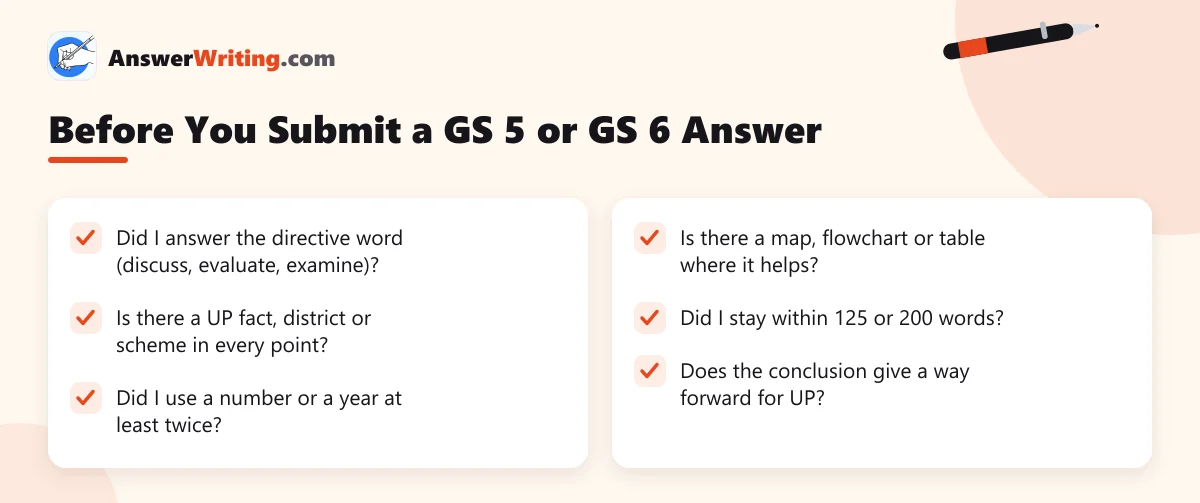
A good UP answer has the same three parts as any Mains answer, plus one extra: a UP fact in every part.
- Introduction (1 to 2 lines): define the term or give one UP fact.
- Body: 3 to 5 points with headings or numbers. Each point should name a UP district, scheme, year or number.
- Conclusion (1 to 2 lines): a way forward that fits UP.
Here is a sample 125-word answer to a real 2025 GS 5 question.
Question: Discuss the jurisdiction of the Allahabad High Court and its role in upholding constitutional values. (8 marks, 125 words)
Sample answer: The Allahabad High Court, set up on 17 March 1866 with a permanent bench at Lucknow, is the High Court for Uttar Pradesh. Jurisdiction: (1) Writ jurisdiction under Article 226 to protect fundamental and legal rights. (2) Appellate jurisdiction over civil and criminal cases from district courts. (3) Supervision of all subordinate courts under Article 227. (4) As a court of record under Article 215, it can punish for its own contempt. Role in constitutional values: It protects rights through writs like habeas corpus, checks illegal state action through judicial review, and keeps the rule of law in the most populous state. Way forward: Filling judge vacancies and wider use of e-courts can cut its large pending caseload.
Notice what makes it work: two exact facts (1866, Lucknow), four Articles, and a short way forward. You can check your own answers against this standard with AnswerWriting’s UP PCS answer evaluator (link below).
What to Study and Where
| Area | Main source |
|---|---|
| UP history, culture, fairs, geography | The official Uttar Pradesh state portal and your UP GK notes |
| UP polity and High Court | The Constitution (Articles 153 to 237) and the UP Legislative Assembly website |
| UP economy and budget | The UP Budget speech and budget documents on the state finance department website |
| Schemes and policies | Official department websites and PIB for central schemes in UP |
| District products | The official ODOP portal of the UP Government |
| Current affairs | A daily newspaper’s UP pages, and notes you make yourself each week |
For the full list of UP topics, see our UP GK guide for UP PCS, and for the district map, our UP divisions and districts list.
An 8-Week Plan
| Week | GS 5 | GS 6 | Practice |
|---|---|---|---|
| 1 | Ancient and medieval UP | UP economy basics, budget | 1 answer a day |
| 2 | 1857 and the freedom struggle in UP | Agriculture, soils, irrigation | 1 answer a day |
| 3 | Art, architecture, fairs, folk forms | Allied sectors: dairy, fisheries, silk | 2 answers a day |
| 4 | UP polity, legislature, High Court | Industry, corridors, Invest UP | 2 answers a day |
| 5 | Local bodies, Citizen Charter, RTI | Energy and environment policies | 2 answers a day |
| 6 | Society: health, education, women | Schemes for women, children, farmers | Half paper (10 questions) |
| 7 | Internal security in UP | Science and technology in UP | Full paper of each |
| 8 | Revise and write 2025 questions | Revise and write 2025 questions | Full paper of each, timed |
If Mains is far away, run this plan slower and add one month of UP current affairs at the end. For how GS 5 and GS 6 fit with the other papers, read our UP PCS Mains strategy after Prelims.
Common Mistakes
- Writing national answers to UP questions. If a question asks about rural health in UP, national data alone will not score.
- Ignoring new policies. The 2025 papers asked about the 2024 Green Hydrogen Policy and the 2025 AYUSH and Science policies.
- Long introductions. In 125 words, an introduction of more than two lines leaves no space for the points.
- No practice under time. Writing 20 answers in 3 hours is a skill. Start full papers at least a month before Mains.
For the GS 6 policies asked in 2025, start with our note on UP policies for GS 6.
Key Takeaways
- GS 5 and GS 6 are both Uttar Pradesh papers, each of 20 questions, 200 marks and 3 hours.
- Section A has 10 questions of 125 words (8 marks); Section B has 10 of 200 words (12 marks).
- GS 5 covers UP history, culture, polity, society and security; GS 6 covers UP economy, agriculture, industry, environment, science and schemes.
- The 2025 papers asked about policies from 2024 and 2025, so UP current affairs matter.
- Put a UP fact, district, scheme or number in every point of your answer.
Practise With Real UP Questions
The fastest way to improve is to write one GS 5 or GS 6 answer every day and get feedback the same day. On AnswerWriting’s UP PCS page you can write answers in Hindi or English, get them checked by AI with a model answer, and practise with previous year questions. Your first three evaluations are free.
Related Reading
FAQs
Is GS 6 of UP PCS an ethics paper?
No. In the official 2025 paper, GS 6 asked about Uttar Pradesh: its economy, agriculture, industry, environment, science and schemes. Ethics is tested in GS 4.
How many marks are GS 5 and GS 6 worth?
200 marks each, so 400 marks together out of 1,500 in Mains.
What is the word limit in GS 5 and GS 6?
125 words for the 10 questions in Section A (8 marks each) and 200 words for the 10 questions in Section B (12 marks each).
Can I write GS 5 and GS 6 in Hindi?
Yes. Questions are printed in Hindi and English, and you can answer in either language.
What is the best source for GS 5 and GS 6?
Official UP government sources: the state portal, the UP Budget, department websites and the ODOP portal, plus a newspaper’s UP pages for current affairs.