In the UPSC interview, questions on your home state and your graduation subject come up in almost every board. They come from your own form, so they are the easiest questions to predict and the most embarrassing to miss. If you prepare these two areas well, the first ten minutes of your interview become much calmer.
This post shows you what boards usually ask in these two areas and a simple way to prepare them.
Why the Board Asks About Your Home State and Degree
UPSC’s rules say the interview board has “a record of the candidate’s career” in front of it. That record is the form you filled online, which most aspirants still call the DAF. It shows your home district, your state, your school and college, and your degree.
Board members use these details for two reasons:
- They are a natural way to start a conversation, before moving to harder topics.
- They test whether you are curious about the world around you. Someone who has lived in a district for 20 years but knows nothing about its problems does not look like a future district officer.
So the board is not checking facts for their own sake. It wants to see whether you have thought about your own place and your own subject.
Home State Questions: What Boards Ask
Most home state questions fall into five groups:
| Area | Sample questions |
|---|---|
| Your district | What is your district known for? What is its biggest problem? |
| Economy | What do most people in your district do for a living? Why do young people migrate from there? |
| Governance | Which government scheme has worked well in your area, and which has not? |
| Culture and history | Which festival, folk art or historical place is your district famous for? |
| Current issues | What is in the news about your state right now, and what is your view? |
Expect a follow-up for every answer. If you say your district has a water problem, the next question may be: “As the District Magistrate, what would you do about it in your first year?”
A simple 4-layer method
Prepare your home state in layers, from the place you know best to the widest view:
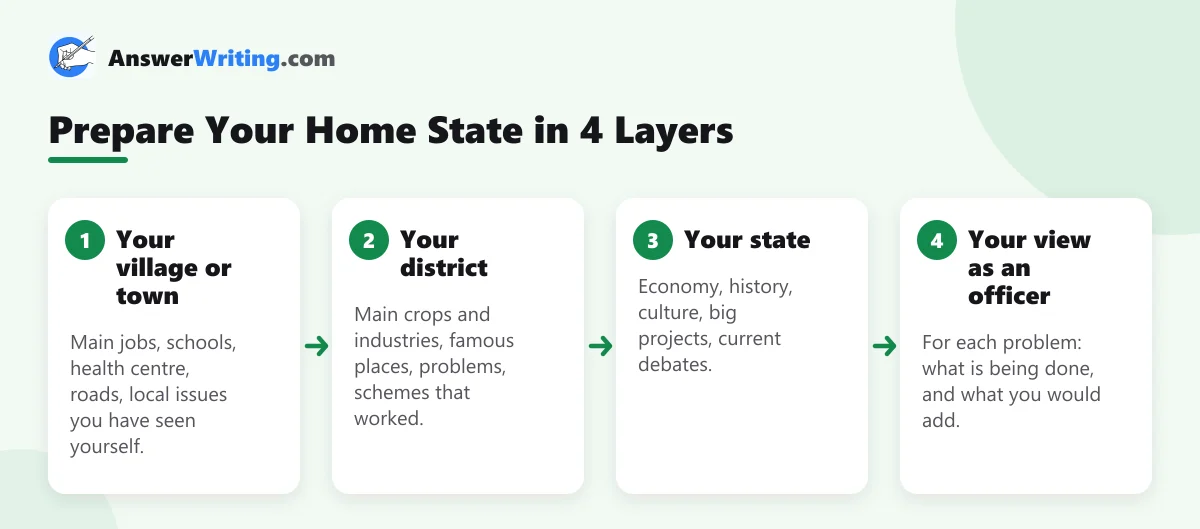
For each layer, write five facts and two problems in a notebook. Then, for each problem, write one realistic step an officer could take. That last part matters most, because it shows the board how you think.
Where to find reliable facts
Use official and reliable sources:
- Your district’s official website (most are on the gov.in domain) for its profile, schemes and important places.
- Your state government’s latest Economic Survey or budget speech for numbers on agriculture, industry and jobs.
- The Press Information Bureau for central schemes in your state.
- A good newspaper’s state edition for the last three to four months of news.
Avoid numbers you are not sure of. Saying “about 70% of people in my district depend on farming, as per the district profile” is better than quoting a number you half remember.
Graduation Questions: What Boards Ask
Your degree tells the board what you spent three or four years learning. The board expects you to know your subject well and to connect it with public life.
Common types of questions:
- The basics of your subject, like “What is the difference between a virus and bacteria?” for a microbiology graduate, or “What is fiscal deficit?” for an economics graduate.
- Links to policy, like “How can your engineering degree help in district administration?”
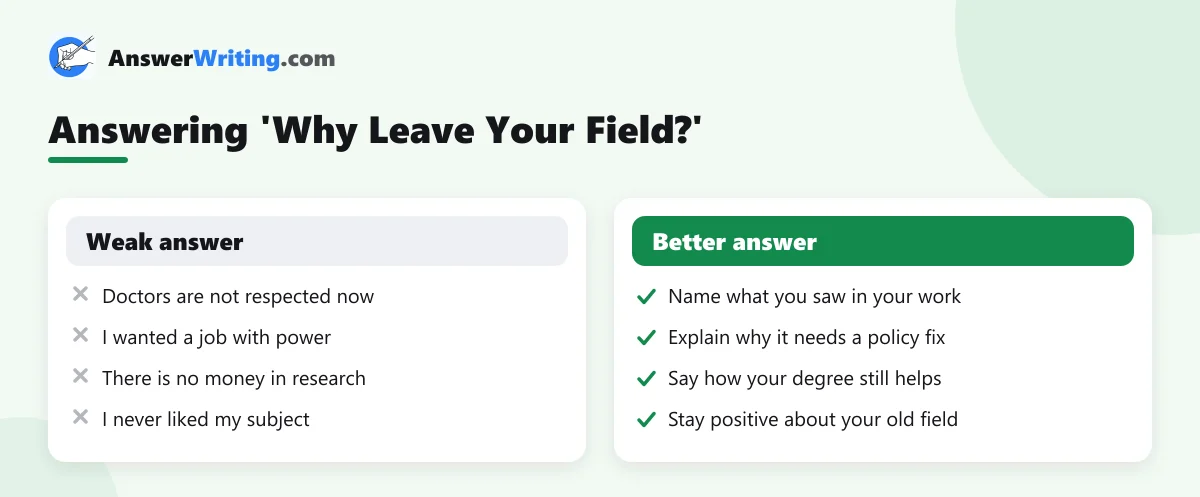
- Why you left your field, like “You studied medicine. Why do you want to leave it and join the civil services?”
- Current developments, like “What is new in your field in the last year?”
The third question is very common, and many candidates answer it badly. Do not criticise your field or say you “wanted more power”. Explain what you saw, what you want to do at a larger scale, and how your degree will still help you.
How to prepare your degree
- Revise the basic concepts of your core subjects. Your old textbooks are enough.
- Write ten questions an expert in your subject might ask, and answer them in two or three sentences each.
- Read about two or three recent developments in your field from reliable sources.
- Prepare one clear example of how your subject connects to a public problem, like water testing for a chemistry graduate or crop insurance data for a statistics graduate.
Common Mistakes to Avoid
The most common mistake is a tourist-brochure answer. “My district is famous for its temples” is not enough; add its problems too. The second is blaming the state government for everything. You can say what is not working, but stay balanced and fair.
If you do not know a fact, say so politely. The board will respect that more than a made-up answer. And do not forget your college town: if you studied in another state, the board can ask about that place too.
For more on how the board uses your form, read our guide to DAF-based questions and how to build a question bank.
Your service order is also on the board’s table. Read how to choose your service preference.
Key Takeaways
- Home state and graduation questions come straight from your DAF, so you can prepare them in advance.
- Prepare your home state in four layers: your town, your district, your state and your view as an officer.
- For every problem you list, prepare one practical step an officer could take.
- Know the basics of your degree, recent developments in it, and one link to public policy.
- If you left your field, explain the move positively.
Practise With Follow-Up Questions
The best way to prepare is to say your answers out loud and face follow-up questions. The AI mentor on AnswerWriting can ask you home state and degree questions one at a time, then ask a follow-up, like a real board would. Use it for 20 minutes a day in the weeks before your interview.
Related Reading
FAQs
Do UPSC boards always ask about the home state?
Not always, but very often. Your home district and state are in your form, so they are an easy starting point for the board.
How much detail should I know about my district?
Know its main economy, its biggest problems, a few important places and the schemes that have worked or failed there. You do not need to memorise every statistic.
What if I grew up in a different state from my home state?
Prepare both. The board may ask about the state in your form and about the place where you actually lived and studied.
Will the board ask technical questions on my degree?
It can. The questions are usually at a basic level, but follow-ups can go deeper. Revise the core concepts of your subject.
How do I answer why I left engineering or medicine?
Explain what you saw in your field, why you want to solve such problems at a larger scale, and how your degree will still help you as an officer. Stay positive about your old field.