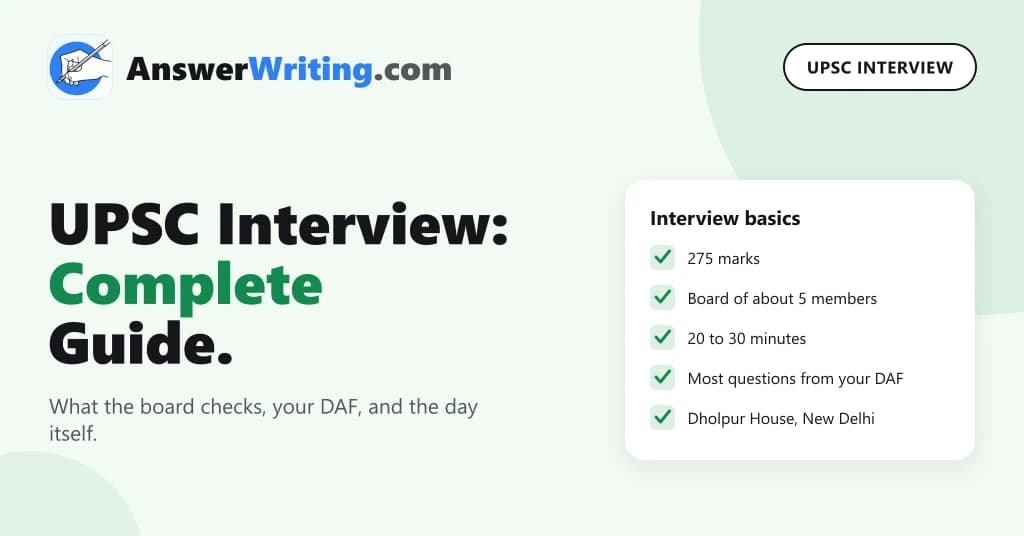
The UPSC interview, officially called the Personality Test, is the last stage of the Civil Services Exam. It carries 275 marks, which are added to your 1,750 Mains marks to make your final score out of 2,025. A board of about five people talks with you for around 20 to 30 minutes. They are not testing how much you have memorised. They want to see whether your personality suits a career in public service.
This guide explains the interview from the start, for anyone who has just cleared Mains or wants to understand the last stage.
Where the Interview Fits in UPSC
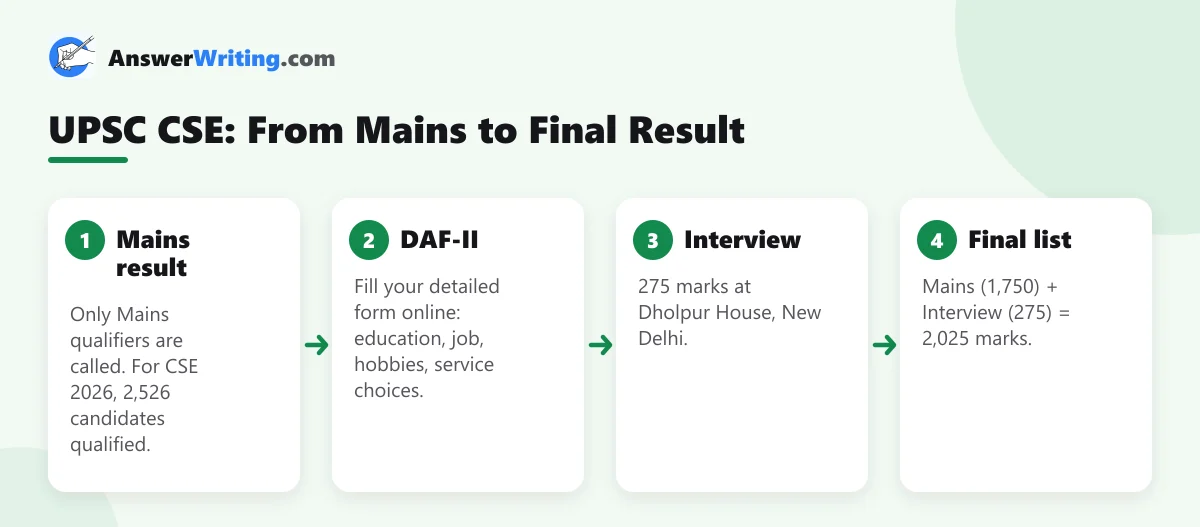
For CSE 2026, UPSC declared the Mains result on 5 November 2026, and 2,526 candidates qualified for the interview. Read our post on the UPSC Mains Result 2026 for the next steps and dates.
What the Interview Board Checks
UPSC’s rules say the interview tests your personal suitability for a career in public service. The board looks at qualities like these:
- How alert you are, and how clearly and logically you explain your views.
- Your balance of judgement: can you see more than one side of an issue?
- How wide and deep your interests are.
- Your ability to work with people and lead them.
- Your honesty and moral integrity.
This means the board is less interested in facts and more in how you think. “I do not know, sir” is an acceptable answer to a factual question. Making up an answer is not.
Who Sits on the Board
Each board is led by a member of UPSC, called the Chairperson, and has about four other members. They are usually senior retired officers, academics and experts from different fields. The Chairperson usually starts, and then each member asks questions on different areas: your education, your home state, your job, your hobbies and current issues.
Your DAF Decides Most Questions
The Detailed Application Form (DAF) you filled after Prelims and DAF-II after Mains are the board’s main papers about you. Most questions come from them: your name, home district, school and college subjects, work experience, hobbies, achievements and service preferences.
So the most important preparation is to know your own DAF completely. If you wrote “reading” as a hobby, be ready for questions on books you have read recently. If you studied mechanical engineering, expect questions on how it connects to public policy.
What Happens on the Interview Day
Interviews are held at the UPSC office at Dholpur House, Shahjahan Road, New Delhi, in a morning or afternoon session. Your date and time are on your e-summon letter, which you download from the UPSC website.
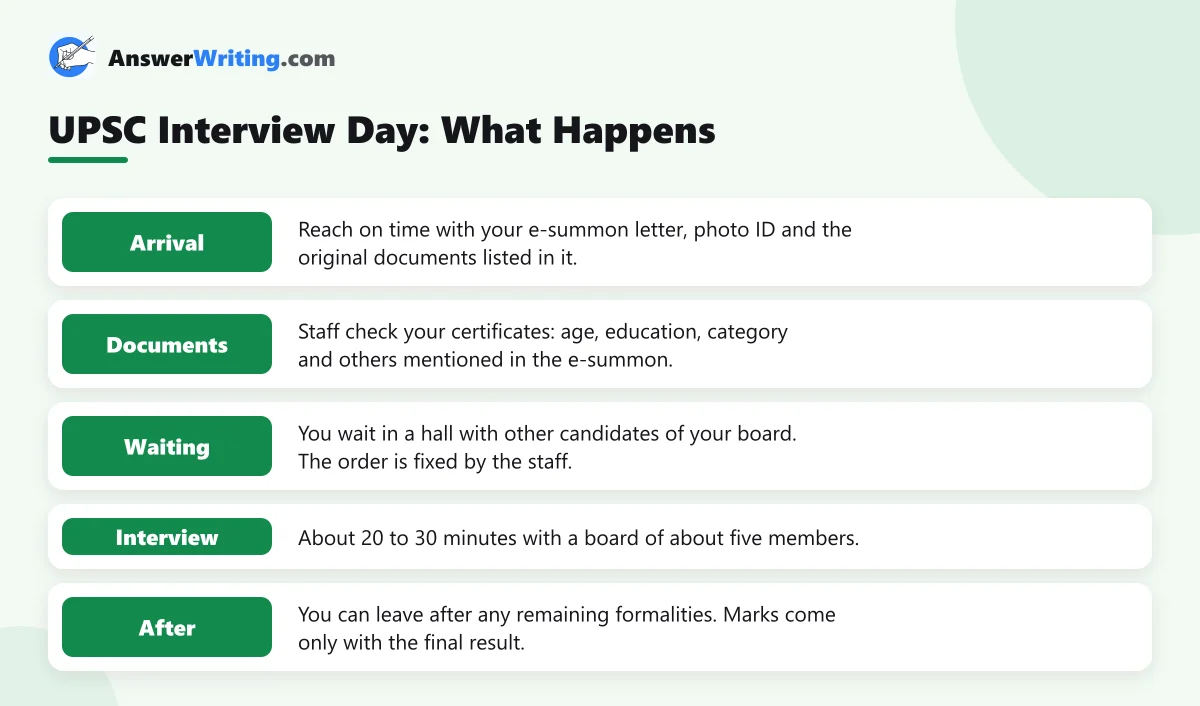
Wear simple, formal clothes you are comfortable in. Carry every document listed in your e-summon letter, because missing documents can create problems. Always follow the instructions in your own e-summon letter, as they are the official rules for your interview.
How to Prepare for the UPSC Interview
- Know your DAF line by line. Write 10 to 15 likely questions for every line and practise your answers out loud.
- Read one newspaper daily. Many questions are on current issues. Form a balanced view on each big issue: what is good, what is a problem, and what can be done.
- Know your home state and district. Expect questions on its economy, problems, history and famous places.
- Revise your graduation subject. Basic questions on your subject are common, especially if you studied something technical.
- Take a few mock interviews. Three to five good mocks are enough. Too many can make your answers sound rehearsed.
- Practise speaking. Answer in short, clear sentences. Practise with a friend, a mirror or an AI tool that asks questions one by one.
Common Mistakes to Avoid
- Giving one-sided or extreme opinions on sensitive issues. The board wants balance.
- Bluffing when you do not know an answer. Say so politely and move on.
- Long answers lose the board’s attention. Most good answers are 30 seconds to one minute.
- Do not argue with a board member. You can disagree politely, but do not debate.
- Writing something in your DAF that you cannot talk about, like a hobby you have not followed for years.
How Marks Work
The interview carries 275 marks. There is no minimum pass mark in the interview, so even a low score does not remove you, but your final rank depends on the total. Scores vary a lot from candidate to candidate. Among the toppers we have covered, interview scores ranged from 179 to 210 out of 275. Read how UPSC evaluates candidates to see how the interview fits with the other stages.
Once you know the basics, see real UPSC interview marks of toppers, follow a 6-week interview preparation plan, build a question bank from your DAF and practise questions on your hobbies.
Key Takeaways
- The UPSC interview carries 275 marks, added to 1,750 Mains marks for a total of 2,025.
- A board of about five members checks your suitability for public service, not your memory.
- Most questions come from your DAF, so know it completely.
- Read a newspaper daily and form balanced views on current issues.
- Three to five good mock interviews are enough.
Practise Interview Questions With the AI Mentor
On AnswerWriting, the 24×7 AI mentor can act as an interview board. Share your background and hobbies, and it asks you questions one at a time and gives feedback on your answers. It is a simple way to practise speaking every day between your mock interviews.
FAQs
How many marks is the UPSC interview?
275 marks. They are added to your Mains marks (1,750) for a final total of 2,025.
Is there a minimum qualifying mark in the UPSC interview?
No. There is no minimum pass mark in the interview. Your final rank depends on your total of Mains and interview marks.
How long is the UPSC interview?
Usually about 20 to 30 minutes, though some can be shorter or longer.
Where is the UPSC interview held?
At the UPSC office, Dholpur House, Shahjahan Road, New Delhi. Your exact date and session are on your e-summon letter.
Can I give the UPSC interview in Hindi?
Yes. You can choose the language of your interview in your form, as per UPSC’s rules. Check the current rules in the official notification and your e-summon letter.