Your UPSC service preference is the ordered list of services you want, from IAS and IFS to the Group B services. After the final result, the government gives you the highest service on your list that your rank and category allow. If you leave a service off the list, you will not be given it, even if your rank is high enough. So this list needs careful thought.
This post explains what the official CSE 2026 rules say, and gives you a simple way to decide your order.
What the CSE 2026 Rules Say
The CSE 2026 notice on upsc.gov.in sets out the main rules on preferences. In simple words:
- You indicate your order of preference in the application form, only for the services you are interested in.
- If selected, you are considered only for the services you listed, subject to other conditions.
- If you list no service at all, you are not considered for service allocation.
- If you want IAS or IPS, you also give a home cadre preference, when and how the Commission asks for it.
- Once submitted, your service and home cadre preferences cannot be changed, except within the update window the notice describes.
The notice also tells candidates to check the Department of Personnel and Training at dopt.gov.in for details of service allocation and cadre allotment.
Many aspirants still call this the “DAF-II” stage, because older exams had a separate detailed form after Mains. For CSE 2026, the details go into the online application and the update windows after Prelims and after Mains. Read the instructions on the portal carefully each time.
The 23 Services
The CSE 2026 notice lists 23 services. Here they are, grouped to make them easier to understand:
| Group | Services |
|---|---|
| All India Services | Indian Administrative Service (IAS), Indian Police Service (IPS) |
| Foreign service | Indian Foreign Service (IFS) |
| Accounts and audit | Indian Audit and Accounts, Indian Civil Accounts, Indian Defence Accounts, Indian Post and Telecommunication Accounts and Finance |
| Revenue | IRS (Income Tax), IRS (Customs and Indirect Taxes) |
| Railways | Indian Railway Management Service (Traffic, Personnel, Accounts), Indian Railway Protection Force Service |
| Other Group A | Indian Corporate Law, Indian Defence Estates, Indian Information, Indian Postal, Indian Trade Service |
| Group B | Armed Forces HQ Civil Service, DANICS, DANIPS, Pondicherry Civil Service, Pondicherry Police Service |
To read what each service does day to day, see our list of services offered through UPSC CSE.
How to Decide Your Order
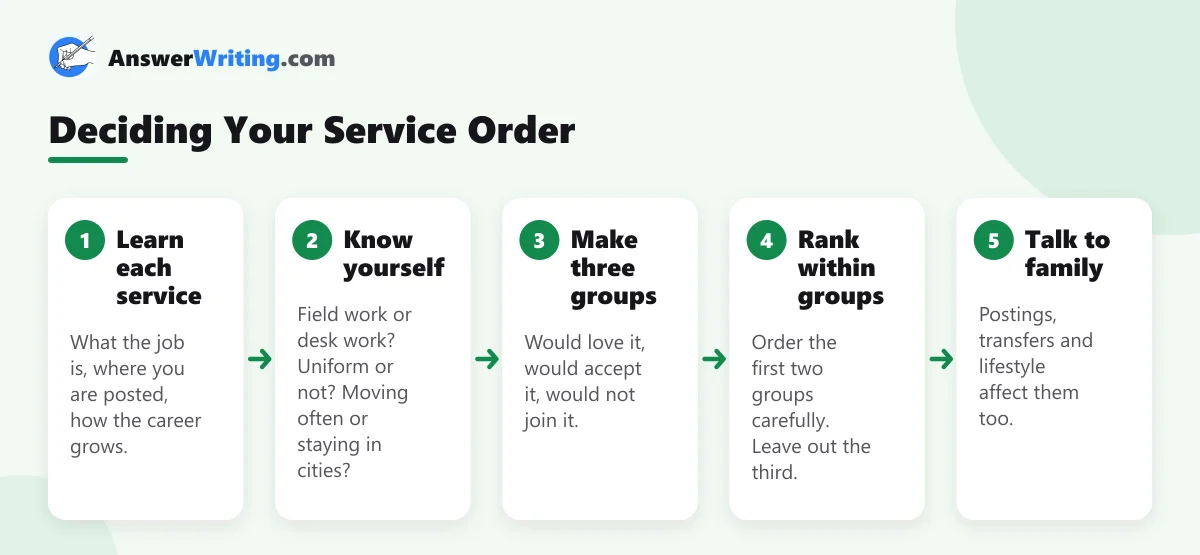
Ask yourself these questions
- Do I want to work in the field with people, or am I happier with policy, finance or law?
- Am I comfortable with a uniform and law-and-order duties?
- Do I want to work abroad for long periods?
- How do I feel about frequent transfers?
- Would I rather have a calmer job in a city, or a demanding one in a district?
There is no “best” order for everyone. A candidate who loves numbers may be happier in the Indian Audit and Accounts Service than in a district post. Our post on what happens after you clear UPSC explains the training and first postings.
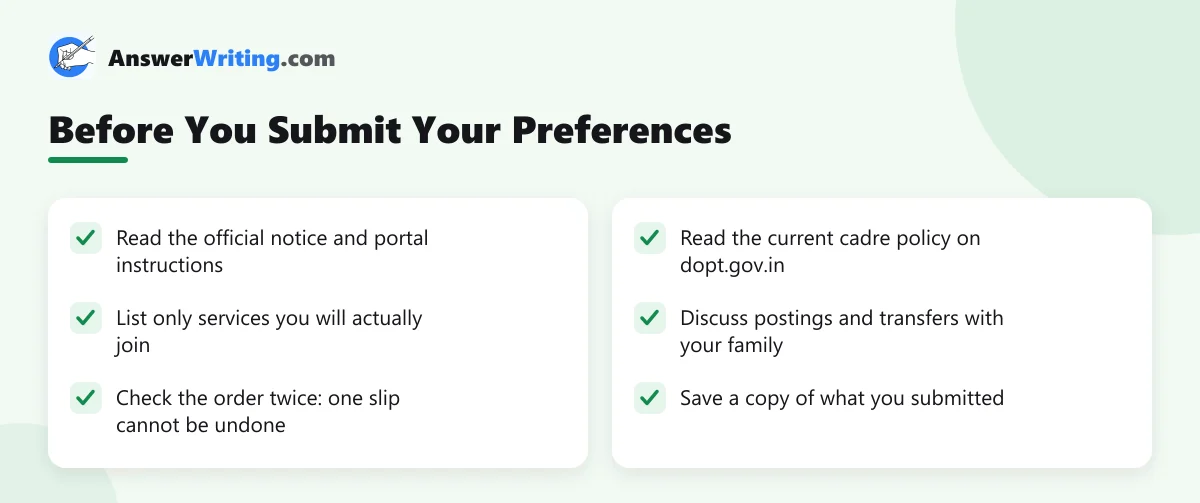
The golden rule: only list what you will join
If you would never join a particular service, leave it off the list. If you list it and get it, you may face a hard choice: join a job you do not want, or let the allocation go. Leaving it off avoids that problem.
But be honest with yourself. Many candidates first think they want only IAS, and later realise they would be very happy in IRS or the foreign service. Learn about each service before you strike it off.
Home Cadre Preference for IAS and IPS
IAS and IPS officers belong to a state cadre. If IAS or IPS is on your list, you give a cadre preference as the Commission asks. Cadres are allotted by the government under the Cadre Allocation Policy in force for that exam. Read the current policy on the DoPT website before you decide, because rules for choosing zones and states have changed over the years.
Special Rules for Candidates Already in Service
The CSE 2026 notice has some rules for candidates already selected through an earlier exam:
- A candidate who is in the IAS or IFS from an earlier exam and continues in that service cannot appear in CSE 2026.
- A candidate already selected or appointed to the IPS cannot opt for, or be allocated, the IPS again through CSE 2026.
- A candidate allocated IPS or a Central Group A service through CSE 2026 can try CSE 2027 once, if granted exemption from training, under conditions listed in the notice.
If this applies to you, read section 3(V) of the notice in full.
Your home state matters for cadre too, so prepare home state questions for the interview.
Key Takeaways
- You are considered only for the services on your preference list. A blank list means no service.
- For CSE 2026, preferences are given in the online application, and cannot be changed later except within the window the notice allows.
- IAS and IPS candidates also give a home cadre preference under the current Cadre Allocation Policy.
- Only list services you would actually join, and learn about each one first.
- Talk to your family, and save a copy of what you submit.
Prepare for “Why This Service?”
Your service order is in front of the interview board, and “Why is IRS your second choice?” is a common question. Practise your reasons with the UPSC CSE AI mentor on AnswerWriting, which can question you on your order like a board member.
Related Reading
FAQs
When do I fill my UPSC service preference?
For CSE 2026, the notice says service preferences are given in the online application. UPSC also opens update windows after Prelims and after Mains; follow the portal instructions.
Can I change my service preference after submitting it?
The notice says no change is allowed once submitted, except as provided for in the update window. Check the portal instructions before you submit.
What happens if I do not list a service?
You will not be allocated that service. If you list no service at all, you are not considered for allocation.
How many services are there in UPSC CSE?
The CSE 2026 notice lists 23 services, including IAS, IFS, IPS, 15 other Group A services and 5 Group B services.
Who allots the cadre for IAS and IPS?
The government allots cadres under its Cadre Allocation Policy. Details are on the DoPT website.