IAS vs IPS vs IFS: Key Differences Every UPSC Aspirant Must Understand
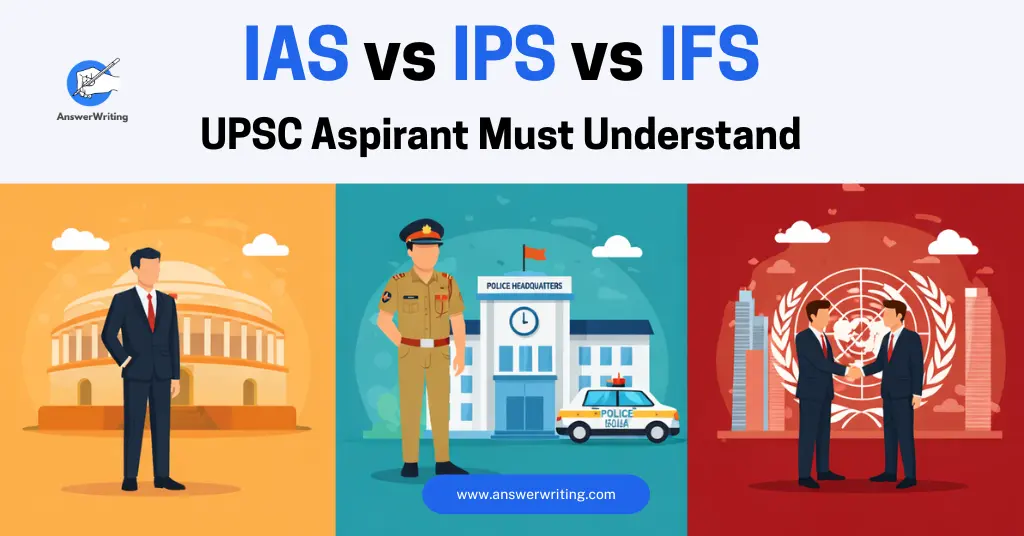
A District Collector coordinating flood relief at midnight, a Superintendent of Police dispersing a violent mob, and a diplomat negotiating India’s position at the United Nations. All three represent the Indian state. Yet, their authority, training, career paths, and constitutional position are fundamentally different.
Understanding IAS vs IPS vs IFS key differences is not just about service preference. It is about understanding how India governs itself, maintains internal security, and conducts foreign policy.
For serious aspirants, this topic intersects with polity, governance, ethics, federalism, and even essay preparation. It also frequently appears in personality test discussions.
Constitutional and Legal Foundation of IAS, IPS and IFS
The constitutional architecture of civil services is found in Articles 308 to 323 of the Constitution of India.
Article 312 empowers Parliament to create All India Services if the Rajya Sabha passes a resolution supported by not less than two-thirds of members present and voting. Under this provision, the Indian Administrative Service and the Indian Police Service function as All India Services.
The legal backing comes from the All India Services Act, 1951.
The Indian Foreign Service, however, is not an All India Service. It is a Central Civil Service under the Ministry of External Affairs.
Structural Difference at a Glance
| Aspect | IAS | IPS | IFS |
|---|---|---|---|
| Constitutional Status | All India Service | All India Service | Central Civil Service |
| Created under | Article 312 | Article 312 | Executive rules under Central Civil Services |
| Cadre System | State Cadre + Central Deputation | State Cadre + Central Deputation | No state cadre, central service only |
| Governing Act | All India Services Act, 1951 | All India Services Act, 1951 | Central Civil Services rules |
This difference reflects India’s federal structure. IAS and IPS officers serve both the Union and the States, embodying cooperative federalism. IFS officers represent the Union abroad.
Nature of Work and Core Responsibilities
The most important distinction in IAS vs IPS vs IFS lies in the functional domain of governance.
IAS: The Generalist Administrator
IAS officers are primarily responsible for district administration and policy implementation. At the field level, a young IAS officer serves as Sub-Divisional Magistrate and later as District Magistrate or Collector. The role includes:
- Implementation of government schemes
- Revenue administration
- Disaster management
- Supervising elections
- Coordinating various departments
At higher levels, IAS officers move into state secretariats and the Union government, drafting policies and steering ministries. The highest position in the Indian bureaucracy is Cabinet Secretary, traditionally drawn from the IAS.
The IAS embodies the generalist tradition in administration, capable of moving across sectors such as health, finance, rural development, and infrastructure.
IPS: The Guardian of Internal Security
IPS officers are responsible for policing and internal security. At the district level, they serve as Superintendent of Police. Their responsibilities include:
- Maintaining law and order
- Crime investigation
- Intelligence coordination
- Counter-terror operations
- Managing paramilitary forces
At senior levels, IPS officers can head state police forces as Director General of Police. At the Union level, they lead central armed police forces and intelligence agencies.
Police reforms, accountability, and autonomy frequently appear in GS Paper II and Ethics questions, especially in light of Supreme Court directives in police reform cases such as Prakash Singh v. Union of India, 2006.
IFS: India’s Diplomatic Corps
IFS officers represent India’s interests abroad. Their work includes:
- Bilateral negotiations
- Multilateral diplomacy
- Trade and economic diplomacy
- Consular services
- Protecting Indian citizens overseas
They serve in Indian embassies and missions worldwide, and in the Ministry of External Affairs in New Delhi. The highest bureaucratic post in the foreign policy domain is Foreign Secretary.
IFS officers operate in the realm of international law, geopolitics, and strategic affairs. For aspirants interested in global politics and foreign policy, this service is uniquely aligned.
Training and Early Career Exposure
Training shapes professional identity and reflects service orientation.
| Service | Training Academy | Focus |
|---|---|---|
| IAS | Lal Bahadur Shastri National Academy of Administration, Mussoorie | Public administration, law, economics, district training |
| IPS | Sardar Vallabhbhai Patel National Police Academy, Hyderabad | Policing, weapons, investigation, physical endurance |
| IFS | Sushma Swaraj Institute of Foreign Service, New Delhi | Diplomacy, international relations, foreign languages |
IAS and IPS officers undergo a foundation course together before moving to their respective academies. IFS officers also undergo language training for their allocated foreign posting.
Early career exposure differs sharply. IAS officers engage with grassroots governance, IPS officers handle law enforcement on the ground, and IFS officers operate in diplomatic environments, often abroad.
Cadre System and Career Progression
IAS and IPS Cadre System
Both IAS and IPS officers are allocated to state cadres. They work in states but can go on central deputation. This structure ensures administrative uniformity and national integration.
A senior IAS officer may serve as Chief Secretary of a state or as Cabinet Secretary at the Union level. An IPS officer may become Director General of Police in a state or head central agencies such as the CRPF or BSF.
IFS Career Path
IFS officers do not belong to state cadres. Their postings alternate between headquarters in Delhi and foreign missions. Senior officers may become Ambassador, High Commissioner, Permanent Representative to international organizations, and eventually Foreign Secretary.
Apex Positions Comparison
| Service | Highest Bureaucratic Position |
|---|---|
| IAS | Cabinet Secretary |
| IPS | Director General of Police or heads of central armed forces |
| IFS | Foreign Secretary |
The Cabinet Secretary is considered the senior-most civil servant in India, traditionally from the IAS.
Authority, Power and Public Perception
The debate around IAS vs IPS vs IFS often revolves around the question of power. However, power must be understood institutionally.
IAS officers exercise administrative authority over district machinery and policy implementation. IPS officers exercise coercive authority under criminal law. IFS officers wield diplomatic influence internationally.
Public visibility tends to be highest for IAS and IPS officers at the district level. IFS officers enjoy high prestige but operate away from domestic political and administrative structures.
Real influence depends on institutional context. A District Magistrate during a disaster may have more immediate authority than an ambassador. Conversely, a diplomat negotiating trade agreements may shape long-term economic interests of the nation.
Service Preference Strategy for UPSC Aspirants
Choosing between IAS, IPS and IFS should not be based solely on rank or perception.
Consider the following dimensions:
- Interest in domestic governance versus global affairs
- Comfort with physical risk and operational pressure, especially in IPS
- Desire for grassroots engagement, more prominent in IAS
- Preference for international exposure and multilingual environments in IFS
- Family considerations, as IFS postings are mostly abroad
In the personality test, board members often ask why a candidate prefers a particular service. The answer must reflect aptitude, values, and long-term commitment.
Exam Relevance and Question Trends
Civil services as an institution appear frequently in UPSC Mains.
Questions have addressed:
- Civil services reforms and lateral entry
- Neutrality and political accountability of bureaucracy
- Police reforms and autonomy
- Ethical dilemmas faced by district administrators
- Role of diplomats in protecting national interest
In Ethics paper, case studies often simulate scenarios involving District Magistrates or SPs. Essay topics frequently revolve around governance, accountability, and public service values.
Understanding IAS vs IPS vs IFS key differences therefore strengthens both conceptual clarity and interview readiness.
Frequently Asked Questions
Is IFS part of the All India Services?
No. The Indian Foreign Service is a Central Civil Service, not an All India Service created under Article 312.
Who has more power, IAS or IPS?
They operate in different domains. IAS officers have broader administrative authority, while IPS officers exercise statutory police powers under criminal law.
Can an IPS officer become Cabinet Secretary?
Traditionally, the Cabinet Secretary has been from the IAS. While the Constitution does not explicitly bar others, the convention strongly favors IAS officers.
Is IFS more prestigious than IAS?
Prestige is subjective. IFS carries diplomatic prestige internationally, while IAS holds central administrative authority within India.
Which service offers more international exposure?
IFS officers are primarily posted abroad, making it the most internationally oriented service.
Conclusion
The comparison of IAS vs IPS vs IFS is ultimately a comparison of three pillars of the Indian state: governance, security, and diplomacy. Each service reflects a different constitutional function and demands a distinct temperament.
For the UPSC aspirant, clarity about these differences is not about ranking services by glamour. It is about aligning personal aptitude with institutional responsibility. A serious candidate studies not only the syllabus, but also the structure of the state he or she aspires to serve.
Deepen your understanding further by studying Articles 308 to 323, the All India Services Act, 1951, and contemporary debates on civil services reforms. That knowledge will serve you well in both Mains and the Interview.