List of Services Offered Through UPSC CSE
While the popular imagination of the UPSC Civil Services Examination (CSE) often begins and ends with the IAS and IPS, the exam is actually a recruitment gateway for over 20 distinct services. Each year, the Department of Personnel and Training (DoPT) notifies a list of services that will be filled based on the final merit list. For a serious aspirant, understanding these services is not just a matter of curiosity; it is a critical part of the Detailed Application Form (DAF) strategy, where service preferences can shape the next 35 years of your professional life.
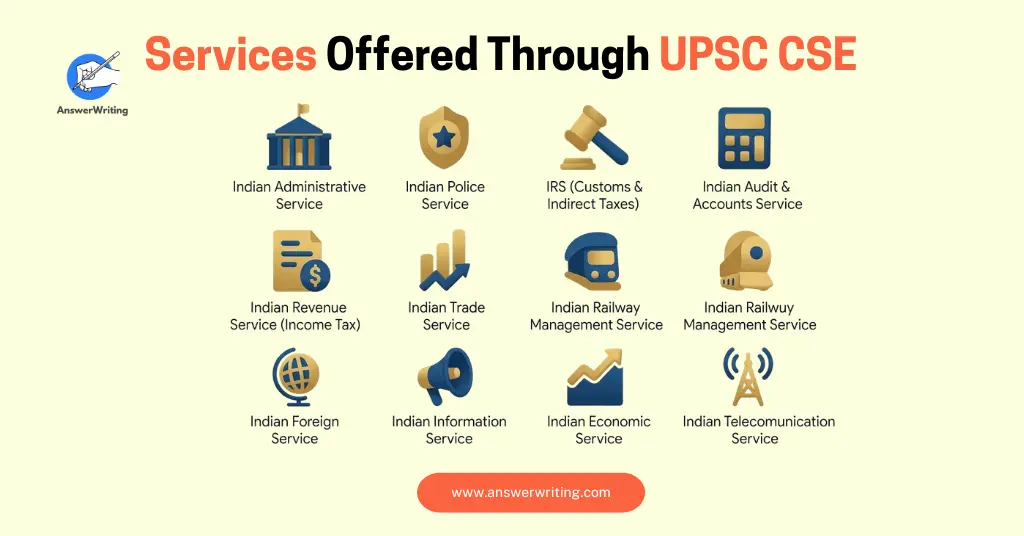
The services are broadly classified into three categories: All India Services, Group ‘A’ Central Services, and Group ‘B’ Central Services.
The Structural Blueprint: Three Tiers of Services
The Indian bureaucracy is structured to maintain a balance between federal flexibility and central oversight. This is reflected in the way services are categorized:
- All India Services (AIS): These are unique because officers are recruited by the Centre but serve under various State Cadres. Their “loyalty” is dual: they are accountable to both the State government they serve and the Union government that recruited them.
- Central Civil Services (CCS): These services fall exclusively under the jurisdiction of the Union Government. Officers in these services work in specialized departments like Income Tax, Railways, or External Affairs and do not belong to a specific state cadre.
- Group ‘B’ Services: These are primarily administrative and policing roles for the Union Territories or specialized support roles in the Ministry of Defence.
The Elite Duo: All India Services (AIS)
Through the Civil Services Examination, recruitment is made to two of the three All India Services. It is important to note that the third All India Service, the Indian Forest Service (IFoS), shares the Preliminary exam with the CSE but has a separate Main examination and personality test.
- Indian Administrative Service (IAS): Often called the “Generalist” service, the IAS is the premier administrative arm of the government. From managing districts as a Collector to heading ministries as a Secretary, the IAS officer’s role is vast, covering policy formulation, implementation, and crisis management.
- Indian Police Service (IPS): The primary service responsible for internal security, law and order, and crime prevention. Officers lead state police forces, central paramilitary forces (like CRPF or BSF), and intelligence agencies (IB, RAW).
Group ‘A’ Central Services: The Specialized Backbone
These services provide the technical and domain expertise required to run a modern state. They are managed by specific “Cadre Controlling Authorities” (Ministries).
1. Diplomacy and Trade
- Indian Foreign Service (IFS): Unlike AIS, IFS officers represent India globally. They handle diplomacy, trade negotiations, and the protection of Indian interests abroad.
- Indian Trade Service (ITS): Operating under the Ministry of Commerce, these officers focus on international trade policy, export promotion, and WTO-related matters.
2. Revenue, Finance, and Audit
- Indian Revenue Service (IRS): Divided into two branches: Income Tax and Customs & Indirect Taxes (GST). They are the financial lifeline of the country, responsible for tax collection and combating economic crimes.
- Indian Audit and Accounts Service (IA&AS): Working under the Comptroller and Auditor General (CAG), these officers ensure financial accountability in government departments and public sector undertakings.
- Indian Defence Accounts Service (IDAS): Manages the extensive finances and audits of the Ministry of Defence, including the Armed Forces and Border Roads Organisation.
- Indian Civil Accounts Service (ICAS): Focuses on government accounting, payment systems, and the implementation of the Public Financial Management System (PFMS).
3. Communications and Information
- Indian Postal Service (IPoS): Manages the world’s largest postal network, transitioning today from traditional mail to e-commerce and rural banking.
- Indian Information Service (IIS): Acts as the communication bridge between the government and the public, managing media wings like the Press Information Bureau (PIB) and Doordarshan.
- Indian P&T Accounts and Finance Service: Handles the complex financial management of the Department of Telecommunications and Posts.
4. The Reorganized Railway Services
Following the merger of several railway cadres, recruitment is now primarily through the Indian Railway Management Service (IRMS). For candidates coming through the CSE, the focus is on:
- IRMS (Traffic)
- IRMS (Personnel)
- IRMS (Accounts)
- Indian Railway Protection Force Service (IRPFS): A specialized paramilitary force dedicated to the security of railway property and passengers.
Group ‘B’ Services: Union Territories and Headquarters
Group ‘B’ services are highly sought after by those who prefer postings in specific geographies, particularly Delhi and the Union Territories.
| Service Name | Area of Operation | Nature of Work |
| DANICS | Delhi, Andaman & Nicobar, Lakshadweep, Daman & Diu, Dadra & Nagar Haveli | Civil Administration (SDM, ADM roles) |
| DANIPS | Same as above | Police Administration (ACP, DSP roles) |
| PONDICS | Puducherry | Civil Administration |
| PONDIPS | Puducherry | Police Administration |
| AFHQCS | Ministry of Defence | Civil support to Armed Forces Headquarters |
How Service Allocation Works: Beyond the Rank
A common misconception is that Rank 1 gets IAS and Rank 500 gets a Group ‘B’ service. While rank is the primary driver, service allocation is a complex interplay of:
- Service Preference: As indicated by the candidate in their DAF. If a Rank 10 candidate prefers the IFS over the IAS, they will be allocated the IFS.
- Category (Reservation): Vacancies are distributed among General, EWS, OBC, SC, and ST categories. A candidate from a reserved category may get a higher-preferred service at a lower rank compared to a general category candidate.
- Medical Fitness: Services like the IPS and IRPFS have stringent physical and medical requirements (height, chest girth, eyesight). If a candidate fails these, they are moved to the next available service in their preference list.
- Vacancy Availability: The number of seats for each service varies every year. In years with fewer IAS vacancies, the cutoff for the “top” services climbs much higher.
Strategic Advice for Aspirants
When filling your DAF, do not follow the “herd mentality.” While the IAS and IPS offer immense power and diversity, the Indian Foreign Service offers unparalleled global exposure, and the Indian Revenue Service offers a specialized, relatively stable urban life.
Consider your personality: Do you crave field-level impact and crisis management (IAS/IPS)? Or do you prefer specialized policy-making and economic analysis (IRS/IA&AS)? Your choice of service is not just about a title; it is about the lifestyle and the nature of the contribution you will make to the nation.