Yes, you can give the UPSC interview in Hindi. Candidates have also faced the interview in other Indian languages, and in that case, as widely reported by past candidates, UPSC arranges an interpreter. The board judges your personality, not your English. What matters is that you speak clearly and confidently in the language you think best in.
This post explains how the language choice works, the real concerns candidates have, and how to prepare.
Language Choices in the UPSC Exam
UPSC gives Indian languages a real place in the Civil Services Exam:
- The Prelims question papers are set in both Hindi and English.
- In Mains, you can write all papers, except the two qualifying language papers, in English or in any language of the Eighth Schedule of the Constitution. That is 22 Indian languages.
- The interview can also be held in an Indian language. The CSE notice does not spell out the process, so follow the instructions on the online portal and in your e-summon letter for choosing your interview language.
Read the language rules in the CSE notice on upsc.gov.in and the instructions on the online portal for your year, because the exact process can change.
How an Interview in Hindi Works
If you choose Hindi, the board members ask questions in Hindi and you answer in Hindi. Many board members are comfortable in both Hindi and English. A member may sometimes ask a question in English; you can still answer in Hindi, politely.
For other Indian languages, such as Marathi, Tamil or Bengali, past candidates report that UPSC arranges an interpreter. The member asks in English or Hindi, the interpreter translates the question into your language, you answer, and the interpreter translates your answer for the board.
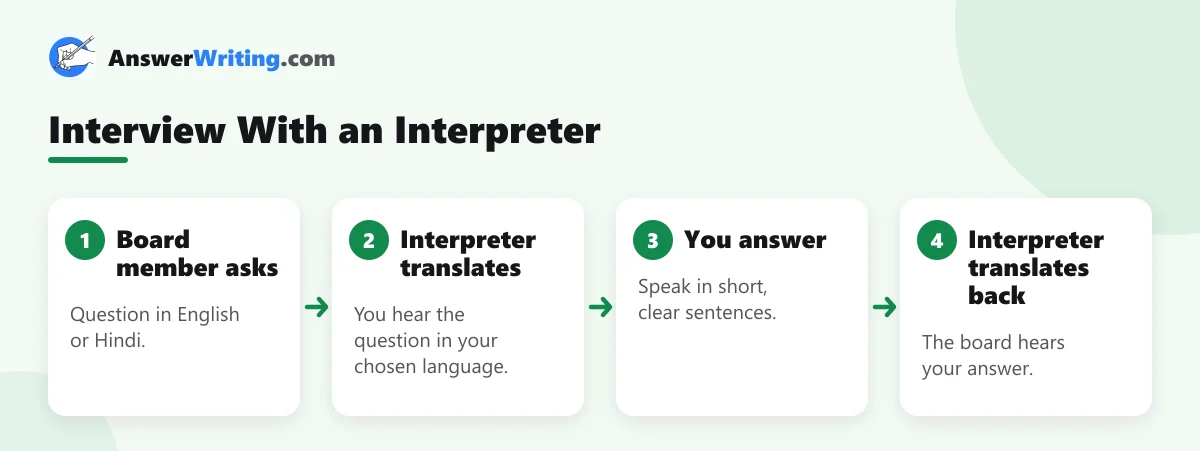
With an interpreter, the conversation takes a little longer, so the board may ask fewer questions. Keep your answers short and pause after each main point.
The Real Concerns, and the Facts
Many Hindi-medium aspirants worry that they will get lower marks. Here is a fair view:
| Concern | What to keep in mind |
|---|---|
| “The board prefers English.” | UPSC’s rules say the interview judges qualities like alertness, judgement, clear expression and integrity. Language is not on that list. |
| “Hindi candidates get lower marks.” | There is no official data showing this. Marks vary a lot between candidates of every medium. |
| “I will not know technical words in Hindi.” | You can use the common English term where there is no simple Hindi word. Do not force difficult words. |
| “Mixing languages looks bad.” | Speaking naturally is better than a stiff, word-by-word translation. |
Many candidates from Hindi and regional-language backgrounds have done well in the interview. Our post on whether Hindi medium is at a disadvantage in UPSC looks at this question in more detail.
Choosing Your Language
Ask yourself one simple question: in which language can I think fastest and explain best under pressure? That is your interview language.
If you wrote Mains in Hindi and think in Hindi, an English interview may slow you down. You might give a weaker answer just because you are searching for words. On the other hand, if you are equally comfortable in both, either is fine.
Do not choose a language just to look impressive. A confident answer in Hindi is far better than a nervous answer in English.
How to Prepare for a Hindi Interview
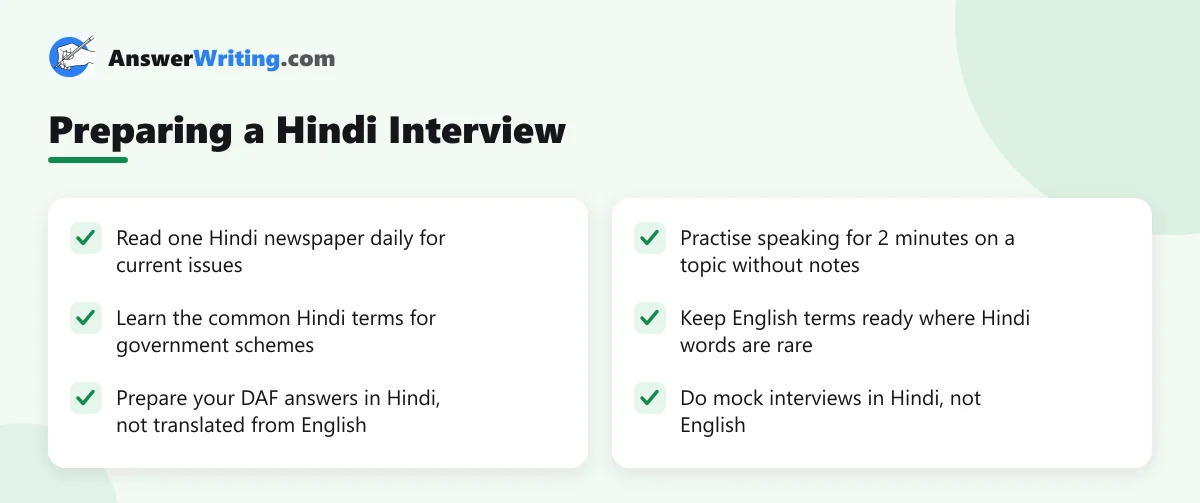
Some practical tips:
- Prepare your DAF answers directly in Hindi. Translating from English notes in your head is slow.
- Learn the official Hindi names of major schemes and institutions. The Hindi version of the Press Information Bureau website is useful for this.
- Use simple, everyday Hindi. You do not need heavy, formal words.
- If a member asks in English, you may answer in Hindi. If you are comfortable, a short English reply is also fine.
- Do at least some mock interviews fully in Hindi.
For a full plan, follow our six-week UPSC interview preparation guide.
Before the day, read our walk-through of the documents and process at Dholpur House.
Key Takeaways
- You can give the UPSC interview in Hindi. For other Indian languages, past candidates report that UPSC arranges an interpreter.
- The board judges personality, judgement and clarity, not English.
- Choose the language in which you can think fastest and explain best under pressure.
- Prepare your DAF answers and current issues directly in your chosen language.
- With an interpreter, keep answers short and pause after each main point.
Practise in Your Own Language
AnswerWriting works in English, Hindi and 22 other Indian languages. Ask the AnswerWriting mentor for UPSC CSE to interview you in Hindi on your DAF, and to point out where your answers were unclear.
Related Reading
FAQs
Can I give the UPSC interview in Hindi?
Yes. Hindi is one of the languages you can choose for the interview.
Can I give the interview in my regional language?
Candidates have taken the interview in other Indian languages too, with an interpreter, as past candidates report. Check the instructions for your year on the UPSC portal and in your e-summon letter.
Will I get lower marks if I speak in Hindi?
There is no official data showing that. The board judges your personality and reasoning, not your language.
Can I mix English words in a Hindi interview?
Yes, for technical terms that have no simple Hindi word. Speak naturally.
What if a board member asks a question in English?
You can answer in Hindi politely, or in English if you are comfortable. Stay calm either way.