UPSC GS3 Paper Pattern Explained
Few UPSC papers test as wide a range of thinking as GS Paper 3. In the same three-hour sitting, you might answer a question on India’s fiscal deficit, then switch to writing about space debris, and end with an analysis of left-wing extremism. That breadth is not accidental. It reflects exactly what the Civil Services exam demands: an officer who can govern across domains.
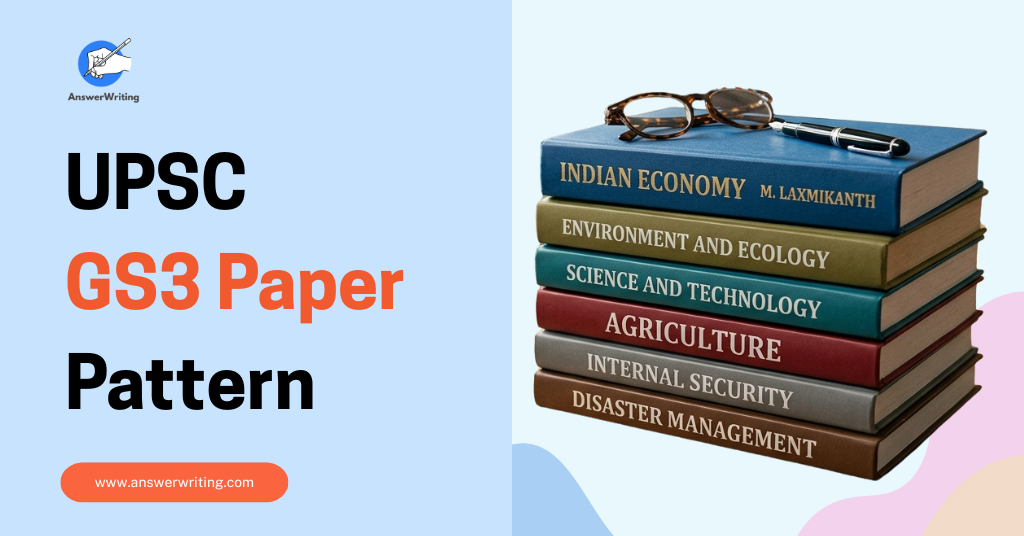
If you are preparing for UPSC CSE Mains, understanding the GS3 pattern is not optional. It is the foundation of your entire strategy for this paper.
What Is GS Paper 3? The Basics First
GS Paper 3 is the third of four General Studies papers in the UPSC Civil Services Mains examination. It is officially titled “Technology, Economic Development, Bio-diversity, Environment and Security.”
Here is the paper at a glance:
| Parameter | Details |
|---|---|
| Total Marks | 250 |
| Duration | 3 Hours |
| Number of Questions | 20 |
| Question Types | 10-mark questions (150 words) and 15-mark questions (250 words) |
| Medium | English or any 8th Schedule language |
| Negative Marking | None |
| Nature | Descriptive/Analytical (no MCQs) |
Every question tests your ability to analyse, not just recall. You are expected to present a structured argument, use examples, and connect issues to policy.
The Six Pillars of GS3 Syllabus
The UPSC syllabus document lists GS3 topics in a broad sweep. Let us break them down clearly.
1. Indian Economy and Economic Development
This is typically the highest-weightage section. It covers economic planning, inclusive growth, budgeting, inflation, banking, investment models, and government schemes.
Key focus areas:
- Planning and NITI Aayog’s role
- Land reforms and farm subsidies
- Infrastructure investment and PPP models
- Effects of globalisation on the Indian economy
- Capital markets, NPAs, and RBI’s monetary policy tools
Questions here often carry a current affairs dimension. The Union Budget and Economic Survey are essential reading.
2. Science and Technology
This section rewards aspirants who follow science news actively. UPSC does not ask you to solve equations. It asks you to explain implications.
Key focus areas:
- India’s space programme (ISRO missions, applications of satellites)
- Biotechnology and its ethical dimensions
- IT, cyber security, and digital governance
- Defence technology (indigenisation, DRDO)
- Intellectual Property Rights and their policy relevance
A strong answer here connects a technology to its social, economic, or security impact.
3. Agriculture
Agriculture carries significant weightage and is closely tied to economic development questions.
Key focus areas:
- Cropping patterns and irrigation systems
- Cold storage, food processing, and supply chains
- Minimum Support Price (MSP) and the debates around it
- Agricultural subsidies and WTO commitments
- Animal husbandry, fisheries, and food security
UPSC increasingly asks about farmer distress, contract farming, and the role of technology in agriculture.
4. Environment, Ecology, and Biodiversity
This section overlaps with GS1 (Geography) and is increasingly prominent in the Mains.
Key focus areas:
- Climate change conventions (UNFCCC, Paris Agreement, COP summits)
- Biodiversity hotspots and the Biological Diversity Act
- Environmental laws: Environment Protection Act, Forest Conservation Act
- Conservation models: biosphere reserves, wetlands, wildlife corridors
- Pollution control: air, water, solid waste management
You must know both the science and the governance side of environmental issues.
5. Internal Security
This is one of the most analytical sections in GS3. It asks you to think like a policy strategist.
Key focus areas:
- Left-Wing Extremism (LWE): causes, spread, government response
- Insurgency in the North-East: historical background and peace accords
- Role of external state and non-state actors
- Cyber security threats and critical infrastructure protection
- Money laundering, drug trafficking, and organised crime linkages
- Border management and role of security agencies
The 2nd Administrative Reforms Commission (ARC) reports on public order and internal security are useful references here.
6. Disaster Management
A dedicated section, though usually carrying fewer questions than Economy or Environment.
Key focus areas:
- Types of disasters: natural and man-made
- Disaster Risk Reduction: Sendai Framework (2015-2030)
- NDMA guidelines and institutional framework
- Post-disaster reconstruction and community resilience
- Case studies: cyclone management, flood response, COVID-19 as a public health emergency
Questions here reward aspirants who can apply frameworks to real incidents.
Topic-Wise Weightage: What UPSC Actually Asks
Based on question analysis from 2018 to 2024, here is an approximate distribution:
| Topic | Avg. Questions Per Year | Approximate Marks |
|---|---|---|
| Indian Economy | 5 to 6 | 60 to 75 |
| Environment and Ecology | 4 to 5 | 50 to 60 |
| Science and Technology | 3 to 4 | 40 to 50 |
| Agriculture | 2 to 3 | 25 to 35 |
| Internal Security | 2 to 3 | 25 to 35 |
| Disaster Management | 1 to 2 | 15 to 25 |
Note: These are indicative averages. UPSC varies distribution year to year. Cross-check with the official UPSC question papers on upsc.gov.in for the most accurate data.
Economy and Environment together account for nearly half the paper in most years. Ignoring either is a serious strategic risk.
How GS3 Connects to Other Papers
GS3 does not exist in isolation. Several topics bleed into other papers, which is both a challenge and an opportunity.
GS3 and GS1: Climate change, disaster vulnerability, and geography of agriculture connect directly. A strong GS1 base in physical geography strengthens your Environment and Disaster Management answers.
GS3 and GS2: Government schemes (PM-KISAN, Jal Jeevan Mission, Smart Cities) are GS2 topics that directly inform GS3 economy and agriculture answers. Security agencies discussed in GS2 (polity) reappear in GS3’s internal security questions.
GS3 and Essay Paper: Economy, technology, and environment are among the most common Essay themes. A well-prepared GS3 candidate already has rich content for these essays.
The UPSC rewards aspirants who think in terms of connections, not silos.
The Art of Answering GS3 Questions
Structure of a Good GS3 Answer
A GS3 answer is not a list of facts. It is an argument with evidence.
For a 15-mark, 250-word question, use this structure:
- Introduction (2-3 lines): Set context. Use a data point, a policy reference, or a brief definition.
- Body (5-6 points): Analyse causes, features, impacts, or steps as demanded. Use sub-headings where appropriate.
- Conclusion (2-3 lines): Suggest a way forward, cite a committee recommendation, or end with a policy imperative.
Diagrams and flowcharts are allowed. A simple labelled diagram in Science and Technology or Disaster Management can add clarity and earn extra credit.
Where Most Aspirants Lose Marks
Many aspirants answer GS3 questions with only surface-level content. They describe a problem but do not analyse it. They list government schemes but do not evaluate their effectiveness.
The examiner is looking for depth. A question on MSP, for instance, expects you to cover farmer welfare, fiscal implications, WTO compatibility, and reform options, not just define what MSP is.
Practising structured answer writing and getting regular feedback significantly improves this depth. Platforms like AnswerWriting.com allow students to submit handwritten answers and receive evaluations from experienced teachers, which mirrors the actual Mains experience far more closely than typing on a screen. Consistent evaluated practice is one of the clearest differentiators between aspirants who crack Mains and those who fall short.
Subject-Wise Preparation Strategy
Here is a focused, prioritised approach for each section:
Indian Economy:
- Start with NCERT Class 11 and 12 Economics for basics.
- Read Ramesh Singh’s “Indian Economy” for depth.
- Follow the Economic Survey (Volume 2 especially) and Union Budget highlights.
- Track RBI reports and NITI Aayog publications for current data.
Science and Technology:
- Read Science Reporter magazine monthly.
- Follow ISRO, DRDO, and ICMR press releases.
- For GS3 purposes, focus on applications and implications, not technical specifications.
Agriculture:
- NCERT Class 10 Geography (Chapter on Agriculture) is a good base.
- Follow Ministry of Agriculture reports and crop-specific schemes.
- Link agricultural questions to rural distress, MSP, and food security debates.
Environment:
- Shankar IAS Environment book is widely used and reliable.
- Track IPCC reports, MoEFCC notifications, and National Green Tribunal (NGT) landmark orders.
- Know major international agreements (CBD, CITES, Ramsar, Paris Agreement).
Internal Security:
- IDSA (Institute for Defence Studies and Analyses) publications are useful.
- Know India’s border disputes, insurgency timelines, and security agency roles.
- Link security questions to governance and socio-economic root causes.
Disaster Management:
- NDMA guidelines are the primary reference.
- Understand the Sendai Framework’s four priorities and India’s alignment.
- Use case studies from recent disasters in answers.
Recent Trends (2020 to 2024): What UPSC Is Signalling
UPSC’s question design has evolved noticeably in recent years.
Economy questions have become more applied. Instead of asking “what is fiscal consolidation,” UPSC now asks how it affects social spending or capital investment. The 2023 paper asked about the implications of India’s rising current account deficit, demanding both economic knowledge and policy analysis.
Science and Technology questions are more contemporary. Questions on Artificial Intelligence governance, the 5G rollout, and quantum computing have appeared. UPSC wants you to connect emerging technologies to India’s development and security needs.
Environment and climate intersect with security. The concept of “climate security” and “environmental migration” has started appearing. This reflects global discourse entering the UPSC syllabus in real time.
Internal Security questions now stress root causes. Rather than only asking about security responses, UPSC increasingly asks why insurgencies persist and what governance failures sustain them. This is a Mains-level analytical shift.
The overall trend points toward integrated, multi-dimensional answers that connect economy, governance, and security together.
5 Common Mistakes to Avoid in GS3
- Treating Economy and Science as separate prep: Many questions blend both. A question on drone regulations, for example, requires both technology knowledge and economic/security policy understanding.
- Ignoring Agriculture: Aspirants focused on Economy often neglect agriculture-specific topics. Agriculture carries consistent weightage and is frequently combined with rural development questions.
- Memorising schemes without understanding their context: Knowing the name of a government scheme is not enough. You must know its objectives, current status, and limitations.
- Writing Internal Security answers without mentioning root causes: A pure law-enforcement framing scores lower than an answer that addresses poverty, governance gaps, and socio-political factors alongside security responses.
- Not practising within word limits: A 150-word answer must be exactly that. Writing 300 words does not earn more marks. It signals poor exam discipline and eats into your time for other questions.
FAQs
Q1. Is GS Paper 3 harder than GS Paper 2 for most aspirants?
It depends on your background. Science and engineering graduates often find GS3 relatively accessible due to the Science and Technology section. Humanities graduates may struggle initially with economic concepts. The key is structured preparation across all six sections, regardless of your background.
Q2. How many questions does GS3 have, and how long should each answer be?
GS3 has 20 questions in total. Questions carrying 10 marks require answers of approximately 150 words. Questions carrying 15 marks require approximately 250 words. The total is 250 marks.
Q3. Can current affairs alone help crack GS3?
No. Current affairs supplement a strong conceptual base. If you do not understand the basics of, say, monetary policy or the Carbon Credit mechanism, current affairs headlines will not make sense in an answer context. Build the conceptual layer first.
Q4. How relevant are UPSC previous year questions (PYQs) for GS3 preparation?
Extremely relevant. Solving PYQs from 2013 onwards reveals recurring themes, the depth UPSC expects, and the kind of multi-dimensional thinking needed. Analyse model answers alongside PYQs to understand what a high-scoring response looks like.
Q5. Is the UPSC GS3 syllabus the same as State PSC GS papers on these topics?
Broadly, yes. Most State PSCs (UPPSC, MPSC, BPSC, etc.) mirror the UPSC GS3 structure for their own GS papers covering economy, environment, and security. However, State PSCs also include state-specific content, so verify the exact syllabus for your target exam.
Q6. How much time should I allocate to GS3 in my preparation schedule?
GS3 is often the most time-intensive of the four GS papers due to its breadth. Many toppers allocate 20 to 25 percent of their total Mains preparation time to GS3. Economy and Environment alone deserve consistent daily attention of at least 45 to 60 minutes during the core preparation phase.
Conclusion
GS Paper 3 rewards aspirants who think like administrators. Every question, whether it is about green bonds or border management, is essentially asking: “What is the problem, why does it exist, and what should the state do about it?”
The paper is wide, but it is not impossible to master. A clear syllabus understanding, consistent reading of quality sources, and disciplined answer writing practice will take you a long way. Start early, stay consistent, and always practice under exam conditions.