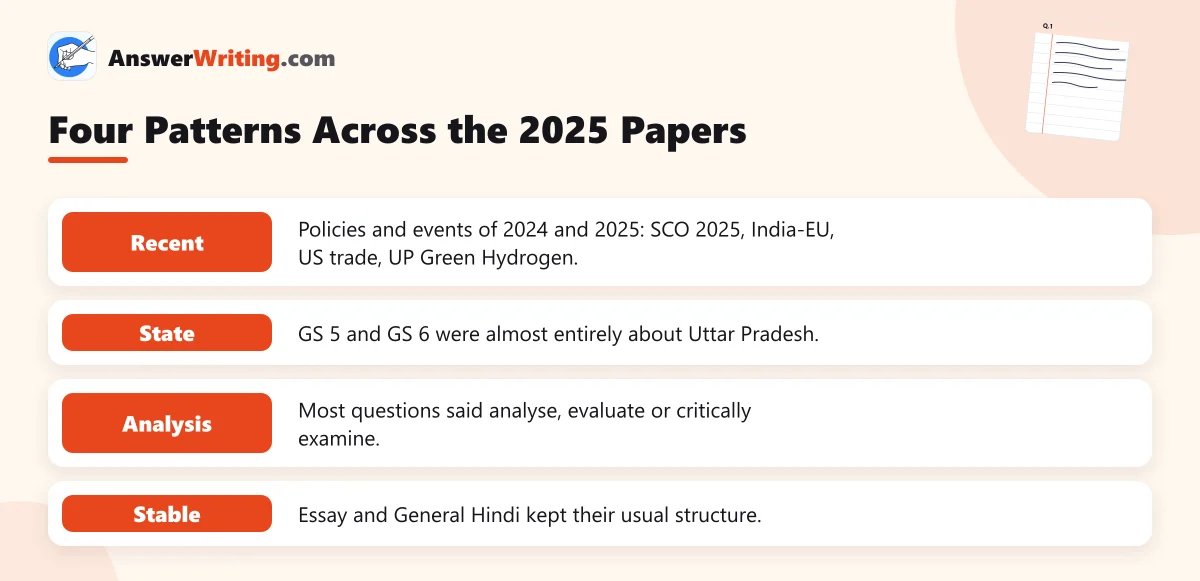
The UP PCS Mains 2025 exam had eight papers: Essay, General Hindi and six General Studies papers. Read together, they show four clear patterns. Questions asked about policies and events from 2024 and 2025. GS 5 and GS 6 asked almost only about Uttar Pradesh. Almost every GS question asked you to analyse or evaluate, not just describe. And the Essay and General Hindi papers stayed in their usual pattern.
Most online analyses cover only two or three papers, or give difficulty ratings without topics. This one covers all eight, using the official question papers on the UPPSC previous year papers page, which UPPSC published in April 2026.
The Eight Papers at a Glance
| Paper | Marks | Main areas asked in 2025 |
|---|---|---|
| Essay | 150 | AI and literature, women, environment, ethics in the economy, organic farming, foreign policy, landslides, rural schemes |
| General Hindi | 150 | Two passages, official drafting, grammar, idioms |
| GS 1 | 200 | Modern history, world history, society, physical geography, resources |
| GS 2 | 200 | Polity, governance, international relations |
| GS 3 | 200 | Economy, employment, technology, internal security, disasters |
| GS 4 | 200 | Ethics, thinkers, attitude, governance, case studies |
| GS 5 | 200 | Uttar Pradesh: history, culture, polity, society, security |
| GS 6 | 200 | Uttar Pradesh: economy, agriculture, industry, environment, science |
All six GS papers had the same structure: 10 questions of 125 words (8 marks) and 10 of 200 words (12 marks) in 3 hours.
GS 1: History, Society and Geography
History: art and technology in the Maurya period; women’s issues in 19th-century reform movements; extremists and moderates; Sardar Patel and the unification of India; change from 1857 to 1947; the unification of Germany as a clash between nationalism and power politics.
Society: globalisation and culture; illiteracy and rural poverty; regionalism as a challenge and an opportunity; urbanisation; modernisation and westernisation; globalisation and family, marriage and kinship.
Geography: glaciers in India; mangroves and coral reefs; the Sino-Indian border dispute; theories of the monsoon and El Nino; forest resources and conservation; refugees and infiltrators; the continental shelf; frontiers and boundaries.
What it tells you: GS 1 still rewards standard books, NCERT-level history and geography, but the questions want explanation. “Analyse”, “critically examine” and “differentiate” appear often. World history (Germany) also appeared, so do not skip it.
GS 2: Polity, Governance and International Relations
Polity: Joint Parliamentary Committees; “legislature is supreme but not sovereign”; the Inter-State Council; the Constituent Assembly as an outcome of colonial-era changes; Union legislative powers and centralisation; the CAG; Public Interest Litigation; the Jammu and Kashmir Reorganisation Act, 2019.
Governance: Alternative Dispute Resolution; the Citizen Charter; human resource development; ICT in policy delivery; Direct Benefit Transfer and Digital India; e-governance; coordination among donors and institutions.
International relations: the India-EU agreement; Sri Lanka in India’s foreign policy; the 25th SCO Summit Declaration, 2025, and cross-border terrorism; UN Security Council reform; Free Trade Agreements and US trade policies.
What it tells you: international relations questions were about the news of the year. Read the year’s summits and trade talks from PIB and the Ministry of External Affairs.
GS 3: Economy, Technology and Security
Economy: problems of handicraft industries; airports and industrial growth; unemployment concepts; digital payments and financial inclusion; jobless growth and employment elasticity in manufacturing; the SDGs on industry, growth and climate; rainfall and irrigation; income inequality; global trade tensions; health and education as the base of development; land reforms and land records; startup schemes.
Technology: genome editing in agriculture, with examples from 2024 and 2025; IT, space and biotechnology for a developed India.
Security and disasters: social media and cross-border radicalisation; nuclear proliferation; human trafficking; drugs and organised crime; “security is development”; reducing man-made disasters like industrial accidents and fires.
What it tells you: one question asked for examples from “2024 to 2025” by name. Keep a one-page note each month on new economic and science developments.
GS 4: Ethics
The paper asked about human values and the family; Chanakya, Aristotle and Gandhi’s view of ends and means; moral and role responsibility; self-regulation and emotional intelligence; social influence and persuasion, including in the Swachh Bharat Abhiyan; induced compliance; ethical administration and good governance; algorithms and automated decisions in government; RTI and privacy; codes of conduct; tolerance and sympathy; undesirable attitudes among educated Indians; and moral integrity in corporate governance.
The longest question was a case study about a public servant whose son is bullied at school and who then faces a viral video attacking his family. It asked about the ethics of using social media to respond.
What it tells you: the paper mixed thinkers, everyday ethics and new technology. Prepare one example from public life or your own experience for each core term, such as integrity, empathy and accountability.
GS 5 and GS 6: The Uttar Pradesh Papers
GS 5 asked about Ayodhya in ancient literature, Agra’s Indo-Islamic architecture, the Arya Samaj and education, Jain sites of Braj, the Magh Mela and Kumbh, Birha and Kajari, 1857 in Meerut, Lucknow, Kanpur and Jhansi, the Allahabad High Court, the Legislative Assembly, rural health, social media and security, and the UP Science and Technology Policy 2025 and AYUSH Policy 2025.
GS 6 asked about UP’s tax reforms, Invest UP, biomass energy, silk schemes, soil health, municipal waste rules, Drone Didi Yojana, wildlife-human conflict, women and child schemes, the Defence Industrial Corridor, the Green Hydrogen Policy 2024, mining in Bundelkhand, crop insurance, the Taj Trapezium Zone rules, UP’s growth from a “BIMARU” state, and digital UP.
What they tell you: these two papers are 400 marks of pure UP content, much of it from state policies. Our UP GK guide for UP PCS lists the static topics; for policies, read the department websites of the UP Government.
Essay and General Hindi
The Essay paper had three sections of three topics; candidates wrote three essays of up to 700 words, 50 marks each. The topics ranged from “The future of literature in the age of Artificial Intelligence” to “Landslides: how much human-induced, how much natural”.
General Hindi had two passages (60 marks), a semi-official letter and a notification (20), grammar questions (40) and idioms with sentences (30).
What to Change in Your Preparation
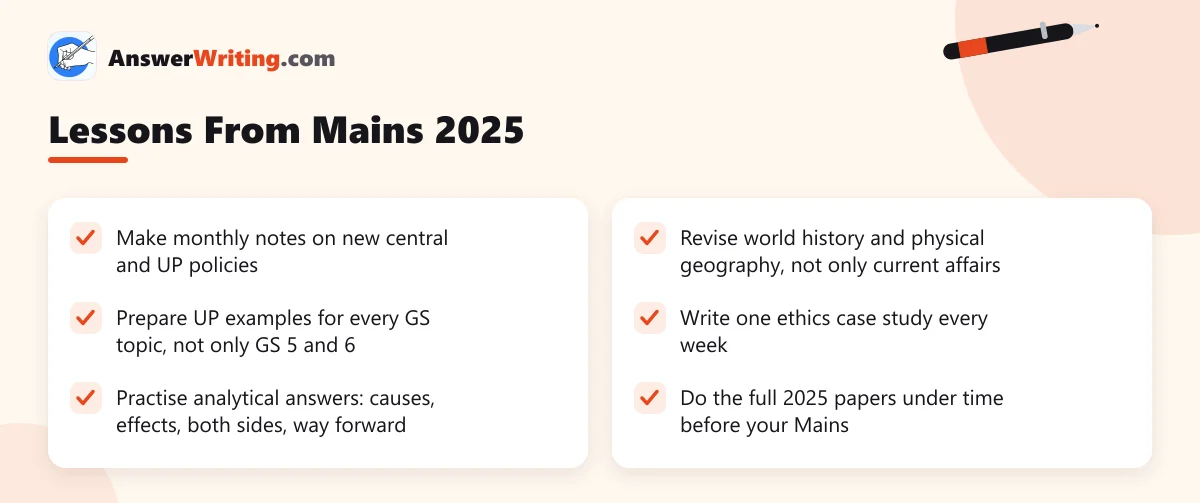
To see how each question type should be written, read our guide to UP PCS Mains planning after Prelims, and check the UP PCS exam pattern for the full scheme.
To write answers to these questions, follow our UP PCS Mains answer writing guide.
Key Takeaways
- UP PCS Mains 2025 had 8 papers: Essay (150), General Hindi (150) and GS 1 to GS 6 (200 each).
- Many questions asked about policies and events of 2024 and 2025.
- GS 5 and GS 6 asked almost only about Uttar Pradesh, often about named state policies and schemes.
- Most GS questions asked you to analyse or evaluate, not only describe.
- The best practice material for the next Mains is the 2025 papers themselves.
Write the 2025 Questions and Get Them Checked
Pick five questions from this post and write them this week under time. On AnswerWriting’s UP PCS page you can get each answer evaluated by AI in Hindi or English, with a model answer to compare. Your first three evaluations are free.
Related Reading
FAQs
How many papers are there in UP PCS Mains?
Eight: Essay, General Hindi and General Studies papers 1 to 6.
What were the total Mains marks in 2025?
1,500: Essay 150, General Hindi 150 and six GS papers of 200 each.
Was there an optional subject in UP PCS Mains 2025?
No. The eight official 2025 papers do not include an optional subject.
Where can I download the UP PCS Mains 2025 question papers?
On the official UPPSC website, under previous year question papers.
Were GS 5 and GS 6 both about Uttar Pradesh in 2025?
Yes. Almost every question in both papers was about Uttar Pradesh, and the rest asked for UP examples or context.