If you are starting UPSC preparation from zero, your first 90 days have one goal: build the base and the habits, not finish the syllabus. In these three months, read the official syllabus, finish the basic NCERT books for two or three subjects, start reading a newspaper daily, write your first answers and take your first practice test. Everything else can wait.
This post gives you a simple plan for those 90 days, using free official sources.
Before Day 1: Know the Exam
UPSC CSE has three stages: Prelims (two objective papers), Mains (nine written papers) and the interview. Prelims only screens candidates; your rank comes from Mains and the interview. Read our simple guide to the UPSC CSE full form and meaning, and read our post on what the UPSC notification tells you.
Then download two things from the official site:
- The latest CSE notice, which contains the full syllabus, from the UPSC notices page.
- The last few years of question papers from the UPSC question paper page.
Print the syllabus. You will use it every week.
The 90-Day Plan
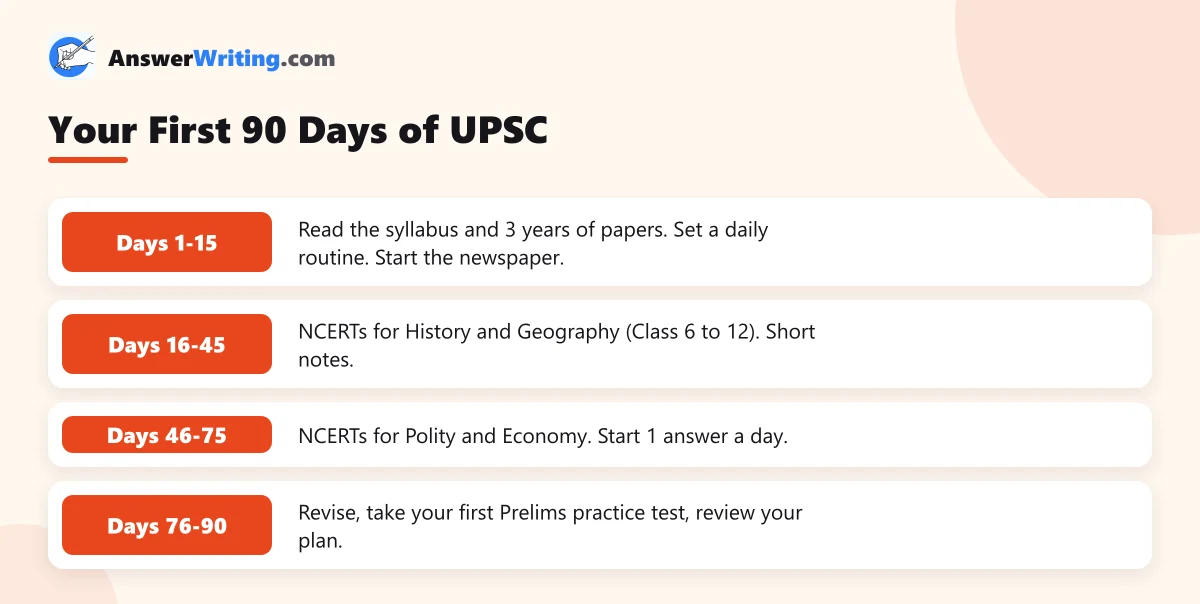
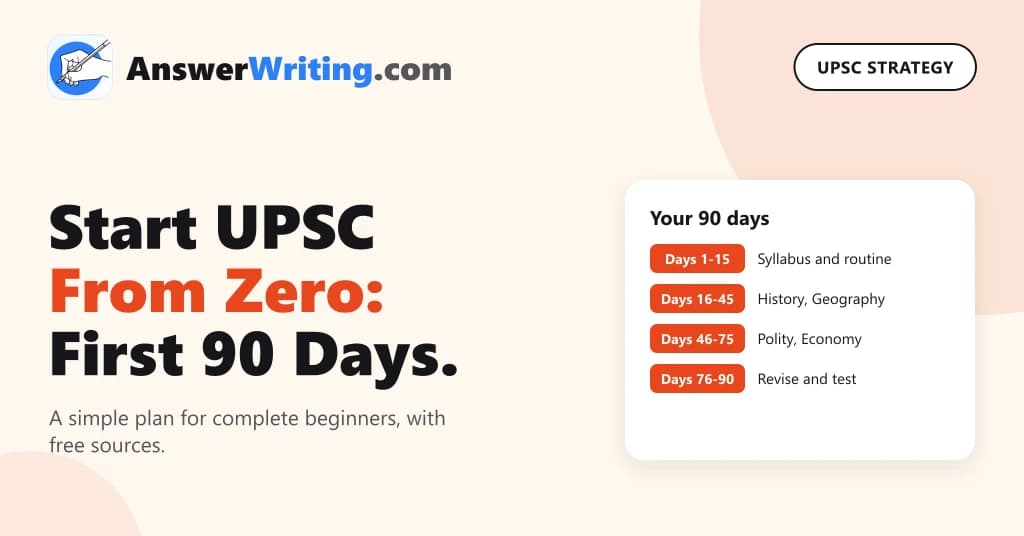
Days 1 to 15: Understand the exam and set a routine
- Read the Prelims and Mains syllabus slowly, line by line.
- Look at three years of Prelims and Mains papers. Do not try to solve them yet; just notice what kind of questions come.
- Fix a daily study time you can keep, even if it is only three or four hours.
- Start reading one newspaper every day for 45 minutes.
Days 16 to 45: History and Geography NCERTs
NCERT books are free on the NCERT textbook page. Start with:
- History: the Class 6 to 10 Social Science books, then Class 12 Themes in Indian History (Parts I to III).
- Geography: the Class 6 to 10 books, then Class 11 (Fundamentals of Physical Geography, India: Physical Environment) and Class 12 (Fundamentals of Human Geography, India: People and Economy).
NCERT has been releasing new middle-school books, so use the latest editions on its website.
Read each book once fully, then make short notes of key points. Do not make notes on the first reading; you will copy the whole book.
Days 46 to 75: Polity and Economy NCERTs, and your first answers
- Polity: Class 9 and 10 Political Science, then Class 11 Indian Constitution at Work.
- Economy: Class 9 and 10 Economics, then Class 11 Indian Economic Development and Class 12 Introductory Macroeconomics.
Now start writing one short answer a day. Pick a simple Mains question on a topic you have read, and write 150 words in about eight minutes. It will feel hard at first. That is normal. Our guide on how to start answer writing for UPSC Mains explains the basic structure.
Days 76 to 90: Revise and test yourself
- Revise your notes from all four subjects.
- Take one full Prelims-style practice test in two hours, in exam conditions.
- Do not worry about the score. Note which subjects felt weakest.
- Review your 90 days: what worked, what did not, and what to change in the next three months.
A Simple Daily Routine
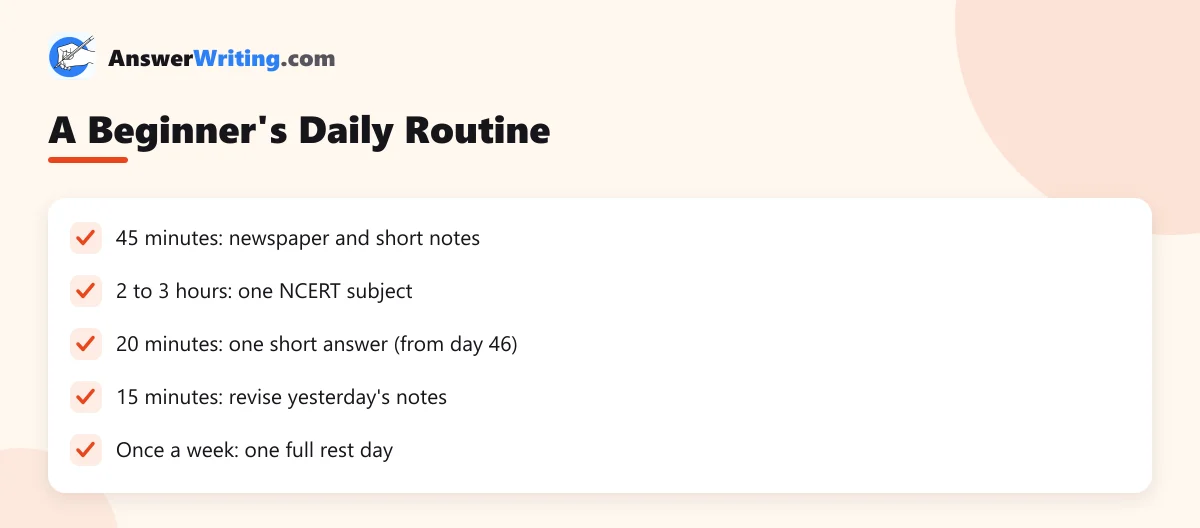
If you work full time, the same plan works over a longer period. See our guide for working professionals preparing for Prelims.
What Not to Do in the First 90 Days
- Do not buy every book and course you hear about. NCERTs and a newspaper are enough for now.
- Do not start your optional subject yet, unless you have already chosen it and studied it in college.
- Do not compare your speed with others on social media.
- Do not skip answer writing because “I will start after Prelims”. Writing early is one of the biggest advantages you can give yourself.
Once you finish the NCERTs, move to one standard book per subject. Our UPSC booklist lists them.
Check your age and attempts first in our post on UPSC eligibility criteria.
Most books you need are free. See our list of official free resources for UPSC.
Many aspirants from Uttar Pradesh also take UP PCS; here is how to prepare for UPSC and UP PCS together.
Key Takeaways
- The first 90 days are for building the base and habits, not finishing the syllabus.
- Start with the official syllabus and previous papers from upsc.gov.in.
- Finish NCERTs for History, Geography, Polity and Economy, free on the NCERT website.
- Read a newspaper daily and start writing one short answer a day from day 46.
- Take your first practice test around day 80, and use it to plan the next three months.
Get Daily Feedback From Day One
When you start writing answers, you need someone to tell you what to fix. On AnswerWriting, the daily UPSC answer writing question gives you a new question every day, and AI evaluation gives feedback and a model answer in minutes. Your first three evaluations are free, and the 24×7 AI mentor can answer your doubts about the plan.
Related Reading
FAQs
Can I start UPSC preparation from zero?
Yes. Most aspirants start with no background. Begin with the syllabus, NCERT books and a newspaper.
Which subject should I start UPSC preparation with?
Many beginners start with History or Polity because they are easy to follow. The order matters less than finishing the NCERTs steadily.
How many hours should a beginner study for UPSC?
Start with a routine you can keep, even three or four hours a day, and increase it slowly.
When should I start answer writing?
Within the first two months. Start with one short answer a day on topics you have read.
Should I join coaching in the first 90 days?
Many candidates prepare on their own with free official sources. Decide after your first three months, once you know your weak areas.