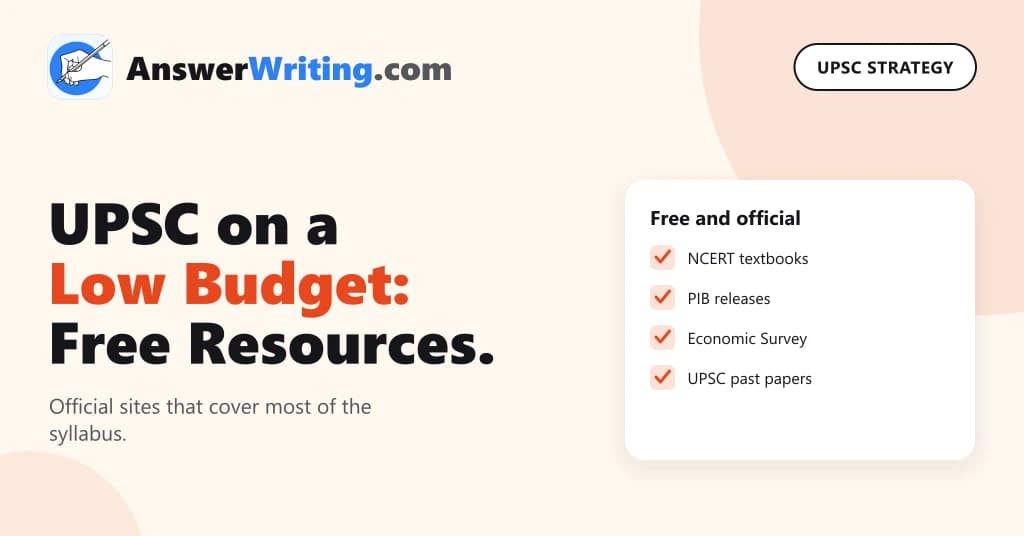
You do not need a lot of money to prepare for UPSC. Most of what you need is free on official government websites: NCERT textbooks, the official syllabus and previous papers, government press releases, the Economic Survey and Budget, and summaries of bills and reports. Add a daily newspaper and a few standard books, and you have a complete base.
This post lists the free official resources that matter most, what each one is for and how to use them in a weekly plan.
The Free Official Resources
| Resource | What it is for | Where |
|---|---|---|
| UPSC notice and syllabus | Exact syllabus and rules | upsc.gov.in |
| Previous question papers | Knowing what UPSC asks | UPSC question papers |
| NCERT textbooks | Base for History, Geography, Polity, Economy, Science | NCERT textbooks |
| Press Information Bureau | Official news on schemes, policies and events | pib.gov.in |
| Economic Survey and Budget | Economy, data and government priorities | indiabudget.gov.in |
| PRS Legislative Research | Simple summaries of bills, Acts and reports | prsindia.org |
| Constitution of India | The official text, for Polity | legislative.gov.in |
| NITI Aayog | Reports and indices on development | niti.gov.in |
| MoSPI | Official statistics and surveys | mospi.gov.in |
| RBI | Monetary policy and reports on the economy | rbi.org.in |
| SWAYAM | Free online courses from Indian universities | swayam.gov.in |
The Publications Division of the government also publishes Yojana and Kurukshetra, two monthly magazines on development and rural issues. They are low-cost, and many libraries keep them.
How to Use Each One
Start with the syllabus and papers
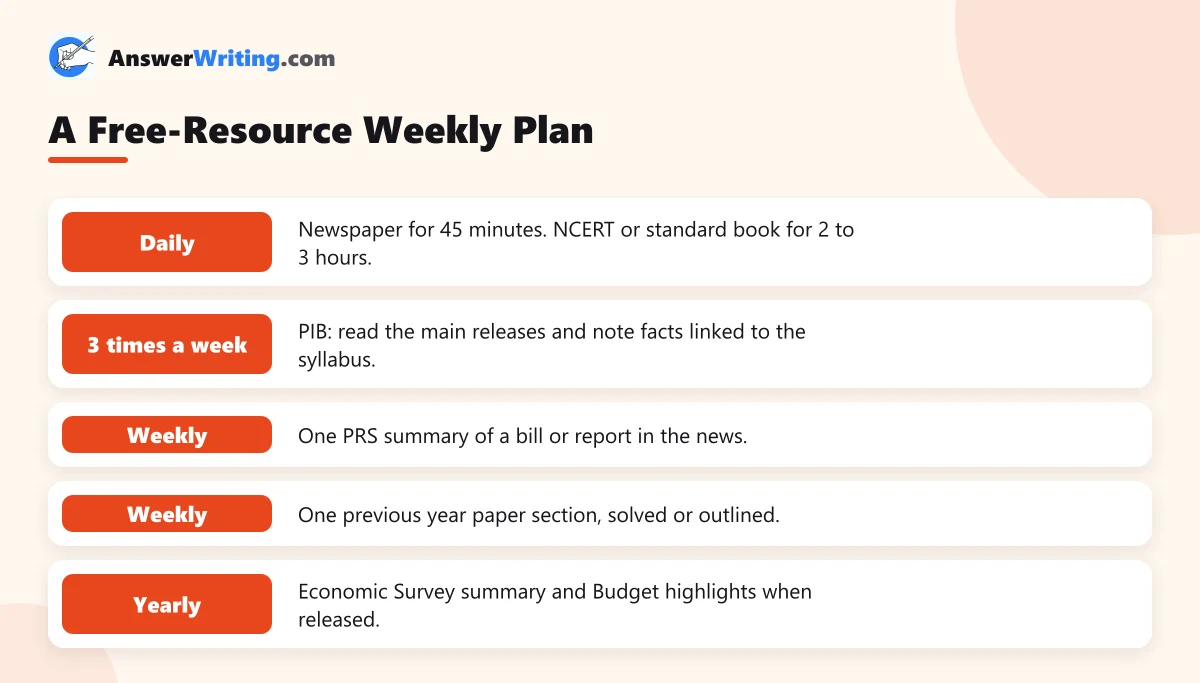
The UPSC syllabus and previous papers are the most important free resources of all. Read the syllabus first, and go through three to five years of papers before you buy any book. This tells you what to read and, just as important, what to skip.
NCERTs for the base
NCERT books from Class 6 to 12 explain each subject in simple language. Read them first for History, Geography, Polity, Economy and Science.
PIB for current affairs
The Press Information Bureau publishes official press releases from every ministry. When a scheme is launched or changed, the release gives the exact facts. Read the main releases two or three times a week, and match them to the syllabus. You can also read them in Hindi and other Indian languages.
Economic Survey and Budget for the economy
The Economic Survey, released before the Union Budget, explains the state of the economy with official data. Read its summary chapter and the chapters linked to the GS3 syllabus. The Budget speech tells you the government’s main plans for the year.
PRS for laws and bills
PRS writes short, simple summaries of bills, Acts and committee reports. When a new law is in the news, read the PRS summary instead of a long newspaper story.
What You Will Still Need
Free official resources cover most of the syllabus, but a few things are worth spending a little on, or borrowing from a library:
- A daily newspaper, in print or digital.
- One standard book per subject after the NCERTs. Our UPSC booklist lists them.
- An atlas for Geography and map practice.
- Practice tests for Prelims, and feedback on your Mains answers.
Public libraries, college libraries and state-run study centres often have these. Many states also run free coaching or study support schemes for aspirants from certain categories; check your state government’s website.
Tips for Preparing on a Low Budget
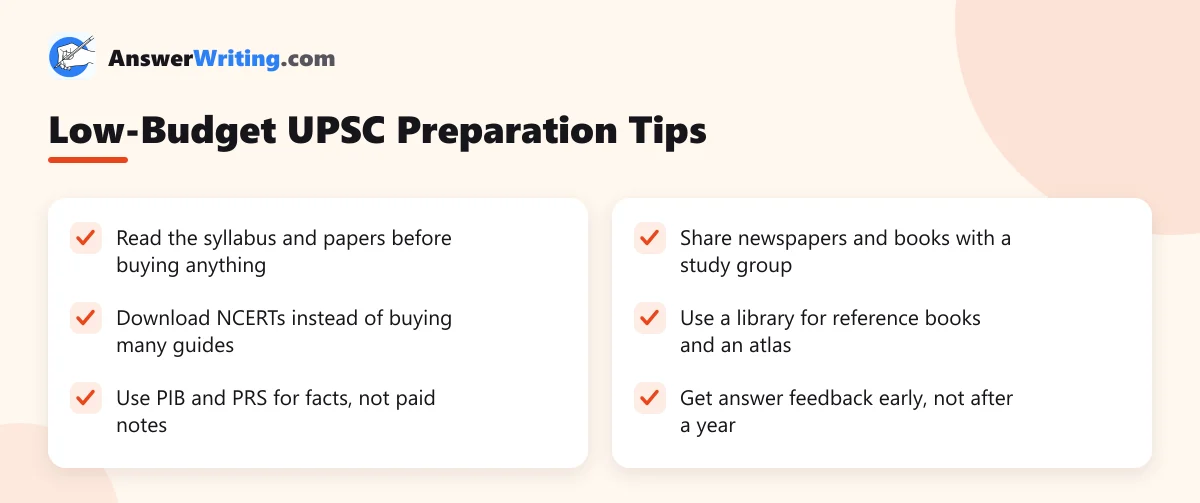
The biggest money mistake is buying many books and notes that cover the same topics. One book read three times is worth more than three books read once. Our post on UPSC coaching vs self-study can help you decide what you really need.
To use these sources in your first months, follow our UPSC preparation plan for beginners.
Key Takeaways
- Most of the UPSC syllabus can be covered with free official resources.
- Start with the official syllabus and previous papers from upsc.gov.in.
- Use NCERTs for the base, PIB for schemes, the Economic Survey for the economy and PRS for laws.
- Spend money only on a newspaper, a few standard books, an atlas and answer feedback.
- Use libraries and study groups to share costs.
Get Free Feedback on Your Answers
Answer feedback is usually the most costly part of preparation. On AnswerWriting, your first three Mains answer evaluations are free: write by hand, upload a photo and get feedback with a model answer in minutes, in English, Hindi and 22 other Indian languages. You can also practise unlimited MCQs and solve previous year questions.
Related Reading
FAQs
Can I prepare for UPSC with only free resources?
You can cover most of the syllabus with free official resources. You will still need a newspaper, a few standard books and some practice tests.
Are NCERT books free?
Yes. NCERT textbooks are free to read and download on the NCERT website.
Is PIB enough for current affairs?
PIB gives official facts on government schemes and policies. Read it along with a daily newspaper for a full picture.
Where can I find previous year UPSC papers for free?
On the UPSC website’s question paper page.
Is the Economic Survey important for UPSC?
Yes, for GS3 and the economy part of Prelims. Read its summary and the chapters linked to the syllabus.