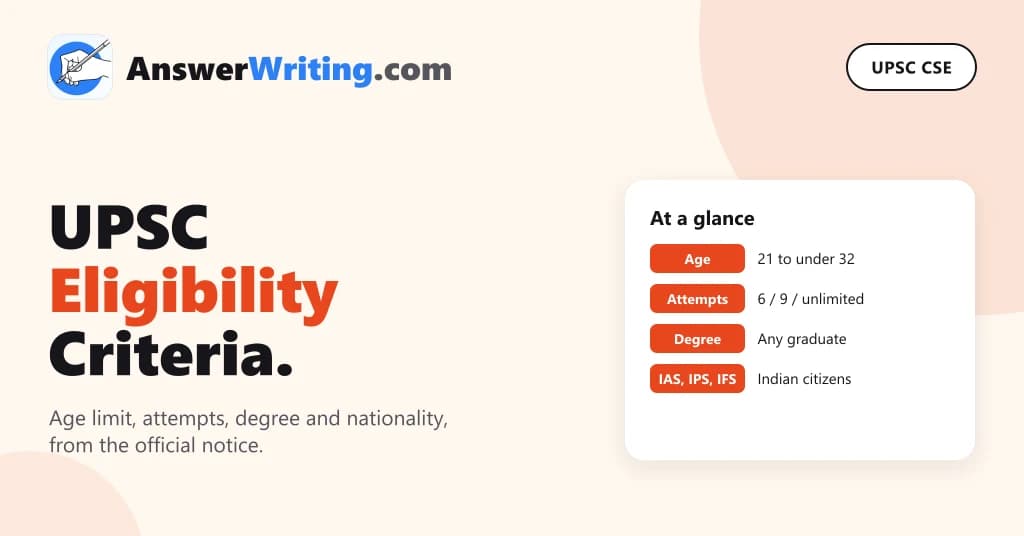
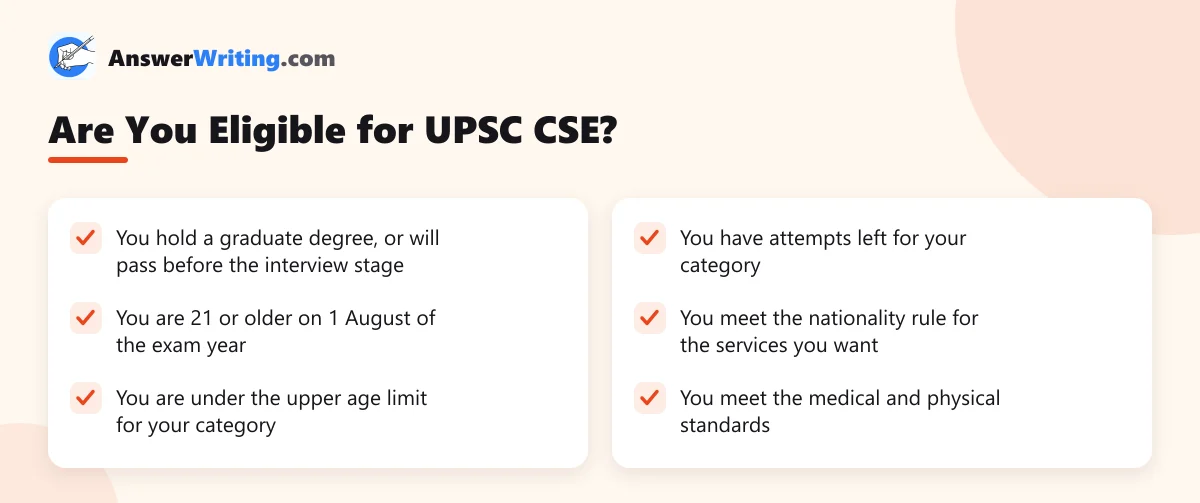
To be eligible for the UPSC Civil Services Exam, you need a graduate degree (final-year students can apply), you must be between 21 and 32 years old on 1 August of the exam year (with relaxation for some categories), and you must have attempts left: 6 for General and EWS candidates, 9 for OBC, and no limit for SC/ST within the age limit. For IAS, IFS and IPS, you must be an Indian citizen.
All rules in this post come from the official CSE 2026 notice on upsc.gov.in. Rules can change each year, so always read the notice for your exam year.
UPSC Eligibility at a Glance
Age Limit
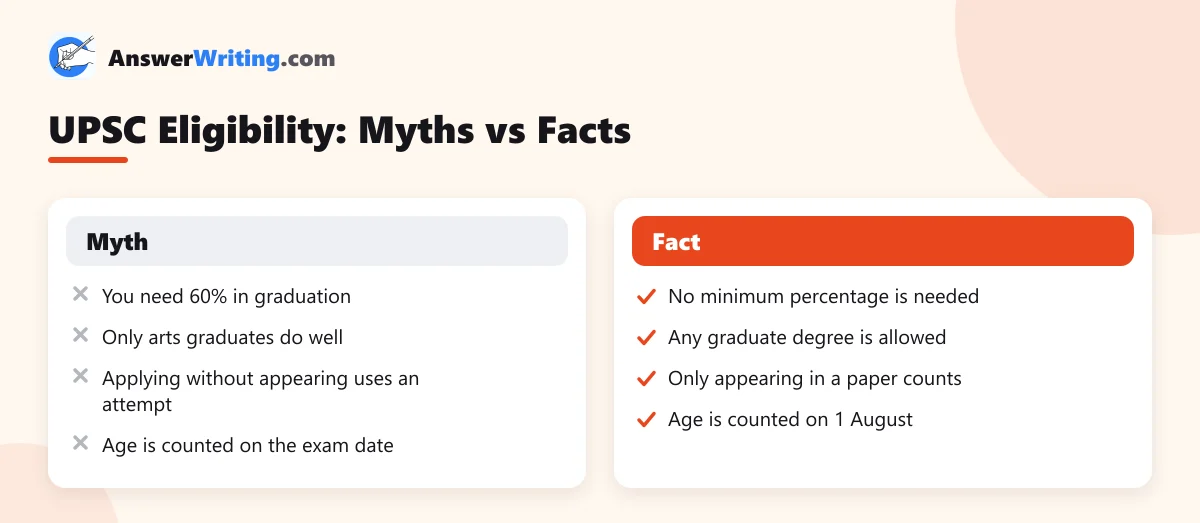
For CSE 2026, you must have reached 21 years and must not have reached 32 years on 1 August 2026. In other words, you must have been born between 2 August 1994 and 1 August 2005.
The upper age limit is relaxed for some groups:
| Category | Relaxation | Upper age (CSE 2026) |
|---|---|---|
| General / EWS | None | Under 32 |
| OBC (eligible for reservation) | Up to 3 years | Under 35 |
| SC / ST | Up to 5 years | Under 37 |
| PwBD | Up to 10 years | Under 42 (more if also SC/ST/OBC) |
| Defence personnel disabled in operations | Up to 3 years | Under 35 |
| Ex-servicemen with 5 years of service (as defined) | Up to 5 years | Under 37 |
If you fall in two groups, such as SC and PwBD, the notice allows the relaxations to add up. The ex-servicemen rules have extra conditions about how and when service ended, so read section 3(II) of the notice if this applies to you.
UPSC accepts the date of birth only as recorded in your Class 10 (matriculation) certificate or an equivalent certificate. Once you submit it, it cannot be changed later.
Number of Attempts
| Category | Attempts allowed |
|---|---|
| General / EWS | 6 |
| OBC | 9 |
| SC / ST | Unlimited (within the age limit) |
| PwBD | 9 for General, EWS and OBC; unlimited for SC and ST |
Two rules about attempts catch many people:
- An attempt at Prelims counts as an attempt at the exam.
- If you appear in even one paper of Prelims, it counts as an attempt. Applying and not appearing does not count.
Read our guide on how to plan your UPSC attempts wisely before you decide when to start.
Educational Qualification
You need a graduate degree from a university set up by a central or state law, a deemed university, or an equivalent qualification. Any subject is fine; there is no minimum percentage.
- Final-year students and those waiting for results can apply for Prelims and Mains.
- If you qualify for the interview, you must show proof of passing your degree within the time UPSC sets.
- MBBS and similar graduates who have not finished their internship can apply, but must show that all requirements, including internship, are complete at the time of the interview.
Nationality
| Service | Who can apply |
|---|---|
| IAS, IFS, IPS | Only citizens of India |
| Other services | Citizens of India, or subjects of Nepal or Bhutan, or Tibetan refugees who came before 1 January 1962 to settle permanently, or certain persons of Indian origin who migrated to settle permanently, with an eligibility certificate from the Government of India |
Who Cannot Apply
The CSE 2026 notice has special rules for candidates already selected through an earlier exam:
- A candidate who is in the IAS or IFS from an earlier exam and continues in that service cannot appear in CSE 2026.
- A candidate already selected or appointed to the IPS cannot choose IPS again through CSE 2026.
- Candidates allocated IPS or a Central Group A service have limited chances to try again, under conditions in section 3(V) of the notice.
Medical and Physical Standards
You must meet the medical and physical standards set out in the exam rules for the services you are allocated. PwBD candidates are eligible for appointment only if, after the medical examination, they meet the physical and medical requirements of the services allocated to PwBD candidates.
Common Questions About Eligibility
If you are still in college, see our post on how to clear Prelims in your first attempt. And if you are new to the exam, start with what UPSC CSE stands for and means.
Once you know you are eligible, follow our 90-day plan to start UPSC preparation.
Key Takeaways
- Age: 21 to under 32 on 1 August of the exam year, with relaxation of 3 years for OBC, 5 for SC/ST and 10 for PwBD.
- Attempts: 6 for General/EWS, 9 for OBC, unlimited for SC/ST within the age limit.
- Any graduate degree works, and final-year students can apply.
- IAS, IFS and IPS need Indian citizenship.
- Appearing in one paper of Prelims counts as an attempt.
Start Preparing Early
Once you know you are eligible, the best time to start writing answers is now, not after Prelims. Try daily answer writing on AnswerWriting: a new question every day, with AI feedback and a model answer. Your first three evaluations are free.
Related Reading
FAQs
What is the age limit for UPSC CSE?
21 to under 32 years on 1 August of the exam year for General and EWS candidates. OBC, SC/ST and PwBD candidates get 3, 5 and 10 years of relaxation.
How many attempts are allowed in UPSC?
6 for General and EWS, 9 for OBC and PwBD (General, EWS, OBC), and unlimited for SC/ST within the age limit.
Can final-year students apply for UPSC?
Yes. You must show proof of passing your degree if you qualify for the interview.
Is there a minimum percentage in graduation for UPSC?
No. Any graduate degree from a recognised university is enough.
Does applying for UPSC count as an attempt?
No. Only appearing in at least one paper of Prelims counts as an attempt.
Can I apply for UPSC after 32?
Only if you belong to a category with age relaxation, like OBC, SC/ST, PwBD or eligible ex-servicemen.