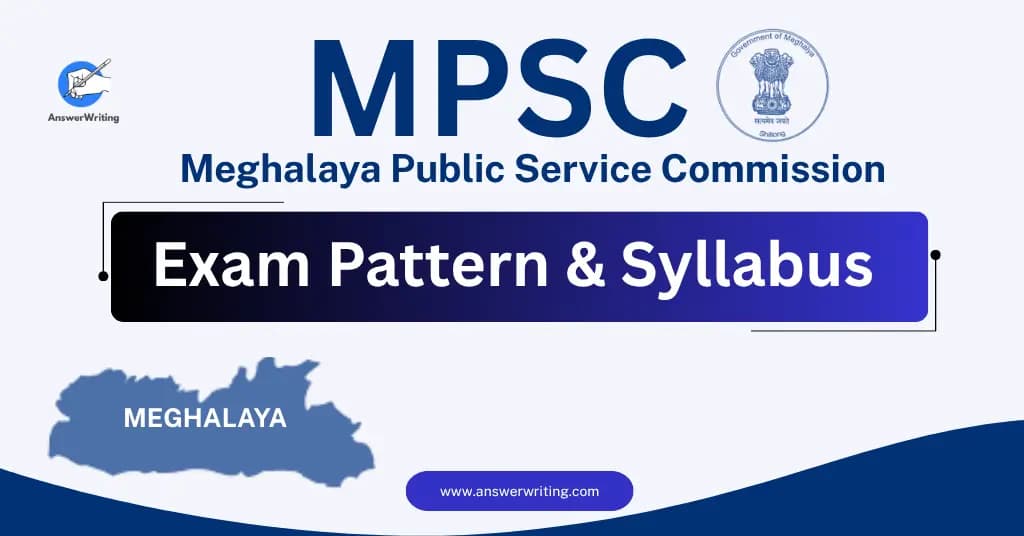
The Meghalaya Public Service Commission (MPSC) is responsible for overseeing the Meghalaya Civil Services Examination, which is used to hire individuals for various administrative roles throughout the state.
The selection procedure is divided into the following three phases:
- Preliminary Exam: The initial screening phase.
- Mains Exam: A more in-depth written evaluation.
- Interview/Personality Test: The final assessment stage.
The Meghalaya PSC Civil Services Preliminary Examination serves as the initial screening phase to shortlist candidates for the Mains. This stage consists of two objective-type (multiple choice) papers.
Prelims Exam Pattern
| Feature | Paper-I: General Studies | Paper-II: CSAT |
| Number of Questions | 100 | 100 |
| Total Marks | 200 marks | 200 marks |
| Duration | 2 hours | 2 hours |
| Negative Marking | $1/3$ marks deducted per wrong answer | $1/3$ marks deducted per wrong answer |
Key Rules & Requirements
- Qualifying Nature: Paper-II (CSAT) is a qualifying paper, meaning you must achieve a minimum set percentage to pass, though these marks aren’t added to your final ranking.
- Mandatory Attendance: You must appear for both papers. If you skip one, you will be disqualified, even if you perform exceptionally well in the other.
- Question Format: All questions are objective-type multiple-choice questions (MCQs).
Paper I: General Studies
This paper focuses on your awareness of the world, our country’s history, and the systems that govern us.
- Current Affairs: Events of national and international significance.
- History: Comprehensive history of India and the Indian National Movement.
- Geography: Physical, social, and economic geography of both India and the world.
- Polity & Governance: The Constitution, political systems, Panchayati Raj, public policy, and rights-based issues.
- Economic & Social Development: Sustainable development, poverty alleviation, inclusion strategies, demographics, and social sector initiatives.
- Environment: General issues regarding environmental ecology, biodiversity, and climate change (no subject specialization required).
- General Science: Broad scientific principles and everyday applications.
Paper II: CSAT (Civil Services Aptitude Test)
This paper is designed to test your analytical and communication skills. Most math-based topics are at a Class X (10th Grade) level.
- Comprehension: Reading and interpreting written passages.
- Interpersonal Skills: Including effective communication skills.
- Logical Reasoning: Analytical ability and logical thinking.
- Decision Making: Practical problem-solving and situational judgment.
- General Mental Ability: Intelligence and aptitude testing.
- Basic Numeracy & Data Interpretation: * Numbers, relations, and orders of magnitude.
- Charts, graphs, tables, and data sufficiency.
Mains Exam Structure
The Meghalaya Civil Services Mains Examination is the second and most critical stage of the recruitment process. Unlike the Prelims, this stage is descriptive (written) and consists of eight papers in total.
The examination is divided into one qualifying paper and seven merit-ranking papers. Each paper has a duration of 3 hours.
| Paper Type | Subject | Total Marks |
| Qualifying Paper | General English | 300 |
| Merit Paper I | Essay | 250 |
| Merit Paper II | General Studies – I | 250 |
| Merit Paper III | General Studies – II | 250 |
| Merit Paper IV | General Studies – III | 250 |
| Merit Paper V | General Studies – IV | 250 |
| Merit Paper VI | Optional Subject Paper – I | 250 |
| Merit Paper VII | Optional Subject Paper – II | 250 |
| Grand Total | (Merit Papers Only) | 1750 |
Crucial Points to Remember
- The Qualifying Hurdle: The General English paper is mandatory, but the marks obtained are not added to your final total. However, you must pass this paper for your other merit papers to even be evaluated.
- Merit Ranking: Your final rank is determined by the combined score of Papers I through VII (totaling 1750 marks) plus your performance in the Interview stage.
- Optional Subjects: You will need to choose one optional subject from a prescribed list, which you will then sit for across two separate papers (Paper VI and VII).
MCS Mains Exam Syllabus for the first two papers focuses on your ability to process information and express complex ideas clearly.
Qualifying Paper: English
This paper is designed to ensure you have a solid grasp of the English language. It is set at a Matriculation (Class 10) level. While it doesn’t count toward your final rank, you must pass it to move forward.
- Objective: To test your ability to read, understand, and express ideas in clear, correct English.
- Key Components:
- Comprehension: Analyzing given passages.
- Precis Writing: Summarizing long texts into concise versions.
- Usage & Vocabulary: Testing grammar and word choice.
- Short Essays: Demonstrating basic writing structure.
Merit Paper I: Essay (250 Marks)
This is the first paper that directly affects your final score. It’s less about “what you know” and more about “how you think.”
- Task: You may be asked to write on multiple topics.
- What Examiners Look For:
- Adherence to Topic: Staying focused without drifting.
- Orderly Logic: Arranging your thoughts in a clear, sequential fashion.
- Conciseness: Writing effectively without unnecessary “fluff.”
- Expression: Credit is awarded for exact and impactful language.
Quick Tip: For the Essay paper, staying updated on the General Studies topics from the earlier images will give you the “fuel” (facts and context) you need to write a compelling 250-mark essay.
Paper II: General Studies – I
Focus: History, Geography, and Society
- History: Modern Indian history (mid-18th century to now), the Freedom Struggle, and post-independence reorganization. It also includes World History (Industrial Revolution, World Wars, and political philosophies like Capitalism and Socialism).
- Society: Features of Indian society, diversity, the role of women, globalization’s effects, and concepts like secularism and regionalism.
- Geography: Physical geography of the world and critical geophysical phenomena like earthquakes, tsunamis, and volcanic activity.
Paper III: General Studies – II
Focus: Governance, Constitution, Polity, Social Justice, and International Relations
- Polity & Constitution: The basic structure of the Indian Constitution, amendments, and the functions of the Executive, Judiciary, and Legislatures.
- Governance: The role of civil services, e-governance, transparency, and accountability. It also covers welfare schemes for vulnerable sections.
- International Relations: India’s relationship with its neighbors and its role in global groupings/agreements.
Paper IV: General Studies – III
Focus: Technology, Economic Development, Biodiversity, Environment, Security, and Disaster Management
- Economy: Planning, resource mobilization, inclusive growth, and government budgeting.
- Agriculture: Major crop patterns, irrigation, food processing, and land reforms in India.
- Science & Tech: Developments and their applications in everyday life.
- Environment & Security: Biodiversity, environmental pollution, and disaster management strategies.
Quick Reference
| Paper | Theme | Main Topics |
| GS I | Past & Place | History, World History, Geography, Indian Society |
| GS II | Rules & Relations | Constitution, Governance, Social Justice, International Relations |
| GS III | Growth & Survival | Economy, Agriculture, Science, Environment, Security |
Paper V: Ethics, Integrity, and Aptitude (250 Marks)
This paper is unique because it doesn’t just test what you know, but who you are and how you handle dilemmas.
- The Goal: To assess your attitude toward integrity, public probity, and problem-solving.
- Key Topics: Human values, lessons from great leaders, moral/political attitudes, and foundational values for civil service (like empathy, tolerance, and impartiality).
- Case Studies: A significant portion of the paper uses real-world scenarios to see how you apply ethical principles in practice.
Papers VI & VII: Optional Subjects (500 Marks Total)
You must choose one subject from the list below. You will take two papers (250marks each) on this single subject. Each paper has 8 questions; you must answer 5.
Available Options include:
- Sciences: Physics, Chemistry, Botany, Zoology, Geology, Mathematics, Statistics.
- Engineering: Civil, Electrical, Mechanical.
- Humanities/Social Sciences: History, Geography, Political Science, Sociology, Psychology, Philosophy, Anthropology, Economics.
- Professional: Law, Management, Medical Science, Commerce & Accountancy.
- Languages/Literature: English, Garo, Hindi, Khasi.
Stage III: The Interview / Personality Test (275 Marks)
If you clear the Mains, you move to this final stage. It’s a directed conversation to see if you have the “mental calibre” for a leadership role.
- What is judged: Mental alertness, logical exposition, leadership, intellectual/moral integrity, and your interest in current affairs.
- Local Knowledge: Expect questions on the customs, manners, and dialects of Meghalaya.
- Final Score: Your interview marks ($275$) are added to your Mains marks ($1750$) for a Grand Total of 2025 marks to determine the final rank.
Final Calculation Table
| Component | Marks |
| Mains (7 Merit Papers) | 1750 |
| Interview | 275 |
| Total Merit Marks | 2025 |