Why UPSC Focuses More on Analysis Than Memory
Why do many aspirants who memorize thousands of facts still struggle to clear the UPSC Civil Services Examination?
The answer is simple. UPSC is not designed to reward memory alone. It rewards understanding, interpretation, and balanced judgement.
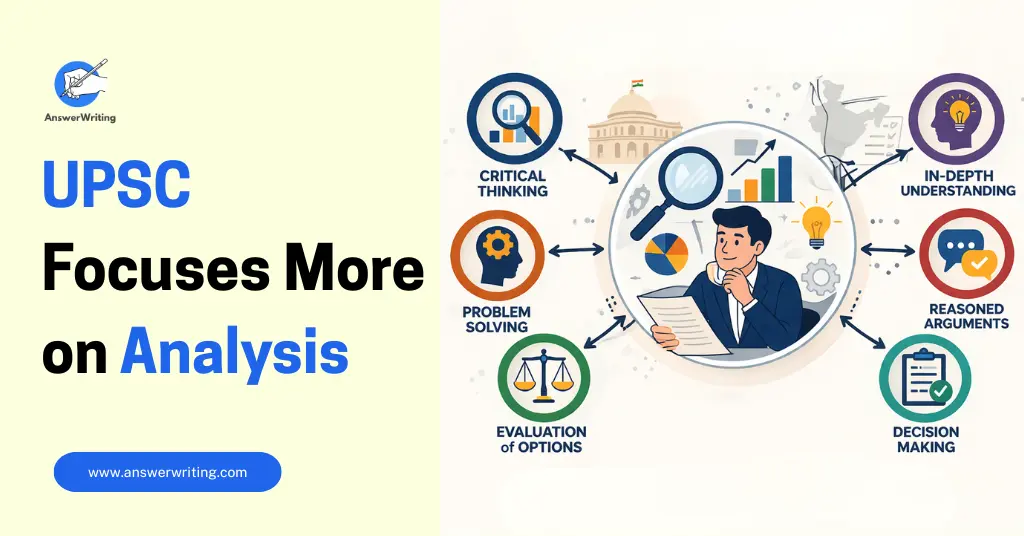
Every year, candidates enter the exam hall with months of notes and hundreds of facts stored in their memory. Yet the question paper demands something else. It asks them to connect ideas, analyse issues, and present reasoned arguments.
This shift from memory to analysis is deliberate. The UPSC exam is meant to select administrators who can handle complex governance challenges, not just recall information.
For serious aspirants, understanding this philosophy is often the turning point in preparation.
Why Many Aspirants Misunderstand the Nature of the UPSC Exam
Many students treat UPSC like a traditional school exam. They believe success comes from memorizing more books, more facts, and more reports.
This approach creates two problems.
First, the syllabus becomes overwhelming. Aspirants keep collecting material but fail to build conceptual clarity.
Second, they struggle to answer questions that require interpretation. Even if they know the topic, they cannot structure a thoughtful answer.
UPSC does not test how much you remember. It tests how well you think.
This difference becomes clear when we compare memory-based exams with analytical exams.
The Fundamental Difference Between Memory-Based Exams and Analytical Exams
| Feature | Memory-Based Exams | Analytical Exams (like UPSC) |
|---|---|---|
| Question Style | Direct factual recall | Conceptual and interpretive |
| Preparation | Memorizing notes | Understanding concepts |
| Evaluation | Right or wrong answer | Quality of argument and structure |
| Knowledge Use | Isolated facts | Interconnected ideas |
| Skill Tested | Recall ability | Reasoning and judgement |
In memory-driven exams, a student may simply recall the exact line from a textbook.
In UPSC, the same topic may appear in a completely new form. Candidates must apply their understanding to unfamiliar questions.
This design reflects the real nature of governance.
Why UPSC Prefers Analytical Thinking
Civil Servants Solve Problems, Not Question Banks
A district magistrate or policy officer rarely deals with textbook questions.
They face complex issues such as water scarcity, public health crises, or conflicts between development and environmental protection.
These problems require judgement, evidence-based reasoning, and balanced decision making.
UPSC therefore tests whether candidates can evaluate a situation from multiple angles.
India’s Policy Problems Are Complex
India’s development challenges are rarely simple.
Consider climate change. It connects environment, agriculture, economy, and international diplomacy.
A civil servant must understand these interconnections before designing policy solutions.
UPSC reflects this complexity in its questions.
For example, a question on renewable energy may also require discussion of economic growth, environmental sustainability, and technological innovation.
The Constitutional Vision Behind the Examination
The Constitution expects the civil services to function as a professional and impartial administrative system.
The framers of the Constitution believed governance requires competence, objectivity, and ethical judgement.
Analytical thinking helps administrators balance competing interests such as development, equity, and sustainability.
This constitutional vision indirectly shapes the design of the UPSC examination.
How the UPSC Exam Pattern Encourages Analysis
The exam pattern itself shows why analysis matters more than memory.
Prelims Questions That Test Conceptual Understanding
The Preliminary Examination contains objective questions. At first glance, they appear factual.
However, many questions test conceptual clarity rather than simple recall.
For example, environment questions often describe ecological situations and ask candidates to apply scientific understanding.
Similarly, economy questions may present policy scenarios instead of asking direct definitions.
Successful candidates rely on elimination techniques and conceptual reasoning.
Mains Questions That Demand Multi-Dimensional Thinking
The Mains examination clearly rewards analytical ability.
Most questions include directive words that require interpretation and balanced discussion.
Common directive words include:
- Analyse
- Examine
- Critically evaluate
- Discuss
- Comment
These directives require candidates to explain causes, consequences, and multiple perspectives.
A purely factual answer rarely receives high marks.
The Interview Stage and Analytical Personality Assessment
The Personality Test, often called the UPSC interview, is the final stage of the examination.
The board does not test academic memory. Instead, it evaluates judgement, clarity of thought, and awareness of social issues.
Candidates may face questions about current events, ethical dilemmas, or administrative challenges.
The goal is to assess how they think under pressure and justify their reasoning.
Real Examples of Analytical UPSC Questions
Past questions clearly show UPSC’s preference for analytical thinking.
Consider the following types of questions.
Example 1 (Polity):
“Discuss the significance of the basic structure doctrine in protecting constitutional democracy in India.”
This question does not ask candidates to simply define the doctrine. It expects them to explain its role in safeguarding democratic principles.
The doctrine itself emerged from the landmark Supreme Court case Kesavananda Bharati vs State of Kerala (1973).
Candidates must connect constitutional law, judicial review, and democratic governance.
Example 2 (Economy):
“Examine the role of digital payments in promoting financial inclusion in India.”
A factual answer listing payment platforms would be insufficient. The candidate must discuss benefits, limitations, and policy challenges.
Example 3 (Environment):
“Evaluate the effectiveness of community participation in forest conservation.”
Here, candidates must link environmental policy, local governance, and sustainable development.
Each question demands interpretation and balanced reasoning.
Why Memorization Alone Often Fails in UPSC
Many aspirants initially rely heavily on memorization.
This strategy may work in short exams, but UPSC requires deeper understanding.
Three major problems arise when preparation focuses only on memory.
First, information overload becomes inevitable. The syllabus covers multiple disciplines such as polity, economy, history, science, and environment.
Second, facts remain disconnected. Without conceptual understanding, students cannot link topics across subjects.
Third, answer writing becomes weak. Analytical questions require structured arguments supported by evidence.
Candidates who only memorize facts often struggle to present coherent answers within the word limit.
How Aspirants Can Develop Analytical Thinking
Analytical thinking is a skill that improves with deliberate practice.
The following strategies help aspirants shift from memorization to deeper understanding.
- Focus on why and how, not just what. Ask why a policy exists and how it affects society.
- Interlink subjects. For example, connect geography with agriculture or environment with economic policy.
- Study previous year questions to understand the analytical pattern.
- Practice answer writing regularly. Writing forces you to organize ideas logically.
- Seek evaluation and feedback.
Many aspirants today use platforms where teachers review handwritten answers and provide structured feedback. Platforms such as AnswerWriting.com allow students to upload their answers and receive detailed evaluation.
This process helps identify weak arguments, missing dimensions, and structural issues. Over time, such feedback significantly improves analytical presentation.
How Analytical Preparation Improves Performance in Every Stage
Analytical preparation benefits all three stages of the UPSC examination.
| Exam Stage | Skill Required | Example |
|---|---|---|
| Prelims | Conceptual clarity | Eliminating incorrect options using logic |
| Mains | Structured analysis | Explaining causes, impacts, and solutions |
| Interview | Balanced judgement | Discussing policy issues with nuance |
When aspirants develop analytical thinking, their preparation becomes more efficient.
Instead of memorizing endless facts, they understand the logic behind topics. This improves retention and answer quality.
Final Thoughts: UPSC Is Testing a Way of Thinking
The UPSC Civil Services Examination is often described as the toughest exam in India. But its real challenge is not the syllabus size.
The real challenge is changing the way you study and think.
Aspirants who focus only on memorization treat preparation like a race to collect information.
Successful candidates take a different approach. They try to understand issues deeply, connect ideas across subjects, and present balanced arguments.
This approach reflects the real demands of public administration.
Civil servants must analyse problems, evaluate evidence, and design solutions that serve society.
UPSC therefore rewards candidates who demonstrate clarity of thought, intellectual curiosity, and sound judgement.
Facts remain important, but they are only the starting point. Analysis turns those facts into meaningful answers.
FAQs
Can UPSC be cleared without memorizing facts?
No. Some factual knowledge is essential. However, memorization alone is not enough. Candidates must understand concepts and apply them to analytical questions.
How much factual knowledge is actually needed?
Aspirants should remember key constitutional articles, important historical events, major reports, and basic data. The focus should remain on conceptual clarity.
How do I convert static knowledge into analytical answers?
Start by asking three questions for every topic: Why is it important? What are its impacts? What are the possible solutions? This approach automatically builds analytical depth.
How important is answer writing practice?
It is crucial for Mains preparation. Writing helps you organize arguments and improve clarity. Regular evaluation also reveals gaps in reasoning.
Are coaching institutes necessary for developing analysis?
Not necessarily. Many aspirants develop analytical skills through self-study, previous year questions, and structured feedback platforms that evaluate handwritten answers.