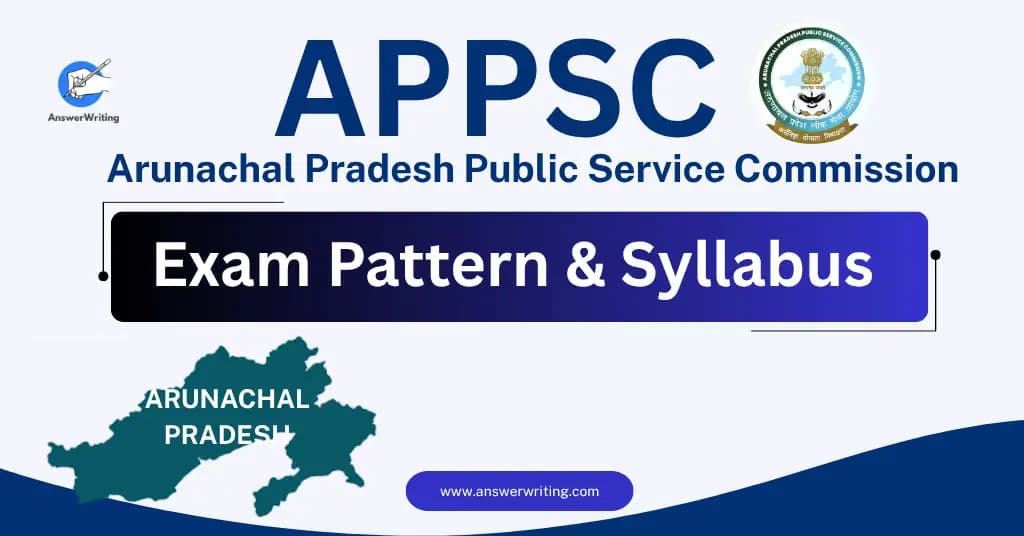
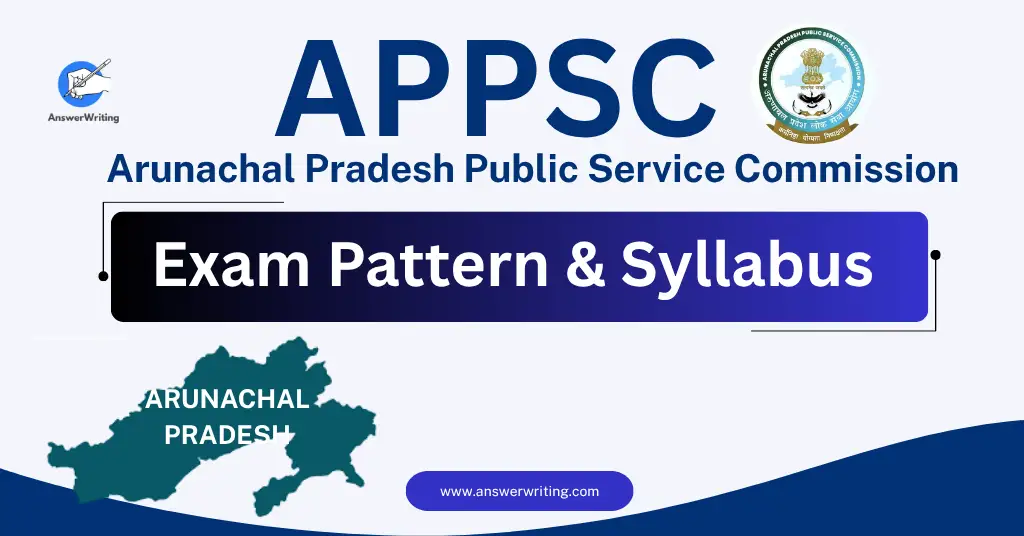
The Arunachal Pradesh Public Service Commission conducts the Combined Competitive Examination (CCE) to fill various administrative roles in the state. The selection process has three stages:
- Preliminary Examination
- Mains Examination
- Interview/Personality Test.
Stage I: Preliminary Examination
The Prelims serves as a filtering stage to shortlist candidates for the Mains. It has two objective-type papers, each structured as follows:
| Feature | Paper I | Paper II |
| Questions | 100 | 100 |
| Total Marks | 200 | 200 |
| Duration | 2 hours | 2 hours |
| Subject | General Studies | CSAT |
| Negative Marking | 1/3 of marks per wrong answer | 1/3 of marks per wrong answer |
Paper I – General Studies Syllabus
Covers awareness-based topics including national and international current affairs, Indian history and the freedom movement, geography of India and the world, Indian politics and governance, economic and social development, environmental ecology, and general science.
Paper II – CSAT Syllabus
Focuses on aptitude and cognitive skills: interpersonal skills, logical and analytical reasoning, general mental ability, basic numeracy, reading comprehension, decision-making, and problem-solving.
Stage II: Mains Examination
APPSC-CCE Mains (Total: 1750 Marks)
The Mains consists of 1 qualifying paper and 7 descriptive merit papers, each 3 hours long.
| Paper | Subject | Marks |
| Qualifying Paper | General English | 300 |
| Paper I | Essay | 250 |
| Paper II | General Studies – I | 250 |
| Paper III | General Studies – II | 250 |
| Paper IV | General Studies – III | 250 |
| Paper V | General Studies – IV | 250 |
| Paper VI | Optional Subject – I | 250 |
| Paper VII | Optional Subject – II | 250 |
Qualifying Paper: General English (300 Marks)
Tests basic language skills reading comprehension, précis writing, vocabulary, and short essay writing. This is at matriculation level and scores here do not count toward merit ranking.
Paper I: Essay (250 Marks)
Candidates write essays on multiple topics. Clear thinking, logical organisation, and precise expression are rewarded.
Paper II: General Studies – I – Indian Heritage, History & Geography (250 Marks)
- Indian art, literature, and architecture from ancient through modern times
- Modern Indian history from the mid-18th century – key events, personalities, and issues
- Phases of India’s freedom struggle and contributions from across the country
- Post-independence national consolidation and reorganisation
- World history from the 18th century industrial revolution, world wars, colonisation, decolonisation, and major political ideologies
- Key features of Indian society, diversity, women’s issues, poverty, urbanisation, and effects of globalisation
- Social empowerment, communalism, regionalism, and secularism
- Physical geography of the world, distribution of natural resources, industrial location factors, and geophysical events like earthquakes, tsunamis, and volcanic eruptions
Paper III: General Studies – II – Governance, Constitution, Polity & International Relations (250 Marks)
- Historical development, evolution, and core features of the Indian Constitution
- Centre-State relations, federal structure, and devolution of powers to local bodies
- Separation of powers, dispute resolution mechanisms, and constitutional bodies
- Comparison of India’s constitutional model with other countries
- Parliament and State Legislature structure, functioning, and privileges
- Executive and Judiciary structure; government ministries and pressure groups
- Representation of the People Act; appointments to constitutional posts
- Statutory, regulatory, and quasi-judicial bodies
- Governance and political history of Arunachal Pradesh since 1947
- Government policies for development; role of NGOs, SHGs, and civil society
- Welfare schemes for vulnerable groups; social sector issues in health, education, and human resources
- Poverty, hunger, and food security challenges
- Good governance: transparency, e-governance, citizen charters, and accountability
- Role of civil services in a democracy
- India’s neighbourhood relations, bilateral and multilateral agreements, and impact of global politics on India
- Major international institutions and their functions
Paper IV: General Studies – III – Technology, Economy, Environment & Security (250 Marks)
- Indian economy: planning, resource mobilisation, growth, and employment
- Inclusive growth, government budgeting, and investment models
- Agriculture: crop patterns, irrigation, storage, transport, subsidies, MSP, food security, and animal husbandry
- Food processing industries and supply chain management
- Land reforms and effects of liberalisation on industry
- Infrastructure: energy, ports, roads, airports, and railways
- Science and technology developments and their everyday applications
- Indian achievements in science and technology; indigenisation of technology
- Emerging areas: IT, space, robotics, nanotechnology, biotechnology, and intellectual property rights
- Environmental conservation, pollution, degradation, and impact assessment
- Disaster management
- Internal security: extremism, role of media and social networks, cyber security, money laundering, organised crime, and border management
- Security forces and their mandates
Paper V: General Studies – IV – Ethics, Integrity & Aptitude (250 Marks)
This paper uses case studies to assess a candidate’s values and approach to real-world dilemmas. Topics include:
- Ethics in human life – its nature, dimensions, and consequences; human values drawn from great leaders and teachers
- Attitude its formation, influence on behaviour, and social dimensions
- Core civil service values: integrity, impartiality, objectivity, empathy, and public service commitment
- Emotional intelligence and its role in governance
- Contributions of moral thinkers from India and the world
- Ethics in public administration: dilemmas, accountability, laws, and regulations as ethical guides
- Probity in governance: RTI, codes of conduct, citizen charters, work culture, and anti-corruption measures
- Case studies on the above themes
Papers VI & VII: Optional Subject (250 Marks Each)
Each optional paper has 8 questions split into Part A and Part B (4 questions each). Candidates must answer 5 questions, with at least 2 from each part.
Available optional subjects include Agriculture, Anthropology, Botany, Chemistry, Civil Engineering, Commerce & Accountancy, Economics, Electrical Engineering, Geography, Geology, History, Law, English, Hindi, Management, Mathematics, Mechanical Engineering, Medical Science, Philosophy, Physics, Political Science & International Affairs, Psychology, Public Administration, Sociology, Statistics, and Zoology.
Stage III: Interview / Personality Test
This is the final and concluding stage of the APPSC CCE selection process, carrying 275 marks.
What is Evaluated:
The interview assesses far more than academic knowledge. The panel examines a candidate’s complete personality profile, including:
- Communication & awareness – how effectively the candidate expresses ideas and stays informed about current affairs
- Intellectual ability – sharpness of mind, capacity to absorb information, and clarity of logical thinking
- Cultural familiarity – knowledge of Arunachal Pradesh’s customs, traditions, and dialects
- Judgment & balance – ability to weigh situations carefully and arrive at well-reasoned conclusions
- Social qualities – leadership potential, ability to work within a group, and capacity for social cohesion
- Character – intellectual honesty and moral integrity
Final Merit Calculation:
Interview marks (out of 275) are combined with Mains scores (out of 1750) to produce a grand total out of 2025, on which the final merit ranking is based.