Write Confidently, Score Higher with AnswerWriting
Refine your UPSC/PCS Mains answers with clinical precision. Our AI-driven evaluation ensures clarity, relevance, and structured writing — helping you improve with every attempt.
Tip: Cite a recent SC judgement in the introduction to strengthen your opening.
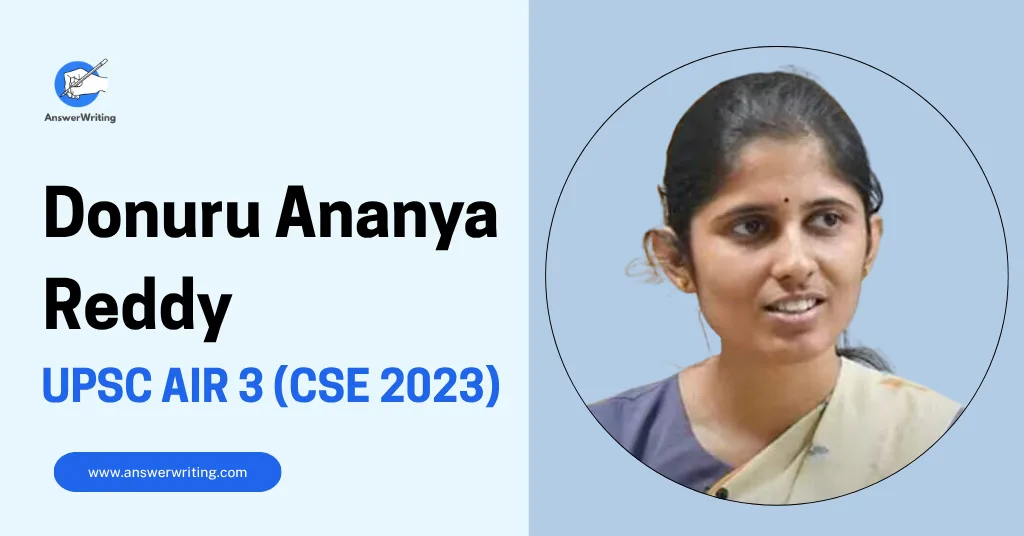
Donuru Ananya Reddy: UPSC AIR 3 (CSE 2023), Strategy, and a First-Generation Success Story | AnswerWriting
Donuru Ananya Reddy: UPSC AIR 3 (CSE 2023), Strategy, and a First-Generation Success Story
Her grandfather envisioned her as a civil servant before she had even finished school. Her father farms land in Mahabubnagar, Telangana. Her mother is a homemaker. No one in her family had ever cleared a civil services examination before her.
Donuru Ananya Reddy secured AIR 3 in UPSC CSE 2023. She was 22 years old. It was her first attempt.
She was also the top woman ranker in the entire 2023 batch, in a year where AIR 1 and AIR 2 both went to men. A Geography graduate from Miranda House who chose Anthropology as her optional. A first-generation civil servant from a small district in Telangana who outperformed nearly six lakh candidates who appeared in the same cycle.
The rank did not come from privilege. It came from a very specific kind of preparation, and from a grandfather’s belief that became a granddaughter’s reality.
Who Is Donuru Ananya Reddy?
Parameter
Details
Full Name
Donuru Ananya Reddy
AIR
3
Exam Year
UPSC CSE 2023
Total Score
1065 out of 2025
Number of Attempts
1 (first attempt)
Optional Subject
Anthropology
Medium
English
Age at Result
22 years
Birthplace
Mahabubnagar, Telangana
Education
B.A. (Hons.) Geography, Miranda House, Delhi University, 2021
Service Allotted
IAS (cadre to be verified from official UPSC allocation list)
Family Background
First in family to clear civil services
Top Woman Ranker
UPSC CSE 2023
Her father, Donuru Suresh Reddy, is self-employed and involved in agriculture. Her mother, Manjula Reddy, is a homemaker. Her younger sister scored 99.99 percentile in JEE Main 2024, placing exceptional academic achievement firmly in the family’s recent history even if civil services was a first.
Her grandfather’s early belief in her potential for public service is not a decorative detail. It was the motivational anchor she returned to across months of intensive preparation.
Donuru Ananya Reddy UPSC Marksheet and Score Details
Component
Marks
Essay
136
General Studies Paper 1
109
General Studies Paper 2
121
General Studies Paper 3
98
General Studies Paper 4
136
Anthropology Paper 1
138
Anthropology Paper 2
137
Written Total
875
Interview (Personality Test)
190
Grand Total
1065
Two numbers stand out immediately. Her GS Paper 4 (Ethics) score of 136 and her Essay score of 136 are among the strongest in her paper-wise breakdown. Both are writing-intensive papers that reward structured thinking, clarity of expression, and depth of values-based reasoning. Those are precisely the areas where consistent writing practice pays off most visibly.
Her Anthropology combined score of 275 out of 500 (Paper 1: 138, Paper 2: 137) reflects remarkable consistency across both optional papers, a sign of thorough and even preparation rather than over-reliance on one paper to compensate for the other.
Her GS Paper 3 score of 98 is the lowest across her GS papers, a reminder that even AIR 3 candidates have uneven paper-wise performances. Strong scores elsewhere absorbed that dip and still produced a written total of 875.
Cross-check all paper-wise figures from official UPSC publications and verified interview transcripts.
Educational Background and Early Life
Ananya completed her Class 10 from Geetham School, Telangana, scoring a perfect 10 CGPA in 2016. She followed that with 97% in Class 12 from Narayana School in 2018.
She then moved to Delhi for her undergraduate education, securing admission to Miranda House, University of Delhi, for a B.A. (Hons.) in Geography, graduating in 2021. Miranda House is consistently ranked among India’s top women’s colleges and its academic environment, particularly its emphasis on analytical writing and social science thinking, aligned well with what UPSC Mains eventually demanded of her.
Her Geography graduation is relevant beyond the degree itself. Geography as a discipline trains students to think across physical, human, economic, and political dimensions simultaneously. That multi-dimensional thinking mapped directly onto GS Paper 1 (physical and human geography), GS Paper 3 (resource management, disaster management, environment), and her Anthropology optional, which shares significant conceptual territory with social and cultural geography.
Growing up in Mahabubnagar, a district in Telangana that is not typically associated with UPSC preparation culture, and then building a preparation strategy that produced AIR 3 on a first attempt, reflects a degree of self-directed discipline that cannot be attributed to environment alone.
Her grandfather’s vision was the seed. Her own preparation was the architecture.
How Many Attempts Did Donuru Ananya Reddy Take?
Donuru Ananya Reddy cleared UPSC CSE in her very first attempt, at age 22.
She began serious UPSC preparation after completing her graduation from Miranda House in 2021. That gave her approximately two to three years of dedicated preparation before appearing in UPSC CSE 2023.
Unlike candidates who carry the weight of previous attempt failures into their preparation, she approached her first attempt with the full benefit of an uninterrupted preparation cycle. There were no marksheets from previous years to analyze, no specific failures to correct. Her challenge was different: building the entire preparation from scratch, correctly, the first time.
She succeeded by keeping her approach flexible rather than rigid. She did not follow a fixed hour-by-hour timetable. Instead, she structured her preparation around syllabus coverage targets and revision milestones, adjusting daily effort based on topic complexity and her own retention levels. That flexibility prevented the burnout that rigid schedules often produce during long preparation cycles.
Her first-attempt success at 22 places her among the youngest top rankers in recent UPSC history, alongside Animesh Pradhan (AIR 2, also first attempt, also 23) in the same 2023 batch.
Choosing Anthropology as an optional when your graduation subject is Geography is a deliberate, researched decision. It requires explanation because it is not the obvious path.
Ananya researched optional subjects carefully before settling on Anthropology. Her reasoning was grounded in three factors.
First, Anthropology has a relatively compact and well-defined syllabus compared to many other optional subjects. A focused candidate can achieve deep coverage within a manageable preparation window, which matters enormously for a first-attempt strategy where time is finite.
Second, Anthropology overlaps meaningfully with GS Paper 1 on Indian society, social change, tribal issues, and cultural diversity. It also reinforces GS Paper 4 on ethics, where understanding human values, social norms, and moral reasoning from an anthropological lens adds depth and originality to answers. Her GS Paper 4 score of 136 reflects that reinforcement directly.
Third, Anthropology rewards clarity of conceptual thinking and structured written expression over rote memorization of large factual databases. That suited her preparation style, which emphasized understanding over accumulation.
She attended coaching specifically for Anthropology optional in Hyderabad (as per available reports), recognizing that a science-adjacent subject with specific technical content benefited from structured classroom guidance. For all other subjects, she was self-directed.
Her Anthropology combined score of 275 out of 500 is a solid, even performance that confirmed the choice was right for her profile.
Standard books aspirants use for Anthropology optional, aligned with the preparation approach Ananya followed, include:
P.K. Nanda for Physical Anthropology
Nadeem Hasnain for Indian Anthropology and tribal studies
IGNOU BA and MA Anthropology notes for structured syllabus coverage
R.N. Sharma for Social and Cultural Anthropology
Previous years’ UPSC Anthropology papers for answer pattern calibration
The lesson for aspirants: research your optional based on syllabus size, GS overlap, and alignment with your thinking style. Do not choose based on what appears most popular in online forums.
UPSC Preparation Strategy of Donuru Ananya Reddy
Ananya’s preparation was built around four core principles: flexible scheduling, smart coverage over exhaustive reading, multiple revisions, and consistent writing practice.
Flexible timetable over rigid scheduling. She did not follow a fixed hour-by-hour daily plan. She set weekly coverage targets by subject and topic, then adjusted her daily effort based on what each day allowed. This approach reduced the psychological cost of missing a rigid schedule and kept her preparation sustainable across a multi-year cycle.
Study hours. She studied 12 to 14 hours per day during her peak preparation phase (as per available reports). That intensity was sustainable because she built in deliberate breaks, including watching cricket matches and reading Dan Brown novels, as stress management tools rather than treating them as distractions to be eliminated.
Smart work over rote learning. She repeatedly emphasized understanding concepts rather than memorizing them. For UPSC, conceptual clarity converts into better answer writing, more accurate MCQ elimination, and more confident interview responses. Memorization without understanding breaks down under exam pressure. Conceptual understanding does not.
Multiple revisions. She revised every topic multiple times before the exam. Single-reading preparation is one of the most common mistakes among first-time aspirants. UPSC tests retrieval under time pressure, not first-read familiarity. Multiple revisions are what convert familiarity into reliable retrieval.
Current affairs. She followed ForumIAS for current affairs tracking and tagged news items to specific GS paper headings. That systematic tagging prevented current affairs from becoming an unmanageable flood of unconnected information.
Coaching. She attended coaching specifically for Anthropology optional in Hyderabad. For all other subjects, she relied on self-study using standard reference books and NCERTs.
Books and Resources Recommended by Donuru Ananya Reddy
Subject
Book / Resource
Author / Source
Indian Polity
Indian Polity
M. Laxmikanth
Modern History
India’s Struggle for Independence
Bipan Chandra
Ancient and Medieval History
NCERT Class 6 to 12
NCERT
Geography
Certificate Physical and Human Geography
G.C. Leong
Indian Economy
Indian Economy
Ramesh Singh
Environment and Ecology
Shankar IAS Environment
Shankar IAS
Ethics (GS4)
Ethics, Integrity and Aptitude
G. Subba Rao and P.N. Roy Chowdhury
Current Affairs
ForumIAS Current Affairs
ForumIAS
Anthropology Optional
Physical Anthropology
P.K. Nanda
Anthropology Optional
Indian Anthropology
Nadeem Hasnain
Anthropology Optional
IGNOU BA and MA Anthropology Notes
IGNOU
Anthropology Optional
Social and Cultural Anthropology
R.N. Sharma
Anthropology Optional
Previous Years UPSC Anthropology Papers
UPSC
Cross-check this list against her published interviews, as specific recommendations may vary by paper and preparation phase.
Mains Answer Writing Approach
Ananya’s Essay score of 136 and her GS Paper 4 score of 136 are the two most instructive numbers in her marksheet for aspirants thinking about answer writing. Both papers reward the same skill: the ability to construct a clear, well-organized argument and sustain it across a full answer length.
Her answer writing approach was structured around consistency of format. Every answer began with a direct introduction that framed the question without restating it. The body organized arguments into clear sub-points, supported by data, policy references, constitutional provisions, or case studies from current affairs. The conclusion connected to governance outcomes, constitutional values, or a forward-looking policy direction.
She practiced writing full-length answers under timed conditions throughout her preparation, not just in the final weeks before Mains. That habit built the speed and structural discipline needed to execute consistently across a full Mains schedule, which runs across multiple days with heavy answer loads each day.
She used diagrams and flowcharts selectively in GS Paper 1 (geography-heavy topics), GS Paper 3 (economy, infrastructure, disaster management), and Anthropology answers where visual representation of kinship structures or evolutionary timelines added precision. Diagrams were deployed purposefully, not as a default.
For aspirants who want to build this kind of evaluated answer writing practice, platforms like AnswerWriting.com offer a Daily Answer Writing feature with fresh daily prompts and progress tracking over time. Building the habit early, with regular external feedback, is what separates consistent Mains performers from candidates who know the content but cannot translate it reliably onto paper.
Word limit discipline was non-negotiable in her practice. She trained herself to express complete, well-supported arguments within UPSC’s expected word ranges, recognizing that writing more is not the same as writing better.
Interview (Personality Test) Experience
Ananya scored 190 out of 275 in the Personality Test. That is a confident performance from a 22-year-old first-attempt candidate appearing before a UPSC board for the first time.
Her DAF presented a distinctive profile: a Geography graduate from Miranda House, an Anthropology optional candidate, a first-generation civil services aspirant from Mahabubnagar, a cricket fan, a Dan Brown reader, and someone with a strong connection to her grandfather’s early belief in her potential. Each of those threads gave the board multiple directions to probe.
She attended mock interview sessions before the actual board appearance (as per available reports) to stress-test her answers and build confidence in articulating her preparation choices clearly. Questions she would have anticipated include: Why Anthropology for a Geography graduate? What does being a first-generation civil servant from your district mean to you? How does your understanding of tribal anthropology connect to the governance challenges you expect to face in the field?
Her score of 190 suggests the board found her genuine, grounded, and intellectually coherent. Those qualities are prepared for, not simply possessed.
Service and Cadre Allotted to Donuru Ananya Reddy
With AIR 3, Donuru Ananya Reddy is allotted the IAS. The specific state cadre had not been officially confirmed in all publicly available reports at the time of writing. Readers should verify cadre allotment from the official UPSC allocation list once published.
As the top woman ranker in UPSC CSE 2023, her result attracted significant national attention, particularly in Telangana where she became one of the most visible examples of a first-generation civil services achiever from a non-metro district.
Key Lessons Every UPSC Aspirant Can Take from Donuru Ananya Reddy
Your optional subject does not have to match your graduation subject. Ananya studied Geography at Miranda House and chose Anthropology as her optional. The right optional is the one with the best combination of manageable syllabus, GS overlap, and alignment with your thinking style. Research that combination carefully before committing.
Flexible preparation outperforms rigid timetables for long preparation cycles. She did not follow a fixed hour-by-hour daily plan. She set weekly syllabus targets and adjusted daily effort to match. Over a two to three year preparation window, that flexibility is what keeps preparation sustainable and prevents burnout.
Multiple revisions are not optional, they are the process. She revised every topic multiple times before the exam. Single-reading preparation produces familiarity. Multiple revisions produce the reliable retrieval that UPSC Mains and Prelims actually test. Build revision time into your preparation from day one, not as an afterthought in the final weeks.
Stress management is preparation, not a distraction. She watched cricket and read Dan Brown novels as deliberate stress relief during her preparation. Sustainable performance across a multi-year preparation cycle requires recovery. Treating rest and recreation as wasted time is a preparation mistake, not a virtue.
Writing quality determines GS Paper 4 and Essay scores more than content volume does. Her scores of 136 in both Essay and GS Paper 4 reflect structured, clear, values-driven writing, not more content than other candidates. Practice writing these papers as argument-construction exercises, not as content-recall exercises.
FAQs About Donuru Ananya Reddy
What is Donuru Ananya Reddy’s UPSC rank? She secured AIR 3 in UPSC Civil Services Examination 2023, results declared April 16, 2024. She was the top woman ranker in the 2023 batch.
What was Donuru Ananya Reddy’s optional subject in UPSC? Her optional subject was Anthropology.
How many attempts did Donuru Ananya Reddy take to clear UPSC? She cleared UPSC CSE in her very first attempt, at age 22.
What is Donuru Ananya Reddy’s total UPSC score? Her total score is 1065, comprising a written total of 875 and an interview score of 190 out of 275.
Which college did Donuru Ananya Reddy attend? She completed her B.A. (Hons.) in Geography from Miranda House, University of Delhi, graduating in 2021.
Did Donuru Ananya Reddy attend coaching for UPSC? She attended coaching specifically for her Anthropology optional in Hyderabad. For all other subjects, she prepared through self-study using standard reference books and NCERTs. She used ForumIAS for current affairs tracking, as per available reports.
Where is Donuru Ananya Reddy from? She is from Mahabubnagar, Telangana. She is the first member of her family to clear the civil services examination.