How to Self Evaluate Your Answers for UPSC Mains
Self-evaluating your own answers for the UPSC Mains is notoriously difficult. When you write an answer, your brain fills in the gaps, making you blind to your own logical leaps or vague generalities.
To bridge the gap between “what you wrote” and “what the examiner wants,” you need a structured, objective framework. Here is how to self-evaluate like a pro.
The “First Glance” Test (Structure & Presentation)
Before reading a single word, look at the page. UPSC examiners have hundreds of copies to grade; legibility and structure win half the battle.
- The Framework: Did you follow the Intro-Body-Conclusion format?
- The “Scannability” Factor: Are there clear headings and sub-headings?
- The Rule of 7: In a 150-word answer, do you have at least 5–7 distinct points? Paragraphs should be short, and bullet points should be crisp.
The Keyword Audit (Content Accuracy)
Read your answer and highlight the “heavy lifters” the technical terms, Constitutional Articles, Committee names, or specific data points.
- The Gap: If your answer is full of “generic” words (e.g., bad, growth, problem, many people), it’s a low-scoring answer.
- The Fix: Replace “The government made a committee” with “The Sarkaria Commission recommended…” Replace “Agriculture is in trouble” with “The primary sector faces structural bottlenecks like disguised unemployment.”
The “Direct Hit” Check (Contextual Relevance)
Go back to the question. Did you answer the Directive Word?
- Critically Analyze: Did you provide both pros and cons, followed by a balanced judgment?
- Discuss/Elucidate: Did you provide examples to “light up” the concept?
- Evaluate: Did you attach a “value” or “success rate” to the policy/event mentioned?
The Data-Diagram Quotient
Every GS answer should ideally have a “Value Addition” element. Ask yourself:
- Did I include a Map of India/World where applicable?
- Is there a Flowchart explaining the process (e.g., the legislative process or the water cycle)?
- Did I cite a Report (NITI Aayog, NCRB, World Bank)?
The Self-Evaluation Scoring Rubric
| Parameter | Score (1-5) | What to Look For |
| Directness | Did I address the “demand” of the question immediately? | |
| Multi-Dimensionality | Did I cover Social, Economic, Political, and Environmental angles? | |
| Fact Density | Are there Articles, Acts, or Data points included? | |
| Conclusion | Is it forward-looking and positive (SDGs, Way Forward)? |
Why Self-Evaluation Often Fails (And How to Fix It)
The biggest pitfall of self-evaluation is Subjective Bias. You know what you meant to say, so you assume the examiner will understand it too.
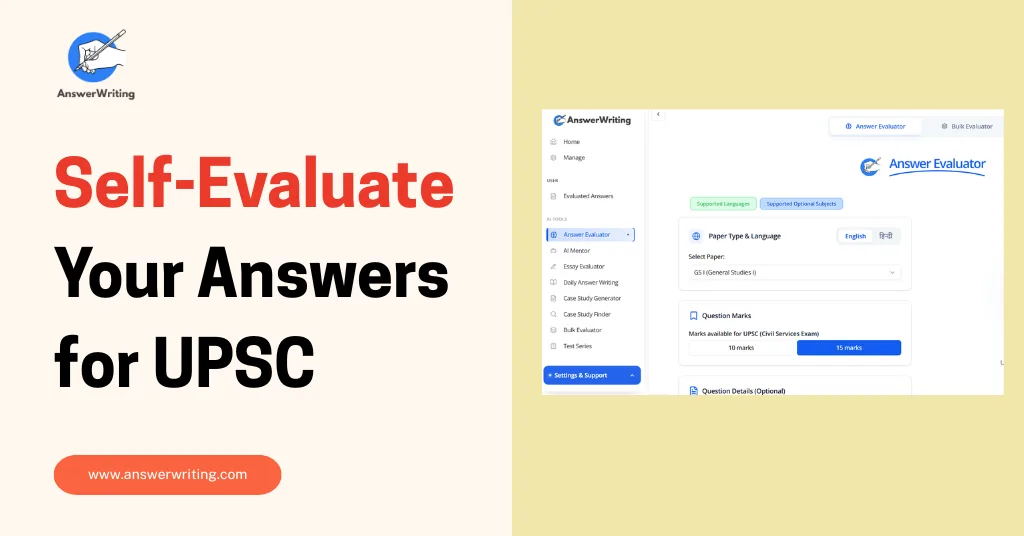
To get a truly objective “Third-Party” perspective, you can use our AI Answer Writing Evaluator.
While you check for content, the AI checks for structural integrity and competitive benchmarking. It uses deep learning to compare your answer against thousands of “Model Answers,” flagging exactly where your language becomes too flowery or where your logic breaks down. It’s like having an ex-examiner sitting next to you, giving you a score in real-time.
Use AI for Instant, Objective Feedback
The biggest problem with self-evaluation is subjectivity you might be too easy (or too hard) on yourself. This is where modern tools bridge the gap.
On AnswerWriting.com, you can upload a photo of your handwritten answer and get:
- An Instant Score: A predicted mark based on UPSC standards.
- Keyword Analysis: The AI checks if you missed essential terminology.
- Structural Feedback: It tells you if your introduction was too long or if your body lacked dimensions.