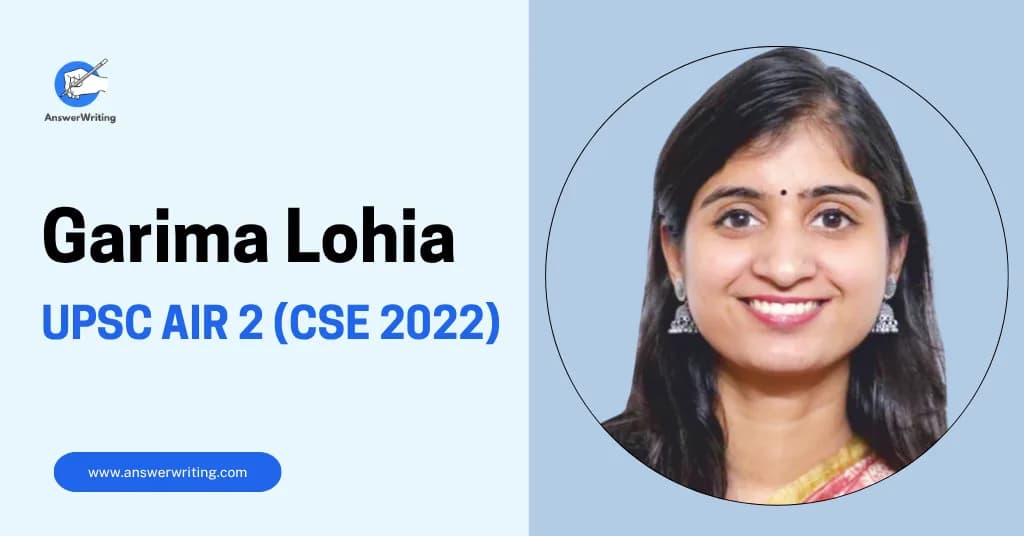
Buxar is a small district in Bihar. It is not a name that appears frequently in lists of cities producing national civil services toppers. It does not have a coaching culture. It does not have a UPSC preparation ecosystem. What it gave Garima Lohia was something harder to quantify: a mother who held a family of four together after losing her husband, and a daughter who turned that adversity into the discipline that produced AIR 2.
Garima Lohia secured AIR 2 in UPSC CSE 2022. She was 24 years old. It was her second attempt. She had failed Prelims in her first.
She prepared entirely on her own, starting during the Covid-19 lockdown in 2020, with no classroom coaching, no father, and a B.Com degree from Kirori Mal College as her academic foundation. Her optional subject was Commerce and Accountancy, one of the rarest optional choices in UPSC CSE, and one of the most strategically sound decisions she made.
Who Is Garima Lohia?
| Parameter | Details |
|---|---|
| Full Name | Garima Lohia |
| AIR | 2 |
| Exam Year | UPSC CSE 2022 |
| Total Score | 1063 out of 2025 |
| Number of Attempts | 2 |
| Optional Subject | Commerce and Accountancy |
| Medium | English |
| Age at Result | 24 years |
| Birthplace | Buxar, Bihar |
| Education | B.Com, Kirori Mal College, Delhi University, 2020 |
| Service Allotted | IAS (cadre to be verified from official UPSC allocation list) |
| Preparation Started | Covid-19 lockdown, 2020 |
| Coaching | No classroom coaching; self-study throughout |
Her father, Manoj Kumar Lohia, was a garments wholesaler in Buxar. He passed away in 2015 due to cardiac arrest, when Garima was around 16. Her mother, Sunita Lohia, a homemaker with no independent income, raised four children alone within a joint family of 13 members.
That family context is not a footnote. It is the foundation of everything that followed.
Garima Lohia UPSC Marksheet and Score Details
| Component | Marks |
|---|---|
| Essay | 131 |
| General Studies Paper 1 | 104 |
| General Studies Paper 2 | 131 |
| General Studies Paper 3 | 94 |
| General Studies Paper 4 | 141 |
| Commerce and Accountancy Paper 1 | 125 |
| Commerce and Accountancy Paper 2 | 150 |
| Written Total | 876 |
| Interview (Personality Test) | 187 |
| Grand Total | 1063 |
Two numbers demand attention. Her GS Paper 4 score of 141 is exceptionally high for an Ethics paper and reflects deep values-based writing built over months of structured practice. Her Commerce and Accountancy Paper 2 score of 150 is a standout optional performance that demonstrates mastery of her chosen subject rather than merely adequate coverage.
Her GS Paper 3 score of 94 is the lowest in her GS breakdown, a reminder that even AIR 2 candidates have uneven paper-wise performances. Consistent strength elsewhere absorbed that dip and still produced a written total of 876.
Cross-check all paper-wise figures from official UPSC publications and verified interview transcripts.
Educational Background and Early Life
Garima completed her early schooling from Woodstock School in Buxar before moving to Delhi for higher education. She secured admission to Kirori Mal College, University of Delhi, for a B.Com degree, graduating in 2020.
Kirori Mal College is one of Delhi University’s established commerce colleges, and its academic environment gave her both the subject depth she later used in her optional and the exposure to a wider peer network than Buxar could have offered.
Her father’s death in 2015 reshaped the family’s circumstances entirely. Her mother stepped into the role of primary anchor for four children with no independent income, supported by the joint family structure. Watching her mother manage that responsibility with composure and consistency shaped Garima’s understanding of resilience in a way that no textbook on ethics could replicate.
She began UPSC preparation in 2020, immediately after completing her B.Com, during the Covid-19 lockdown. That timing, which might have seemed like a disadvantage, turned out to be an advantage. The lockdown forced a self-directed, home-based preparation model that she maintained throughout her entire UPSC cycle. She never developed a dependence on classroom instruction because she never had access to it.
How Many Attempts Did Garima Lohia Take?
Garima took two attempts. She did not clear Prelims in her first attempt.
Her Prelims failure in the first cycle is a strategically important detail. It meant that despite beginning preparation in 2020 with a full year of dedicated study, the first filter stopped her before she could reach Mains. That experience forced a sharp recalibration.
After the first Prelims failure, she identified two specific problems. First, her MCQ accuracy under time pressure was inconsistent. She had strong content knowledge but was losing marks to elimination errors and time management within the two-hour paper. Second, she was spreading her reading across too many sources, creating content overload without improving retrieval.
She fixed both. She narrowed her sources significantly for the second cycle. She increased her Prelims mock test volume and used each mock not just for practice but as a diagnostic tool to identify exactly which topic areas and question types were costing her marks.
The second attempt produced AIR 2.
That gap between a Prelims failure and a national AIR 2 is not a story of talent suddenly appearing. It is a story of methodical problem identification and targeted correction. Every aspirant who has failed Prelims should read that arc carefully.
Garima Lohia’s Optional Subject: Commerce and Accountancy and Why It Was the Right Fit
Commerce and Accountancy is one of the least chosen optional subjects in UPSC CSE. That rarity works both for and against candidates who select it.
Against: fewer resources, fewer peer groups, and limited availability of coaching specifically designed for this optional.
For: examiners see far fewer Commerce and Accountancy copies than Sociology, PSIR, or History copies. A well-written, technically precise Commerce answer stands out in a pile of humanities answers. Garima leveraged that distinctiveness.
Her choice was grounded in direct alignment. She had just completed a B.Com from Kirori Mal College. Commerce and Accountancy was not a new subject she had to learn from scratch. She was deepening knowledge she already had, refining it to UPSC’s analytical expectations rather than building it from zero.
The optional covers financial accounting, cost accounting, auditing, business statistics, and management. These are areas where precision and structured presentation matter enormously. Her engineering-style, left-brain analytical approach to these topics, combined with the clarity of written expression she developed through daily answer writing, produced a combined score of 275 out of 500 (Paper 1: 125, Paper 2: 150).
Commerce and Accountancy also has meaningful overlap with GS Paper 3, which covers Indian economy, budget, taxation, financial inclusion, and economic development. Studying her optional simultaneously reinforced her GS3 preparation rather than competing with it for study time.
Standard books aspirants use for Commerce and Accountancy optional, aligned with the preparation approach Garima followed, include:
- R.L. Gupta and M. Radhaswamy for Financial Accounting
- S.P. Jain and K.L. Narang for Cost Accounting
- Tandon and Pearce for Auditing
- ICAI study material for technical depth
- Previous years’ UPSC Commerce and Accountancy papers for answer pattern calibration
The takeaway for aspirants: if your graduation subject has a UPSC optional equivalent, explore it seriously before dismissing it as obscure or unpopular. Depth in a familiar subject almost always outperforms surface coverage of a popular one.
UPSC Preparation Strategy of Garima Lohia
Garima’s preparation ran entirely on self-study from the Covid-19 lockdown in 2020 through to her UPSC CSE 2022 result in May 2023. No classroom coaching. No study groups driven by a coaching institute. Just books, online resources, test series, and a deliberate, limited source approach.
Study hours. She studied 8 to 9 hours per day (as per available reports). That is a sustainable, quality-focused figure rather than the extreme hours that UPSC preparation culture sometimes glorifies. Her emphasis was on what those hours produced, not on maximizing the number.
Limited sources. She restricted herself to a small, reliable set of books per subject and did not add new sources during her revision phase. This discipline is harder to maintain than it sounds. The temptation to keep reading new material is constant. Garima’s approach was to master fewer books completely rather than skim many books partially.
NCERT foundation. She built her GS base on NCERTs before moving to standard reference books. This created a clean conceptual map that made advanced reading faster to absorb and easier to connect to current affairs.
Previous Year Questions as the primary filter. She used PYQs to calibrate how deeply to study each topic before investing preparation time in it. PYQs reveal both the pattern of questioning and the depth of analysis UPSC actually rewards. Studying without this filter leads to over-preparation on low-yield topics.
Daily answer writing. She wrote answers every day, not just during test series weeks. That daily habit built both the speed and the structural discipline her Mains performance eventually reflected.
ForumIAS test series. She enrolled with ForumIAS for their Mains test series, which gave her structured writing practice and evaluator feedback. For Prelims, she used mock tests diagnostically after her first attempt failure.
No new books in the revision phase. During the final months before each exam stage, she stopped adding new sources entirely. Revision of existing, well-understood material is what consolidates performance. New reading in the revision phase creates anxiety without improving retrieval.
Books and Resources Recommended by Garima Lohia
| Subject | Book / Resource | Author / Source |
|---|---|---|
| Indian Polity | Indian Polity | M. Laxmikanth |
| Modern History | India’s Struggle for Independence | Bipan Chandra |
| Ancient and Medieval History | NCERT Class 6 to 12 | NCERT |
| Geography | Certificate Physical and Human Geography | G.C. Leong |
| Indian Economy | Indian Economy | Ramesh Singh |
| Environment and Ecology | Shankar IAS Environment | Shankar IAS |
| Ethics (GS4) | Ethics, Integrity and Aptitude | G. Subba Rao and P.N. Roy Chowdhury |
| Current Affairs | The Hindu (daily) | Newspaper |
| Commerce Optional | Financial Accounting | R.L. Gupta and M. Radhaswamy |
| Commerce Optional | Cost Accounting | S.P. Jain and K.L. Narang |
| Commerce Optional | Auditing | Tandon and Pearce |
| Commerce Optional | ICAI Study Material | ICAI |
| Commerce Optional | Previous Years UPSC Commerce Papers | UPSC |
| Mains Practice | ForumIAS Test Series | ForumIAS |
Cross-check this list against her published interviews, as specific recommendations may vary by paper and preparation phase.
Mains Answer Writing Approach
Garima’s GS Paper 4 score of 141 is the single most instructive number in her marksheet for aspirants thinking about answer writing. Ethics is a paper where most candidates know the theory. What separates scores is the ability to apply that theory to case studies and value-based questions with clarity, precision, and genuine conviction.
Her answer writing approach was built around daily practice from the very beginning of her preparation, not just in the months before Mains. She wrote full-length answers every day, under timed conditions, and revised them for structure and clarity. That habit, sustained over two years, built the speed and consistency her Mains performance reflects.
Her answer format followed a clear structure throughout. A direct introduction that addresses the question without restating it. A body with organized sub-points, backed by data, constitutional provisions, government schemes, or case studies drawn from current affairs. A conclusion connecting to policy direction or constitutional values. That structure, applied consistently across all GS papers, is what produces a reliable written total rather than a variable one.
She used ForumIAS test series for evaluated practice, where each test copy received structured feedback. The feedback loop was critical. Writing answers without evaluation reinforces existing habits, good or bad. Writing with regular feedback corrects errors before they compound.
For aspirants building their Mains answer writing without access to a formal test series, AnswerWriting.com’s Answer Evaluator offers structured AI feedback on individual Mains answers covering content, structure, language, and UPSC scoring parameters. Getting consistent external evaluation on your answers, whether through a test series or a dedicated tool, is what turns writing practice into writing improvement.
She used diagrams and flowcharts selectively in GS Paper 3 and Commerce and Accountancy answers where relationships between concepts benefited from visual representation. Diagrams were a communication tool, deployed only when they added clarity that prose alone could not match.
Interview (Personality Test) Experience
Garima scored 187 out of 275 in the Personality Test, a solid performance that reflects thorough DAF preparation and confident, grounded communication.
Her DAF presented a distinctive profile to any board: a B.Com graduate from Kirori Mal College who chose Commerce and Accountancy as her optional, grew up in Buxar, Bihar, lost her father at 16, began UPSC preparation during a lockdown, and cleared the exam on her second attempt with no coaching. Each of those threads invited genuine, substantive questions.
She prepared by anticipating every direction her DAF could generate. How does a Commerce graduate approach public administration? What specific challenges does Buxar face, and how does her preparation equip her to address them? How did her family circumstances shape her understanding of governance, welfare, and public accountability? Those are not generic questions. They require honest, considered, deeply personal answers that cannot be scripted in advance.
She attended mock interview sessions before the actual board appearance (as per available reports), using feedback to sharpen her communication and reduce filler language.
Her 187 reflects a candidate who was self-aware, authentic, and genuinely engaged in the conversation. The Personality Test rewards candidates who have thought deeply about who they are and why they are there. Garima’s preparation history gave her a great deal of genuine material to draw from.
Service and Cadre Allotted to Garima Lohia
With AIR 2, Garima Lohia is allotted the IAS. The specific state cadre had not been officially confirmed in all publicly available reports at the time of writing. Readers should verify cadre allotment from the official UPSC allocation list once published.
Her result was part of the historic UPSC CSE 2022 batch where all four top ranks went to women: Ishita Kishore (AIR 1), Garima Lohia (AIR 2), Uma Harathi N (AIR 3), and Smriti Mishra (AIR 4). That outcome attracted significant national attention and became one of the most discussed UPSC results in recent memory.
For Garima specifically, her result carried particular resonance in Bihar, where a candidate from Buxar reaching AIR 2 without coaching or institutional support sent a clear signal about what self-directed preparation can achieve in districts far removed from India’s UPSC preparation hubs.
Key Lessons Every UPSC Aspirant Can Take from Garima Lohia
- Failing Prelims in your first attempt is a data point, not a final verdict. Garima failed Prelims in her first cycle and came back to secure AIR 2 in her second. She treated the failure as a diagnostic report, identified specific problems in her MCQ strategy and source management, fixed both, and returned with a corrected approach. That is the only productive response to a Prelims failure.
- Your graduation subject may be your strongest optional. Garima chose Commerce and Accountancy because she had just completed a B.Com. She was deepening existing knowledge, not building a new subject from scratch. Before choosing a popular optional that you have no prior background in, honestly assess what your degree has already prepared you to do.
- No coaching is not the same as no preparation. Garima prepared entirely on her own using books, online resources, and a test series. Her preparation was rigorous, structured, and deeply self-directed. Coaching is a supplement, not a prerequisite. Many of the most important preparation habits, including daily answer writing, PYQ analysis, and disciplined revision, can be built without a classroom.
- Stop adding new sources in the revision phase. One of her most cited strategic decisions is refusing to read new material in the months before the exam. Revision of well-understood content consolidates performance. New reading in the revision phase creates anxiety without improving retrieval. Fix your source list early and stick to it.
- GS Paper 4 is a scoreable paper, not a random one. Her score of 141 in Ethics came from sustained, values-based writing practice across her entire preparation cycle, not from last-minute reading of ethics texts. Treat GS Paper 4 as a writing paper that rewards clarity of moral reasoning and structured case study responses. Build that skill early.
FAQs About Garima Lohia
What is Garima Lohia’s UPSC rank? She secured AIR 2 in UPSC Civil Services Examination 2022, results declared May 23, 2023.
What was Garima Lohia’s optional subject in UPSC? Her optional subject was Commerce and Accountancy.
How many attempts did Garima Lohia take to clear UPSC? She took two attempts. She did not clear Prelims in her first attempt and secured AIR 2 in her second.
What is Garima Lohia’s total UPSC score? Her total score is 1063, comprising a written total of 876 and an interview score of 187 out of 275.
Did Garima Lohia attend coaching for UPSC? No. She prepared entirely through self-study without attending any classroom coaching. She used the ForumIAS Mains test series for structured answer writing practice and feedback, as per available reports.
Which college did Garima Lohia attend? She completed her B.Com from Kirori Mal College, Delhi University, graduating in 2020.
Where is Garima Lohia from? She is from Buxar, Bihar. She is widely cited as one of the most prominent examples of a self-study UPSC success story from a non-metro district in recent years.