How to Plan UPSC Attempts Wisely?
In the ecosystem of the UPSC Civil Services Examination, an “attempt” is the most expensive currency an aspirant possesses. While the notification officially states that an attempt is counted only when you appear for at least one paper in the Preliminary examination, the psychological and chronological cost is far higher. A mismanaged attempt is not just a lost chance; it is a year of your life surrendered to the “cycle of failure.”
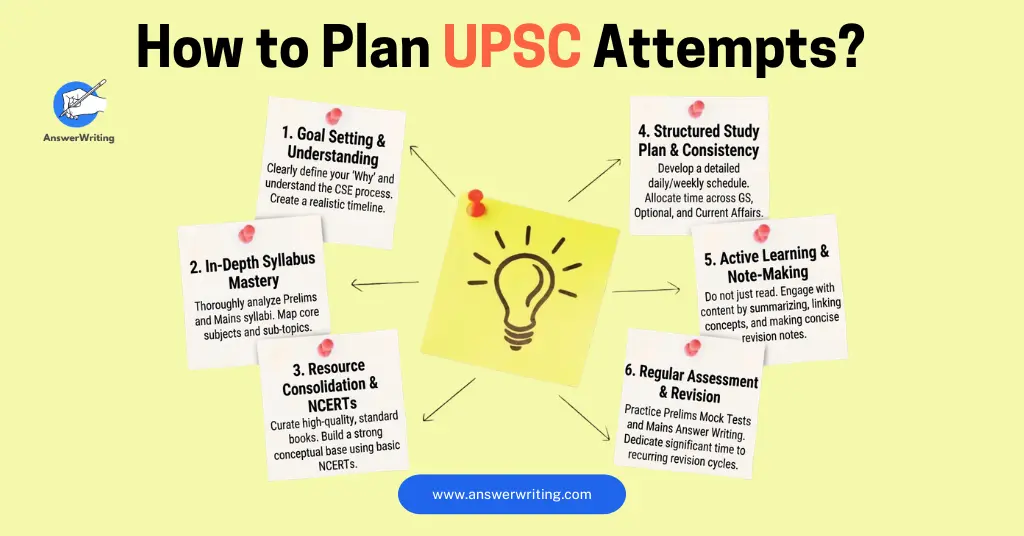
As we navigate the 2026 exam landscape, the complexity of the papers demands that your first attempt be your best attempt. Planning this journey requires a shift from a “hoping to pass” mindset to a “calculated success” strategy.
The Preparation Maturity Index: When Are You Actually Ready?
The most common mistake is deciding to sit for the exam based on the calendar rather than competence. Many aspirants feel that since they have turned twenty-one, they must appear. However, the UPSC does not reward age; it rewards “Preparation Maturity.”
A seasoned aspirant knows that you are ready only when you satisfy the 70% Rule. This means you have completed seventy percent of the static syllabus (History, Polity, Geography, Economy) and have at least one full reading of your Optional subject. If you are entering the Prelims hall thinking you will “finish the Optional after Prelims,” you have already significantly lowered your chances of success.
The philosophy must be “Mains-First.” The gap between the Preliminary and Main examinations is barely three months. This period is for revision and polishing your expression, not for learning new concepts. If your answer-writing muscles are not yet developed, your “clearing” the Prelims will only lead to a heartbreak in the Mains.
The Trap of the “Trial Attempt”
There is a persistent myth that one should take a “trial attempt” to experience the pressure of the exam hall. In 2026, with the sheer volume of high-quality mock tests and simulated environments available, this is an obsolete and dangerous strategy.
An attempt is a point of no return. Once you shade that first bubble in the OMR sheet, that attempt is gone. For a General category candidate, six attempts might seem like a lot, but as the years progress, the “Age Factor” begins to weigh in. By your third attempt, if you haven’t reached the Interview stage, the pressure of a “gap in the resume” starts affecting your mental clarity. Treat your first attempt with the gravity of your last.
A Strategic Checklist for 2026 Aspirants
Before you fill out the UPSC application form in February, run through this self-evaluation checklist. If you cannot answer “Yes” to at least four of these, consider deferring your attempt by a year.
| Criteria | Readiness Benchmark |
| Optional Subject | Completed at least once with notes ready. |
| Current Affairs | Consistent reading of a national daily for 12 months. |
| GS Static | Three rounds of revision for Core subjects. |
| Answer Writing | Ability to write a 150-word answer in 7 to 8 minutes. |
| CSAT | Consistently scoring above 80 in mock papers. |
Strategic Timing: Age vs. Preparedness
The timing of your attempt should also factor in your socio-economic reality. If you are twenty-one and still in your final year of graduation, you have the luxury of time. It is often wiser to wait until you are twenty-two or twenty-three, ensuring your foundation is unshakable.
Conversely, for those starting at twenty-seven or twenty-eight, the strategy must be one of “Calculated Aggression.” You do not have the luxury of a three-year “foundation” phase. You must compress your preparation and ensure that your first attempt is backed by a professional-level rigour. For candidates in the OBC (9 attempts) or SC/ST (unlimited until age 37) categories, the “number” of attempts might be less of a constraint, but the “energy” of your youth is still a finite resource. Use it when your focus is at its peak.
The Final Review: The Role of Feedback
Self-delusion is the greatest enemy of a UPSC aspirant. You might feel you are ready because you have read “Laxmikanth” five times, but the exam tests application, not just reading. This is where objective feedback becomes non-negotiable.
Before committing to an attempt, evaluate your performance in simulated environments. It is not enough to know the facts; you must know how to present them under the watchful eyes of an examiner. Many successful candidates now rely on data-driven feedback loops. For instance, platforms like AnswerWriting.com offer a sophisticated way to get handwritten answers evaluated for the Mains, providing a realistic mirror of where you stand. If your evaluated scores are consistently in the bottom quartile, it is a clear signal that your “Mains-readiness” is not yet at the required threshold.
Conclusion
Planning your UPSC attempts is a lesson in patience and self-honesty. The exam is a marathon, but it is composed of several high-intensity sprints. Do not enter the race just to see the track; enter it when you have the stamina to reach the finish line.
A year of “extra” preparation is not a year lost; it is an investment that prevents the trauma of repeated failures. Build your fortress of knowledge, sharpen your writing skills, and only when you feel the quiet confidence of preparedness, make your move.