How to Become an IAS Officer: The Complete Roadmap from Eligibility to Selection
Every year, close to ten lakh candidates register for the UPSC Civil Services Examination, and roughly a thousand are finally recommended for appointment. Of those, only a fraction, typically the highest-ranked candidates, are allocated to the Indian Administrative Service (IAS). The numbers alone tell you that becoming an IAS officer is not about raw ambition; it is about a clear understanding of the process, a disciplined preparation strategy, and the temperament to sustain effort over one to three years of focused work.
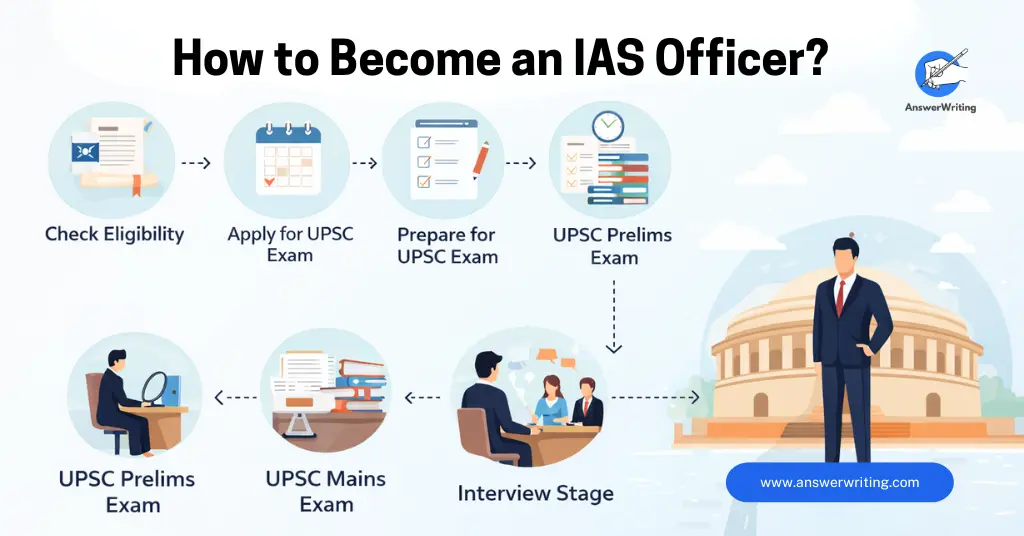
This guide does not sell you a dream. It lays out, in practical terms, everything you need to know: what the IAS actually involves, who is eligible, how the examination works, what a realistic preparation plan looks like, and what happens after you are selected. Whether you are a college student considering this path or a working professional contemplating a career switch, this is the roadmap you need before you pick up your first book.
What Does an IAS Officer Actually Do?
Before committing years of your life to this pursuit, it helps to understand what you are signing up for. The IAS is one of the three All India Services created under Article 312 of the Constitution (the other two being the Indian Police Service and the Indian Forest Service). IAS officers serve both the Union and State governments, and their roles span an extraordinary range of responsibilities across a career that can last over three decades.
At the entry level, an IAS officer typically serves as a Sub-Divisional Magistrate (SDM) and then as a District Magistrate/Collector (DM), wielding considerable executive authority over law and order, revenue administration, development programmes, and disaster management at the district level. As officers gain seniority, they move into positions as Divisional Commissioners, Secretaries to State Governments, and eventually to the highest echelons of the Union Government, including Cabinet Secretary, the senior-most civil servant in the country.
The role is not limited to administration. IAS officers shape policy, manage public finances, oversee implementation of flagship government schemes (from MGNREGA to Ayushman Bharat), and represent the government’s institutional memory across political transitions. The IAS cadre is governed by the IAS (Cadre) Rules, 1954, and the IAS (Pay) Rules, with cadre allocation determining which state an officer serves in for most of their career.
Understanding this breadth matters because it influences how you prepare. UPSC is not looking for subject-matter experts alone; it wants candidates who can think across disciplines, communicate clearly, and demonstrate the judgment required for public administration.
Eligibility Criteria for the UPSC Civil Services Examination
Educational Qualification
The minimum educational requirement is a bachelor’s degree from a university recognized by the University Grants Commission (UGC), or an equivalent qualification. The degree can be in any discipline: arts, science, commerce, engineering, medicine, law, or any other field. There is no preference for any particular stream.
Candidates who are appearing in the final year of their graduation can also apply for the Preliminary Examination. However, they must produce proof of passing the degree before the Mains Examination. Candidates holding professional degrees (MBBS, B.Tech, LLB, CA, etc.) and those with postgraduate qualifications are all equally eligible. Degrees obtained through distance education or open universities recognized by UGC are also accepted.
Age Limit and Number of Attempts
This is one of the most critical aspects to understand, and it varies significantly by category. The following table captures the current eligibility framework:
| Category | Minimum Age | Maximum Age | Maximum Attempts |
|---|---|---|---|
| General | 21 years | 32 years | 6 |
| OBC (Non-Creamy Layer) | 21 years | 35 years | 9 |
| SC / ST | 21 years | 37 years | Unlimited (until age limit) |
| PwBD (General) | 21 years | 42 years | 9 |
| PwBD (OBC) | 21 years | 42 years | 9 |
| PwBD (SC/ST) | 21 years | 42 years | Unlimited (until age limit) |
| EWS (Economically Weaker Sections) | 21 years | 32 years | 6 |
The age is calculated as on 1st August of the year in which the examination is held. An “attempt” is counted when a candidate actually appears for at least one paper of the Preliminary Examination; merely filling the form does not count as an attempt.
The EWS category, introduced following the 103rd Constitutional Amendment Act, 2019, provides 10% reservation in civil services but does not offer any age relaxation or additional attempts beyond the General category limits. This is a point many aspirants initially misunderstand.
Nationality
For the IAS and IPS specifically, the candidate must be a citizen of India. Some other services under the Civil Services Examination (such as IRS or IRTS) are open to subjects of Nepal, subjects of Bhutan, and Tibetan refugees who came to India before 1st January 1962 with the intention of permanently settling, as well as persons of Indian origin who have migrated from certain countries. However, if your goal is specifically the IAS, Indian citizenship is mandatory.
Physical and Medical Standards
There is no specific physical standard (like height or chest measurement) for the IAS, unlike the IPS. However, candidates must be in good mental and physical health. A medical examination is conducted after the final result, and candidates with conditions that could impair their ability to perform duties may face issues. In practice, this is rarely a barrier unless there are serious undisclosed health conditions.
The Three Stages of the UPSC Civil Services Examination
The Civil Services Examination (CSE) is conducted in three sequential stages. Clearing each stage is mandatory to proceed to the next.
Stage 1: Preliminary Examination (Prelims)
The Prelims is an objective-type (MCQ) examination held usually in May or June. It consists of two papers, both conducted on the same day:
General Studies Paper I carries 200 marks (100 questions, 2 marks each) and covers current events, Indian polity and governance, economic and social development, history of India and the Indian national movement, geography, environment, and general science. This is the paper that determines your qualification for Mains, and there is a penalty of one-third marks (0.66 marks) for each incorrect answer.
General Studies Paper II, commonly known as CSAT (Civil Services Aptitude Test), carries 200 marks and tests comprehension, logical reasoning, analytical ability, decision-making, basic numeracy, data interpretation, and English language comprehension. This paper is qualifying in nature; you need to score a minimum of 33% (66 marks out of 200) to qualify. The marks of this paper are not counted in the merit for Prelims qualification, but failing to cross the 33% threshold means disqualification regardless of your Paper I score.
A critical point that many aspirants learn the hard way: Prelims marks are not carried forward. They are used solely to shortlist candidates for Mains. The cutoff varies each year and across categories, but the general category cutoff has typically hovered between 90 and 110 marks (out of 200) in recent years. Treat Prelims as a do-or-die screening test and prepare accordingly with extensive practice of previous year questions and mock tests.
Stage 2: Main Examination (Mains)
The Mains Examination is a descriptive (written) test, usually held in September, and it is the most decisive stage of the entire process. It consists of 9 papers, of which 7 are counted for final merit:
| Paper | Subject | Marks | Counted for Merit? |
|---|---|---|---|
| Paper A | Compulsory Indian Language | 300 | No (Qualifying, 25% threshold) |
| Paper B | English | 300 | No (Qualifying, 25% threshold) |
| Paper I | Essay | 250 | Yes |
| Paper II | General Studies I (Indian Heritage, History, Geography) | 250 | Yes |
| Paper III | General Studies II (Polity, Governance, Constitution, Social Justice, IR) | 250 | Yes |
| Paper IV | General Studies III (Economy, Technology, Environment, Disaster Management, Security) | 250 | Yes |
| Paper V | General Studies IV (Ethics, Integrity, Aptitude) | 250 | Yes |
| Paper VI | Optional Subject, Paper 1 | 250 | Yes |
| Paper VII | Optional Subject, Paper 2 | 250 | Yes |
| Total (Merit) | 1750 |
The qualifying language papers (Paper A and Paper B) are set at a 25% passing threshold and are not counted in the merit ranking. However, failing them means disqualification. For Paper A, candidates can choose any one of the languages listed in the Eighth Schedule of the Constitution.
The GS papers test your ability to write structured, analytical, and concise answers, usually within a 150 to 200 word limit for 10-mark questions and 250-word limit for 15-mark questions. The Ethics paper (GS IV) includes case studies that test your moral reasoning and decision-making, and it has become one of the most scoring papers when prepared well.
The Essay paper requires two essays (one from each section), each of about 1000 to 1200 words. Essay topics are broad, often philosophical or policy-oriented, and demand clear thinking, wide reading, and the ability to present a balanced argument.
The Optional Subject is a significant strategic decision that we will discuss separately below.
Stage 3: Personality Test (Interview)
Candidates who clear the Mains cutoff are called for the Personality Test, which carries 275 marks. The interview is conducted by a board typically chaired by the UPSC Chairman or a Member of the Commission, along with other experts. It usually lasts 25 to 40 minutes.
The Personality Test is not a knowledge quiz. The board assesses your clarity of thought, depth of understanding of issues, leadership qualities, communication skills, logical exposition, and overall personality. Questions often stem from your Detailed Application Form (DAF), covering your educational background, hobbies, home state, work experience, and current affairs.
Your final rank is determined by the combined score of Mains (1750 marks) and Interview (275 marks), giving a total of 2025 marks. The Prelims score plays no role in this final calculation.
How is IAS Specifically Allocated? Understanding Service Allocation
One of the most common misconceptions among aspirants is that you “apply for IAS” or “sit the IAS exam.” In reality, you appear for the Civil Services Examination, and the service you are allocated (IAS, IPS, IFS, IRS, etc.) depends on two factors: your final All India Rank and the service preferences you fill in your application form.
The candidate ranked first gets their top preference. As ranks descend, preferences are matched with available vacancies across all services and categories. In a typical year, the top 100 to 180 ranks (varying by category and vacancies) secure IAS allocation. This means that even a rank of 200 might not guarantee IAS if the candidate’s category has fewer vacancies that year.
Cadre allocation (which state you serve in) was revised under the 2017 Cadre Allocation Policy. The system now uses a roster-based approach that balances three factors: the candidate’s home state preference, their spouse’s domicile (if applicable), and a rotational roster to ensure equitable distribution across cadres. The days of simply being assigned to your home cadre are gone; approximately one-third of officers in any cadre are now “outsiders,” which was a deliberate policy choice to bring a national perspective to state administration.
A Practical Preparation Strategy
Choosing an Optional Subject
The optional subject accounts for 500 marks out of 1750 in Mains, making it the single largest scoring component. Your choice of optional can materially affect your final rank. Consider these factors when choosing:
The degree of overlap with the GS syllabus matters more than most aspirants realize. Subjects like Geography, Political Science and International Relations (PSIR), Public Administration, and Sociology have substantial overlap with GS papers, which means your preparation effort yields returns in multiple papers simultaneously. Your academic background and genuine interest play a role in sustaining preparation over months, but do not let familiarity alone drive the choice. Some candidates from engineering backgrounds score exceptionally well in Sociology or Anthropology because they prepared strategically.
Look at scoring trends over the past five to seven years. Some optionals have shown consistently high averages (like Anthropology in certain years), while others have seen unpredictable evaluations. UPSC does not publish official subject-wise statistics, but community data and toppers’ marks provide reasonable indicators. Also consider the availability of quality study material, guidance (if you plan to take coaching for the optional), and the size of the syllabus relative to the time you have.
Popular choices include Sociology, Geography, PSIR, Public Administration, History, Philosophy, and Anthropology among humanities-leaning optionals, and Mathematics among the technical ones. There is no universally “best” optional; there is only the best optional for you.
Building Your Foundation (Months 1 to 6)
The initial phase of preparation should focus on building a solid conceptual base across all subjects. Begin with NCERTs, specifically the Class 6 to 12 textbooks for History, Geography, Political Science, Economics, and Science. These are not “basic” books; they are the foundation on which every advanced source builds. Read them actively, making short notes as you go.
Once the NCERT base is in place, move to standard reference books:
- Indian Polity: M. Laxmikanth’s “Indian Polity” (the most widely used text for polity preparation; nearly indispensable)
- Modern Indian History: Spectrum’s “A Brief History of Modern India” or Bipan Chandra’s “India’s Struggle for Independence”
- Geography: G.C. Leong’s “Certificate Physical and Human Geography” supplemented by NCERT and current affairs
- Economy: Ramesh Singh’s “Indian Economy” or Sriram’s IAS Economy notes
- Environment: Shankar IAS Academy’s “Environment” booklet
- Ethics: Lexicon for Ethics by Chronicle Publications (for terminology and case study frameworks)
Simultaneously, develop the habit of reading one quality newspaper daily. The Hindu or The Indian Express are the standard recommendations, not because other papers are inferior, but because their editorial quality and coverage of governance, policy, and international relations align closely with what UPSC demands. Make concise notes from your newspaper reading; this current affairs repository will serve you in Prelims, Mains, and the Interview.
Answer Writing and Test Series (Months 6 to 12)
If there is one piece of advice that virtually every topper emphasizes, it is this: start answer writing early and do it consistently. Knowing the content is necessary but not sufficient. UPSC Mains tests your ability to present knowledge in a structured, analytical, and concise format under time pressure. You have approximately seven minutes per question in the actual exam, which leaves no room for rambling.
Begin by writing answers to previous year questions (PYQs). UPSC’s own questions are the best benchmark for understanding what is expected. Start untimed if necessary, but progressively impose time limits. Join a reputable test series (online or offline) by the six-month mark. The test series serves two purposes: it forces you to write regularly and it exposes you to evaluation, which reveals blind spots in your content, structure, and presentation.
For the Essay paper, practice writing at least two to three full-length essays per month in the later stages of preparation. A good essay is not a collection of facts; it is a coherent argument with an introduction that frames the issue, a body that presents multiple dimensions (social, economic, political, ethical), and a conclusion that offers perspective or a way forward.
Revision and Prelims-Specific Preparation
Revision is not an afterthought; it should be built into your schedule from the start. Plan for at least three full revision cycles before each stage of the exam. Without revision, even well-read aspirants struggle to recall specifics under exam conditions.
For Prelims specifically, analysis of Previous Year Questions is non-negotiable. UPSC has a pattern, even if it is not rigidly predictable. Certain themes recur (constitutional provisions, environmental conventions, economic indicators, government schemes), and PYQ analysis reveals the depth and angle at which UPSC asks questions. Supplement this with a quality MCQ test series, attempting at least 50 to 80 full-length mock tests before the Prelims.
A critical but often neglected point: do not ignore CSAT if your quantitative aptitude is weak. Every year, a small but significant number of otherwise well-prepared candidates fail to qualify because they did not take the 33% CSAT threshold seriously. If math and reasoning are your weak areas, dedicate specific practice time to CSAT from the outset.
The Coaching Question
Whether to join coaching or prepare through self-study is one of the first dilemmas aspirants face, and the answer is less binary than social media debates suggest. Self-study is entirely viable, as proven by multiple toppers every year who prepared without any institutional coaching. The resources available today, including free lectures on YouTube, UPSC-focused platforms, open-access government reports, and affordable test series, make self-study more feasible than ever before.
However, coaching can add value in specific areas: a structured optional subject course if self-study material is limited, a test series with personalized feedback on answer writing, and mentorship that helps you stay on track strategically. The risk with coaching is over-dependence, where candidates attend every class and read every handout but never develop the independent analytical thinking that UPSC rewards.
The practical middle ground that works for many successful candidates is to self-study the GS portion using standard books, join a test series for answer writing practice, and consider coaching only for the optional subject if needed.
Training and Probation: What Happens After Selection
Clearing the UPSC examination and receiving your service allocation is the beginning, not the end. All candidates recommended for the All India Services and Central Services undergo a Foundation Course at the Lal Bahadur Shastri National Academy of Administration (LBSNAA) in Mussoorie, Uttarakhand. This common foundation course, lasting about 15 weeks, brings together IAS, IPS, IFS, and other service probationers for a shared training experience covering law, public administration, Indian history, economics, and outdoor activities designed to build camaraderie and a shared sense of public purpose.
After the Foundation Course, IAS probationers continue with Phase I of the IAS Professional Course at LBSNAA itself. This covers district administration, land revenue, law and order, development management, and public policy in greater depth. Probationers also undertake a “Bharat Darshan” tour, visiting different parts of the country to understand India’s diversity firsthand.
Phase II involves attachment to a district in the probationer’s allocated cadre state, where they work under a senior District Magistrate and get hands-on exposure to revenue administration, election management, disaster response, and the implementation of government schemes at the grassroots level. There is also a village attachment component, where probationers live in a village for a period to understand rural India from the ground up. The total probation period, including training and district attachment, lasts about two years before an officer is confirmed in the service.
Common Myths and Mistakes to Avoid
Perhaps the most persistent myth surrounding the IAS examination is that it is an exam only for those with elite educational backgrounds. The data tells a different story. Toppers and successful candidates regularly come from state universities, Hindi-medium backgrounds, small towns, and modest economic circumstances. What they share is not a pedigree but a method: consistent preparation, strategic subject choices, and relentless practice of answer writing.
Another myth worth dismantling is the notion that clearing UPSC requires 14 to 16 hours of daily study. Quality matters far more than quantity. Most successful candidates report effective study times of 6 to 8 hours daily during serious preparation, with the emphasis on “effective,” meaning focused, distraction-free engagement with the material. Burnout from unsustainable schedules is a real and common reason for underperformance, particularly in a multi-year preparation journey.
On the mistakes front, the most damaging one is accumulating too many sources without finishing any. It is far better to read Laxmikanth thoroughly three times than to read five different polity books once each. UPSC rewards depth and clarity, and that comes from repeated engagement with limited, high-quality sources rather than superficial coverage of everything available.
Neglecting answer writing until the last few months is another frequent error. Many candidates spend 80% of their preparation time reading and only 20% writing. For Mains, this ratio should be closer to 50-50 in the later stages. Similarly, treating Prelims as a formality or as something that can be “managed” in the last month is a mistake that costs many otherwise capable aspirants their attempt.
Finally, choosing an optional subject based solely on hearsay or trend-chasing, without personally evaluating the syllabus, your comfort level, and the scoring history, can lead to regret midway through preparation. Spend a week seriously evaluating two or three options before committing.
Frequently Asked Questions
Can I become an IAS officer without coaching?
Yes. Multiple UPSC toppers, including several Rank 1 holders, have prepared entirely through self-study. The key requirements are self-discipline, access to standard books and online resources, a good test series for answer writing practice, and the ability to design and follow your own study schedule. Coaching is a tool, not a prerequisite.
What is the ideal age to start preparing for UPSC?
There is no single ideal age. Many successful candidates begin serious preparation in their final year of college or shortly after graduation, typically around 21 to 23 years of age. However, candidates in their late twenties and early thirties, including working professionals, clear the exam regularly. Starting earlier gives you more attempts, but maturity and life experience can be significant advantages in Mains and the Interview.
How many hours should I study daily?
Focus on 6 to 8 hours of quality study rather than chasing a specific number. In the initial months, even 4 to 5 focused hours are productive if you are building your base systematically. In the three to four months leading up to an exam (Prelims or Mains), most serious aspirants ramp up to 8 to 10 hours. Consistency over months matters far more than intensity on any single day.
Is there reservation for EWS candidates in UPSC?
Yes. Following the 103rd Constitutional Amendment Act, 2019, a 10% reservation for Economically Weaker Sections has been implemented in the Civil Services Examination. However, EWS candidates do not receive any age relaxation or additional attempts; their eligibility conditions (32 years, 6 attempts) are the same as the General category. The reservation applies to the number of vacancies allocated.
Can a private university graduate appear for UPSC?
Yes, provided the university is recognized by the University Grants Commission (UGC) or established by an Act of Parliament or State Legislature. The mode of education (regular, distance, or online) does not matter as long as the degree is from a recognized institution. Candidates should verify their university’s recognition status on the UGC website if there is any doubt.
What if I do not get IAS but receive allocation to IPS, IFS, or another service?
Every service allocated through the UPSC Civil Services Examination, whether it is the IPS, Indian Foreign Service, IRS (Income Tax or Customs), IRAS, or others, offers a meaningful and impactful career in public service. Many candidates who initially felt disappointed at not securing IAS have gone on to build distinguished careers in their allocated service. You can also attempt the exam again (if you have remaining attempts) while serving, though this requires careful consideration of service rules and the personal costs of re-entering the preparation cycle.
Bringing It All Together
Becoming an IAS officer is a process that rewards clarity of purpose, sustained discipline, and intelligent strategy over raw talent or brute-force effort. The examination system, for all the anxiety it generates, is remarkably transparent: the syllabus is published, previous year papers are available, and the pattern is analyzable. What separates successful candidates from the rest is rarely access to secret resources; it is the consistency with which they engage with what is openly available.
Start by honestly assessing where you stand: your academic strengths, your reading habits, your writing ability, and the time you realistically have. Build a plan that accounts for all three stages of the exam, not just Prelims. Prioritize answer writing from day one, revise relentlessly, and treat every mock test as a learning opportunity rather than a verdict. And above all, remember that this examination tests not just what you know, but how you think, how you communicate, and whether you have the temperament and judgment that public service demands.
The path is long, but it is clearly marked. Your job is to walk it with discipline and clarity.