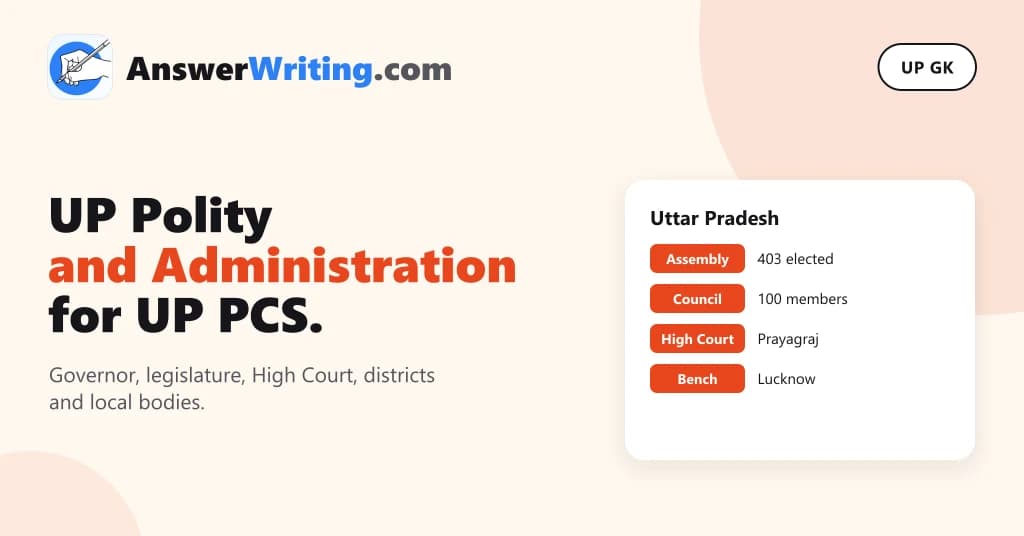
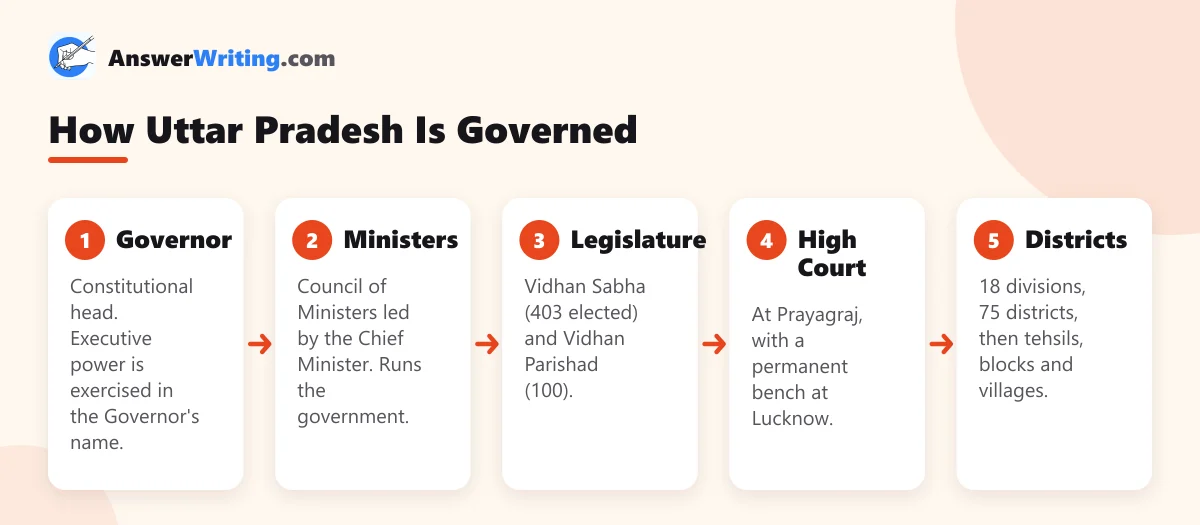
Uttar Pradesh polity and administration is a core part of UP PCS Mains GS V and also appears in Prelims. UP has a Governor, a bicameral legislature (the Vidhan Sabha with 403 elected members and the Vidhan Parishad with 100 members) and a High Court at Prayagraj with a bench at Lucknow. The state is run through 18 divisions and 75 districts. In 2025, GS V asked about the role of the Governor of UP, the jurisdiction of the Allahabad High Court and the Right to Information Act in UP.
This post explains how UP is governed, using the official constitutional setup page of the UP state portal and the Constitution.
The Structure at a Glance
The Governor
Under the Constitution, the executive power of the state is vested in the Governor and is exercised directly or through officers under the Governor (Article 154). The state portal notes these points:
- All executive business of the state is carried on in the Governor’s name.
- The Chief Minister informs the Governor of the decisions of the Council of Ministers.
- The Governor is a part of the state legislature under Article 168.
- The Chief Justice of the High Court administers the oath to the Governor.
- The Governor can grant pardons, reprieves and remissions, or suspend or commute sentences, for offences against state laws (Article 161).
In GS V 2025, the question was to comment on the role of the Governor of Uttar Pradesh as a constitutional head. A good answer covers the Governor’s constitutional powers, the convention of acting on the advice of the Council of Ministers, discretionary situations and examples from the state.
The Legislature
| House | Members | Key facts |
|---|---|---|
| Vidhan Sabha (Legislative Assembly) | 403 elected | Term of five years unless dissolved earlier |
| Vidhan Parishad (Legislative Council) | 100 | A permanent house; members serve six years and one-third retire every second year |
Some useful facts from the state portal:
- UP has had a bicameral legislature since 1937.
- Until 1967, the Assembly had 431 members, including one nominated Anglo-Indian member.
- After Uttarakhand was created in November 2000, the Council’s strength came down from 108 to 100.
Note: the portal’s setup page still says the Assembly has one nominated member. Nomination of Anglo-Indian members to state Assemblies ended in January 2020 under the 104th Constitutional Amendment, so the Assembly today has 403 elected members. The official UP Legislative Assembly website is the best source for current details.
UP also sends 80 members to the Lok Sabha and 31 to the Rajya Sabha.
The High Court
The Allahabad High Court, the High Court of Judicature at Allahabad, sits at Prayagraj and has jurisdiction over Uttar Pradesh. According to the state portal:
- It was established on 17 March 1866, which makes it one of the oldest high courts in India.
- It has a permanent bench at Lucknow.
- It is a court of record, so its records cannot be challenged in lower courts and it can punish for contempt.
Below the High Court are the district courts. The District Judge controls the subordinate judiciary of a district, and the Munsif’s court is the lowest civil court.
Divisional and District Administration
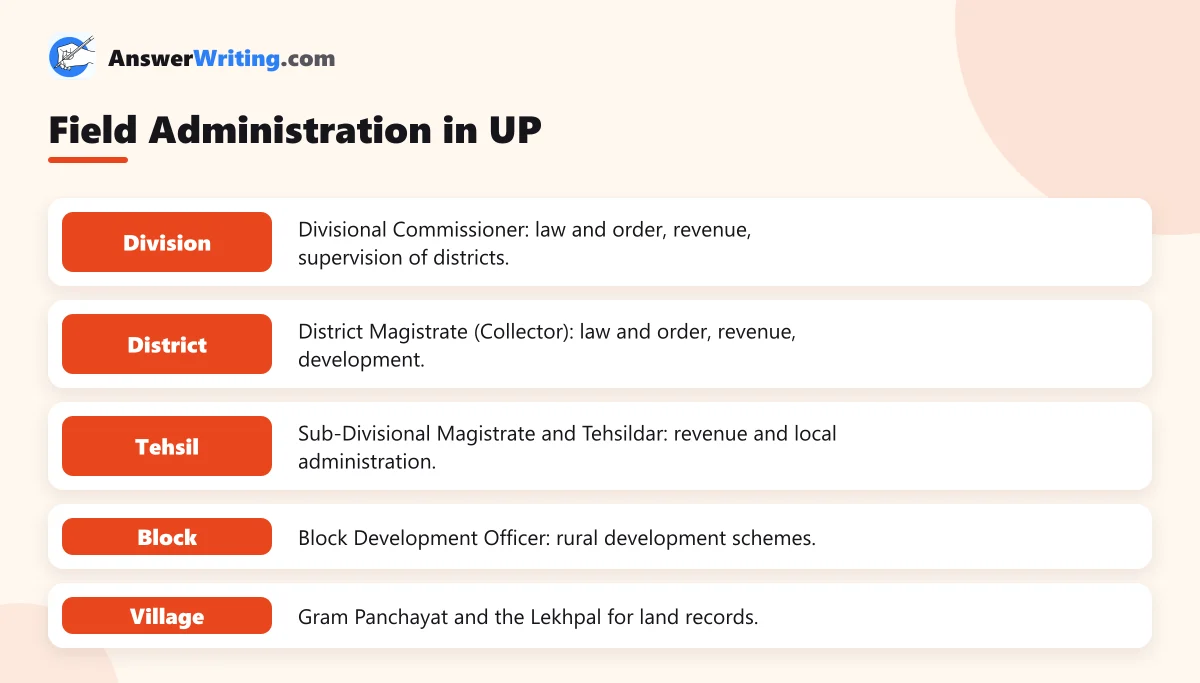
The state portal explains that the Divisional Commissioner is responsible for law and order, revenue and administration in the division, and supervises district officers and local bodies. Each district is under a District Magistrate, who has wide administrative, police and revenue powers and also looks after planning and development.
This matters for UP PCS beyond the exam: the Deputy Collector (SDM) post, filled through UP PCS, sits at the tehsil level of this structure.
Local Bodies
UP has urban local bodies such as Nagar Nigams (the state profile lists 17) and municipal boards, and rural local bodies under the three-tier Panchayati Raj system: the Gram Panchayat, the Kshetra Panchayat at the block level and the Zila Panchayat at the district level. Prelims 2025 had a question on Panchayati Raj institutions in India, so learn the 73rd and 74th Amendments along with UP’s set-up.
Other Bodies to Know
- The Uttar Pradesh Public Service Commission (UPPSC), at Prayagraj, which conducts the PCS exam.
- The Uttar Pradesh Public Service Tribunal, set up in 1976 for faster justice in service cases of government employees, as the state portal notes.
- The State Election Commission, which conducts local body elections.
- The State Information Commission, under the Right to Information Act. GS V 2025 asked about the relevance of RTI in UP.
How to Revise
- Learn the Articles linked to state government: 153 to 167 (executive), 168 to 212 (legislature), 214 to 237 (High Courts and subordinate courts).
- Learn UP’s numbers: 403, 100, 80, 31, 75, 18.
- Draw the field administration chart from memory.
- Write one GS V answer a week on a polity topic, with a UP example.
For the district list, see our UP divisions and districts list.
The physical setting of the state is covered in UP geography for UP PCS.
Key Takeaways
- UP has a Governor, a bicameral legislature since 1937 and a High Court at Prayagraj with a Lucknow bench.
- The Vidhan Sabha has 403 elected members; the Vidhan Parishad has 100 members.
- The Allahabad High Court was established on 17 March 1866.
- Field administration runs from the Divisional Commissioner to the District Magistrate, SDM, BDO and Gram Panchayat.
- GS V 2025 asked about the Governor, the High Court’s jurisdiction and RTI in UP.
Practise GS V Polity Answers
Polity answers score well when they add Articles and state examples. Write one and get it checked with the UP PCS answer evaluator on AnswerWriting, in Hindi or English, with a model answer. Your first three evaluations are free.
Related Reading
FAQs
How many members does the UP Vidhan Sabha have?
403 elected members. Nomination of an Anglo-Indian member ended in 2020.
How many members does the UP Vidhan Parishad have?
100 members.
Where is the High Court of Uttar Pradesh?
At Prayagraj, with a permanent bench at Lucknow.
When was the Allahabad High Court established?
On 17 March 1866, according to the UP state portal.
Who administers the oath to the Governor of UP?
The Chief Justice of the Allahabad High Court.
Since when has UP had a bicameral legislature?
Since 1937.