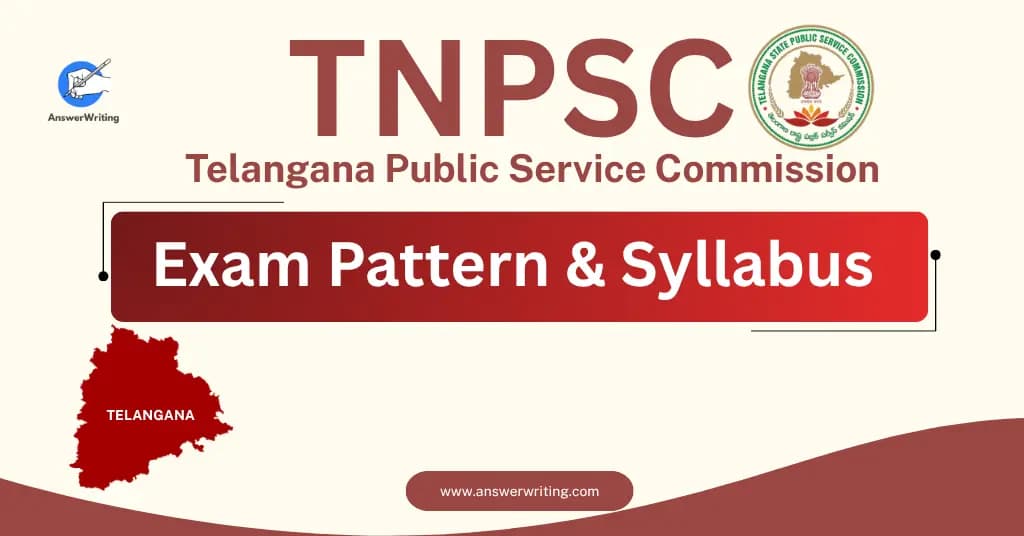
The Telangana Public Service Commission (TNPSC) conducts the Combined Recruitment Examination (CRE) to fill administrative posts in the state. The selection process is carried out in two successive stages:
- Preliminary Examination
- Mains Examination
Based on the information provided on the Chahal Academy page for TSPSC, the recruitment process for Group 1 services in Telangana consists of two primary stages: a Preliminary Examination and a Mains Examination.
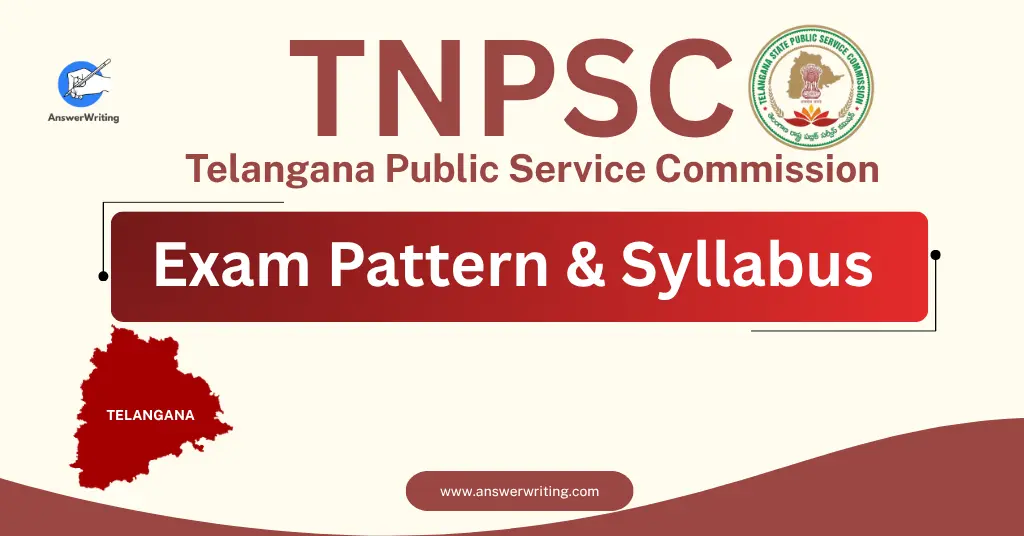
Stage I: Preliminary Examination
The Preliminary exam is a screening test consisting of one objective-type paper. Marks from this stage are not counted for the final merit list.
| Feature | Details |
| Number of Questions | 150 |
| Total Marks | 150 Marks |
| Duration | 2.5 Hours |
| Subjects Covered | General Studies and Mental Ability |
| Negative Marking | 1/3rd of the marks assigned to a question will be deducted for every wrong answer. |
Stage II: Mains Examination
The Mains exam consists of a qualifying English paper and six merit-based descriptive papers.
| Paper | Subject | Duration | Total Marks |
| Qualifying | General English (X Class Standard) | 3 Hours | 150 (Qualifying only) |
| Paper I | General Essay | 3 Hours | 150 |
| Paper II | History, Culture and Geography | 3 Hours | 150 |
| Paper III | Indian Society, Constitution and Governance | 3 Hours | 150 |
| Paper IV | Economy and Development | 3 Hours | 150 |
| Paper V | Science & Technology and Data Interpretation | 3 Hours | 150 |
| Paper VI | Telangana Movement and State Formation | 3 Hours | 150 |
| Total | 900 Marks |
TSPSC Syllabus
Preliminary Syllabus: General Studies and Mental Ability
- Current Affairs: Regional, National, and International importance.
- International Relations and Events.
- General Science: India’s Achievements in Science and Technology.
- Environmental Issues: Disaster Management (Prevention and Mitigation Strategies).
- Economic and Social Development of India.
- Geography: World Geography, Indian Geography, and Geography of Telangana state.
- History: History and Cultural Heritage of India.
- Polity: Indian Constitution and Polity; Governance and Public Policy in India.
- Telangana Specifics: Policies of Telangana State; Society, Culture, Heritage, Arts and Literature of Telangana.
- Social Exclusion: Rights issues (Gender, Caste, Tribe, Disability, etc.) and inclusive policies.
- Logical Reasoning: Analytical Ability and Data Interpretation.
Mains Syllabus
Qualifying Paper: General English
- Spotting Errors (Spelling, Punctuation).
- Fill in the blanks (Prepositions, Conjunctions, Verb tenses).
- Rewriting sentences (Active/Passive voice, Direct/Reported Speech).
- Usage of Vocabulary and Jumbled sentences.
- Comprehension, Précis Writing, Expansion, and Letter Writing.
Paper I: General Essay
- Candidates must write three essays, selecting one from each section (each section contains three questions).
- Topics: Contemporary Social issues, Economic Growth and Justice, Indian Politics, Historical and Cultural Heritage of India, Science and Technology, Education and Human Resource Development.
Paper II: History, Culture and Geography
- History and Culture of India (with special reference to the Modern Period 1757–1947 A.D.).
- History and Cultural Heritage of Telangana.
- Geography of India and Telangana (Physical setting, Drainage, Agriculture, Mission Kakatiya, SEZs).
Paper III: Indian Society, Constitution and Governance
- Indian Society: Structure, Issues, and Social Movements.
- Constitution of India.
- Governance aspects.
Paper IV: Economy and Development
- Indian Economy and Development.
- Telangana Economy.
- Development and Environmental Problems.
Paper V: Science & Technology and Data Interpretation
- Role and Impact of Science and Technology.
- Modern Trends in Application of Science.
- Data Interpretation and Problem Solving.
Paper VI: Telangana Movement and State Formation
- The Idea of Telangana (1948–1970): Historical background, Mulki rules, and 1969 agitation.
- Mobilisation Phase (1971–1990): Rise of various unions and student organizations.
- Towards Formation of Telangana State (1991–2014): Political developments and the final achievement of statehood.