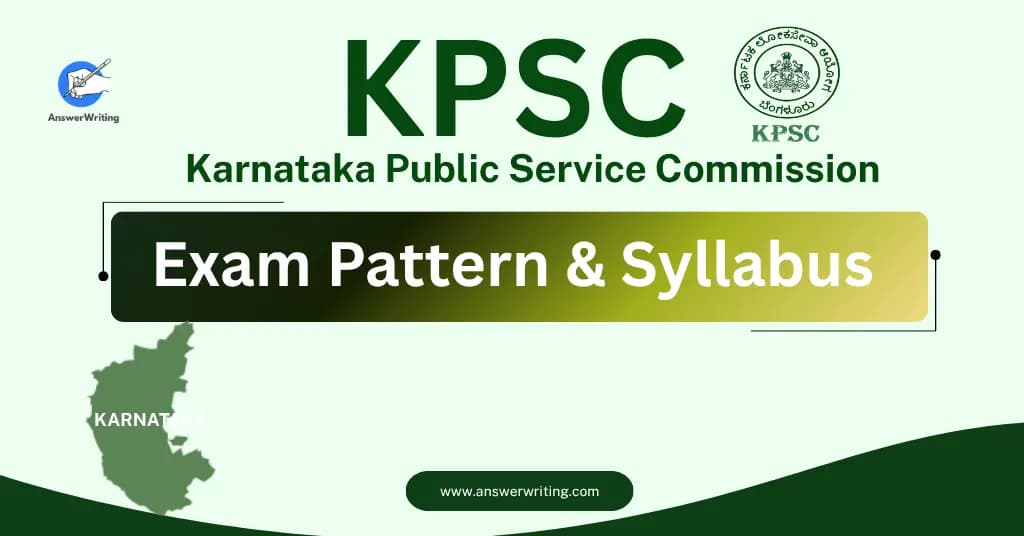
The KAS Exam is conducted by the Karnataka Public Service Commission (KPSC) to recruit candidates for Group A and Group B posts across various State Government departments. The selection process unfolds in three successive stages:
Stage 1 – Preliminary Examination
This stage consists of two objective-type (MCQ) papers, each carrying 200 marks with a duration of 2 hours, making a combined total of 400 marks. There is a negative marking of 0.25 marks for every wrong answer. Question papers are set in both Kannada and English. General Mental Ability questions are set at Class X / SSLC level, while the remaining questions are at degree level.
| Paper | Section | Questions | Marks |
| Paper I | General Studies (National & International) | 40 | 80 |
| Humanities | 60 | 120 | |
| Total | 100 | 200 | |
| Paper II | General Studies (State Importance) | 40 | 80 |
| General Science, Technology, Environment & Ecology | 30 | 60 | |
| General Mental Ability | 30 | 60 | |
| Total | 100 | 200 |
Stage 2 – Main Examination
The Main Examination is descriptive in nature and consists of two qualifying papers and five merit-based papers, all compulsory. Question papers are set in both Kannada and English; candidates may answer in either language, except for the qualifying papers.
Qualifying papers require a minimum of 35% (52.5 out of 150 marks) in each. Marks from these papers are not counted toward the final merit list; failing to clear them disqualifies a candidate from further stages.
Qualifying Papers
| Paper | Subject | Marks | Duration |
| Qualifying Paper 1 | Kannada (First Language, SSLC level) | 150 | 2 Hours |
| Qualifying Paper 2 | English (First Language, SSLC level) | 150 | 2 Hours |
Merit-Based Papers (Each carries 250 marks | 3 Hours)
| Paper | Subject | Sections Covered |
| Paper I | Essay | Two essays of 125 marks each and one on national/international issues and one on state/local issues |
| Paper II | GS Paper 1 | History & Cultural Heritage (India & Karnataka); Social & Political Perspective; Indian Economy, Planning & Rural Development |
| Paper III | GS Paper 2 | Physical Features & Natural Resources; Overview of Indian Constitution; Public Administration, Management & International Relations |
| Paper IV | GS Paper 3 | Science & Technology in Indian Development, IT in Public Domain; Advances in Natural, Life & Agriculture Sciences, Health & Hygiene; Ecology & Environmental Challenges |
| Paper V | GS Paper 4 | Ethics; Integrity; Aptitude |
Total Written Examination Marks: 1250
Stage 3 – Personality Test (Interview)
Candidates who qualify the Main Examination on merit are called for a Personality Test, which assesses mental capability, reasoning, judgment, moral character, intelligence, and suitability for public service. The interview carries 25 marks, which are added to the Main Examination score for the final merit list.
Grand Total = 1250 (Written) + 25 (Interview) = 1275 Marks
Eligibility Criteria
Candidates must hold a Bachelor’s or Master’s degree from a recognized Indian university or an equivalent qualification. Candidates awaiting results of their qualifying examination may also apply for the Preliminary stage. Medical graduates who have passed their final year examination but not yet completed their internship may be provisionally admitted to the Main Examination, provided they complete the internship before the interview stage.
Age Criteria
| Category | Maximum Age |
| General | 38 years |
| OBC (2A, 2B, 3A, 3B) | 41 years |
| SC / ST / Category-1 | 43 years |
| Physically Disabled | Additional 10 years relaxation |
Minimum age for all candidates: 21 years.
Number of Attempts
| Category | Attempts Allowed |
| General | 5 |
| OBC | 7 |
| SC / ST | Unlimited (up to age limit) |
Syllabus
Conducted by the Karnataka Public Service Commission (KPSC), the KAS exam is divided into two stages: the Preliminary Examination and the Mains Examination.
PRELIMINARY EXAMINATION
The Prelims serves as a screening stage and consists of two objective-type papers.
Paper I
- Current events of national and international importance
- History of India with emphasis on its social, economic, cultural, and political aspects, particularly the Indian national movement with a special focus on Karnataka
- World Geography and Geography of India, with a focus on Karnataka
- Indian polity and economy political system, rural development, planning, economic reforms, sustainable development, poverty alleviation, demographics, and social sector initiatives
Paper II (State Studies, Science and Technology, Mental Ability)
- Current events of state importance and important state government programmes
- General Science and Technology, Environment and Ecology contemporary developments in science and technology, general issues on health, environmental ecology, biodiversity, and climate change (no subject specialization required)
- General Mental Ability comprehension, logical reasoning, analytical ability, decision-making, problem-solving, basic numeracy, and data interpretation (Class X/SSLC level)
MAINS EXAMINATION
The Mains is descriptive in nature and consists of Qualifying Papers (Kannada and English) and Merit-ranking Papers (Essay and General Studies).
Qualifying Papers – Kannada and English
These papers test the candidate’s ability to read and understand serious discursive prose and express ideas clearly. Both papers cover the following areas:
| Component | Marks |
| Comprehension | 25 |
| Précis Writing | 25 |
| Usage | 25 |
| Communication Skills | 25 |
| Vocabulary | 25 |
| Essay | 25 |
Paper I – Essay (250 Marks)
Candidates write two essays of 125 marks each in Kannada or English:
- Essay 1: Topics of international or national importance
- Essay 2: Topics of state or local importance
Paper II – General Studies 1
Section I: History and Cultural Heritage of India and Karnataka (6 Units)
Unit 1: Cultural Heritage of India
- Indus Civilization its distinction from Vedic Civilization; evolution of the caste system; religious conditions and emergence of religious movements
- Sanskrit literature and Vedic texts, epics, Puranas, prose works on polity and ethics, Panchatantra; Mughal contributions to literature
- Science and Technology in ancient India of mathematics, astronomy, physics, chemistry, medicine (including surgery), shipbuilding, mining, metallurgy, engineering, and architecture
- Arts of Maurya and Gupta periods; Khajuraho, Jain temples at Mount Abu, Odisha temples; Pallava, Chola, and Pandyan contributions; Mughal architecture; Cathedral architecture; Ajanta frescoes; Mughal and Rajput painting; classical music and dance; folk arts
- India’s cultural contributions to Central Asia, China, Japan, Southeast Asia, and Sri Lanka
- Religions of India and Hindu Dharma (Shaiva, Vaishnava, Shakta sects; Upanishad and Gita philosophy; Yoga); Jainism (Ratnatraya, Ahimsa, Digambara and Svetambara sects); Buddhism (Four Noble Truths, Eightfold Path, Hinayana and Mahayana sects); Christianity (teachings, denominations, missionary activities); Islam (Five Pillars, Sufis of Karnataka, Shia and Sunni sects); Sikhism (principles and evolution)
Unit 2: Toward Transforming Indian Society -Major Schools of Thought
- Eradication of social and religious wrongs; casteless society ideals
- Ideal of service; empowerment of the depressed classes
- Two-Nation theory and Islamic revivalism; Hindutva and patriotism
- Dravidian movement; Dalit empowerment through religion and education
- Socialist approach and Total Revolution; Gram Swaraj, Satyagraha, and Bhoodana
Unit 3: From Kadambas to the Hoysalas
- Antiquity of Karnataka; Kannada language and literature; extent of Kannadanadu
- State and district gazetteers; museums, archives, and preservation of historical monuments; World Heritage Sites in Karnataka
- Contributions of the Kadamba-to-Hoysala period to architecture, sculpture, literature, and religion
Unit 4: The Vijayanagara Empire and Thereafter (1336–1799)
- Vijayanagara Empire origin, political history (Harihara, Bukka, Krishnadevaraya, Aliya Ramaraya), Battle of Talikota, administration, society, economy, religion, arts, and foreign accounts
- Religious sects Shankaracharya, Ramanujacharya, Madhwacharya; Sri Basaveshwara and the Vachana movement; Haridasa movement
- Bahmani Shahis ,Mahmud Gawan; Adil Shahis of Bijapur; Sufis in Karnataka
- Chikkadevaraja Wodeyar; Nayakas of Keladi and Chitradurga; Rani Chennamma and Sangolli Rayanna; Hyder Ali and Tipu Sultan (1761–1799)
Unit 5: Modern Mysore (1799–1947)
- Krishna Raja Wodeyar III and his contributions
- Armed rebellions against the British in Karnataka
- Commissioner’s Rule (1831–1881)
- Nizam’s rule in Hyderabad-Karnataka
- Progress of Mysore under the Dewans
Unit 6: Freedom Movement in Karnataka and Unification (1885–1956)
- Rise of nationalism; Pre-Gandhian era (1885–1920); Gandhian era (1920–1948)
- Freedom movement in Hyderabad-Karnataka; important personalities
- Unification of Karnataka causes, role of Alur Venkatrao, literacy and cultural associations, print media, three stages of unification (1947–1956)
- Social and cultural developments education, printing and press, Kannada literature, Backward Class movement, Miller Committee Report, folk arts
Section II: Social and Political Perspective (7 Units)
- Post-independence Karnataka political consolidation; backward classes and social justice (Havanur, Venkataswamy, and Chinnappa Reddy Committee Reports); Dalit movement; Devaraja Urs and land reforms
- Language issue Gokak Movement; inter-state boundary and water disputes; Mahajan Committee Report; Nanjundappa Committee Report on regional imbalance
- Social change and movements social structure, theories of change, social disorganization, directed social change, and social policy
- Social change and modernization role conflict, intergenerational gap, youth unrest, changing status of women, industrialization, urbanization, Sanskritization, westernization; current social evils fundamentalism, Naxalism, corruption, black money
- Government and political system legislature, executive and judiciary; political parties; center-state relations; Panchayati Raj; communalism and regionalism; national integration
- Socioeconomic system Jajmani system; market economy; occupational diversification; trade unions; globalization and social impact
- Rural social system and rural development village community structure, democratization, poverty, land reforms, green revolution, rural development projects
Section III: Indian Economy, Planning, and Rural Development (8 Units)
- Indian economy post-independence growth across agriculture, industry, and services; poverty and inequality; Karnataka’s economic growth and sectoral changes
- India’s international economic relations trade composition and direction, foreign capital, balance of payments; Karnataka’s export profile
- Development disparities rural-urban gaps, public policies, Special Economic Zones, regional development boards in Karnataka
- Planning goals, objectives, achievements and failures of Five Year Plans (I to VII); planning under new economic policies (VIII Plan onwards); planning in Karnataka
- Decentralization top-down vs. bottom-up planning; Panchayati Raj institutions; district planning committees; state finance commissions; resource mobilization in Karnataka
- Rural development agriculture’s role in the national economy; land reforms; irrigation; food security; rural credit and marketing; agricultural labour; rural infrastructure (energy, transport, markets, housing, health) in Karnataka
- Rural development initiatives poverty alleviation and employment programmes; conservation of common property resources; self-help groups and microfinance in Karnataka; rural tank rejuvenation; sanitation and health care schemes
- Data collection, analysis and interpretation bar graphs, line graphs, pie charts; tabular data; data sufficiency; probability; permutations and combinations; quantitative aptitude number sequences, averages, ratio and proportion, profit and loss, percentages, time and work, speed-time-distance, simple interest
Paper III – General Studies 2
Section I: Physical Features and Natural Resources
Geography of the World
- Lithosphere Earth’s place in the solar system; rocks; earthquakes; volcanoes; plate tectonics; agents of erosion
- Atmosphere structure, composition, elements of climate, and broad climatic types
- Hydrosphere ocean salinity, currents, tides, and ocean deposits
- Physiography of continents mountains, rivers, forests, grasslands, deserts; population distribution, demographic transition, and quality of life indicators
Geography of India
- Physiography, climate, rivers, soils, natural vegetation
- Mineral resources iron ore, manganese, copper, bauxite, coal, petroleum, natural gas, nuclear deposits
- Major crops distribution and production of cereals, millets, oilseeds, plantation crops, and commercial crops
- Indian demography growth, composition, distribution, density, and Human Development Index
- Industrial planning and development major, medium, small, and tiny industries; industrial infrastructure; backward regions and rural industrialization
- Regional planning tribal and hill areas, drought-prone areas, command areas, and river basins; classification of towns and cities
Geography of Karnataka
- Physiographic divisions, climate, rivers, rainfall, natural vegetation, and soils
- Agriculture and agro-climatic regions; major crops; plantation and commercial crops; mineral resources
- Sources of power hydro, thermal, solar, nuclear, and wind
- Major, medium, and small-scale industries; agro-based industries
- Transportation and communication systems; Geographic Information Systems (GIS)
- Urban land use policy urbanization, literacy, population problems, city classification, rural-urban fringe, slums and urban housing, intra- and inter-regional trade
Section II: Overview of Indian Constitution (7 Units)
- Nature and salient features of the Constitution Preamble, Directive Principles, Indian federation
- Fundamental Rights equality, freedom, anti-exploitation, religious freedom, cultural and educational rights, constitutional remedies; provisions for SC, ST, and minorities; Prevention of SC/ST Atrocities Act
- Distribution of legislative powers Union-State relations; administrative and financial relations; powers of constitutional bodies
- Legislature unicameral and bicameral systems; delegated legislation; legislative procedure and committees; judicial review; Comptroller and Auditor General; Attorney General
- Important constitutional amendments basic structure theory; emergency provisions; 73rd and 74th amendments; Panchayati Raj
- Welfare mechanisms Directive Principles; Election Commission; Public Service Commissions; Women’s Commission; Human Rights Commission; Finance Commission; National Development Council
- Services under Union and State constitutional provisions for government and public servants
Section III: Public Administration, Management, and International Relations (7 Units)
- Public vs. private administration; New Public Administration and New Public Management; responsive administration
- Organisational structure personnel, financial, and administrative law; welfare administration; development administration
- Organisational behaviour and management decision-making, communication, centralization, decentralization, delegation, responsibility, and control
- Formal and informal organisations; functional management finance, HR, marketing, production, leadership, and motivation
- Management tools PERT and CPM, POSDCORB, SWOT analysis, PDCA cycle, performance appraisal, manpower planning, conflict management, team building, and quality tools
- Administrative reforms ethics and values in public service; good governance; accountability; Lokpal and Lokayukta; grievance redressal; district administration; welfare programmes for SC, ST, and women; Administrative Reforms Commissions
- United Nations and international organisations and origin and role of the UN (General Assembly, Security Council, ICJ, peacekeeping); specialized agencies (WHO, ILO, FAO); international bodies (IMF, World Bank, WTO, ASEAN, SAARC, G-8, IAEA, NAM, OPEC); India’s relations with neighbours
Paper IV – General Studies 3
Section I: Role and Impact of Science and Technology
- Basics of science and technology classical and emerging areas; national S and T policy; technology missions
- ICT and computers, internet, broadband, IT industries, BPO, e-governance, e-commerce, e-learning, digital divide
- Space science and technology and global and Indian space programmes (INSAT, IRS, EDUSAT, Chandrayaan); satellite applications in education, agriculture, and rural development
- Energy resources hydel, thermal, nuclear, and renewable sources (solar, wind, biomass, geothermal, tidal, hydrogen); enabling legislation and investment opportunities
- Disasters, pests, and pollution climate change; floods, cyclones, tsunamis; disaster management; crop science; safe drinking water; sanitation and waste disposal; pollution control
- Related themes universalizing S and T literacy; Human Development Index; knowledge society; human capital; rural upliftment through technology; agro-food processing; biofuel; water harvesting
Section II: Natural Sciences, Life Sciences, Agricultural Science, Health and Hygiene (7 Units)
Natural Science
- Plants crop plants, medicinal plants, photosynthesis, transpiration
- Animal classification domestic and wild animals; their utility
- Microorganisms bacteria, viruses, fungi; beneficial and harmful effects
Agriculture Science
- Crop production and protection; chemical fertilizers and vermicompost; green, white, yellow, and blue revolutions; organic farming; farm mechanization; agro-processing; post-harvest technology; land and water resource management
Horticulture and Sericulture
- Floriculture, vegetables, fruits, plantation crops, spices, and medicinal plants; hi-tech horticulture; post-harvest management
- Sericulture importance in India and Karnataka; mulberry and non-mulberry sericulture; cocoon production
Biotechnology
- Genetic engineering and stem cell research; transgenic plants; molecular breeding; bio-fertilizers, bio-pesticides, bio-fuels, tissue culture, cloning; food safety and biotechnology regulations
Animal Husbandry
- Livestock importance; cattle, buffalo, sheep, goat, swine, and poultry breeds; dairy management; milk cooperatives (AMUL, KMF)
- Fisheries marine and inland resources; exclusive economic zone; aquaculture; ornamental fish; value addition and quality control
Agriculture Development Policies and Trade
- National and Karnataka agricultural policies; agricultural price, seed, and credit policies; NARS; farmer welfare programmes; crop insurance (NAIS, WBCIS); food security; export potential; WTO and Agreement on Agriculture
Health and Hygiene
- Human body systems digestive, circulatory, respiratory, excretory, and reproductive
- Medical systems Allopathy, AYUSH, Naturopathy, and Yoga; NRHM; national HIV and TB programmes
- Communicable, epidemic, endemic, and vector-borne diseases; gastroenteritis, malaria, cholera, dengue, bird flu, chikungunya; vaccines and immunology; health awareness programmes
Section III: Challenges and Issues of Development, Environment and Ecology (6 Units)
- Environmental conservation forest conservation, wildlife protection, Project Tiger, national parks and sanctuaries, impact of mining, ecotourism; Red Data Book; endangered species
- Natural resources forest types and conservation; water resource management; rainwater harvesting; infrastructure development impacts; land acquisition and rehabilitation
- Ecosystem and biodiversity basic ecology, food chain, biodiversity hotspots, threats to diversity, sustainable forest management, intellectual property rights
- Environmental pollution and solid waste management air, water, soil, and noise pollution; types of solid waste; recycling and reuse; Environment Protection Act; Air and Water Pollution Control Acts
- Role of IT in environment and health climate change, acid rain, global warming, wasteland reclamation, watershed management, river linking, and water crisis
- Community and civil society interface joint forest management; development, displacement, and rehabilitation; disaster management; ozone layer, CFC, and carbon credits
Paper V – General Studies 4
Section I: Ethics
- Essence, determinants, and consequences of ethics in human action; dimensions of ethics; ethics in private and public relationships
- Ethics in public administration ethical dilemmas; laws, rules, and conscience as sources of ethical guidance
- Accountability and ethical governance; corporate governance; ethical issues in international relations
- Concept of public service transparency, Right to Information, codes of ethics and conduct, citizens’ charters, work culture, quality of service, utilization of public funds, anti-corruption measures
- Human values lessons from great leaders, reformers, and administrators; role of family, society, and educational institutions in value formation
Section II: Integrity
- Integrity, impartiality, non-partisanship, objectivity, dedication to public service, empathy, tolerance, and compassion toward weaker sections
Section III: Aptitude
- Foundational values for civil service; aptitude – content, structure, relation with thought and behavior; moral and political attitudes; social influence and persuasion
- Emotional intelligence and its application in administration and governance
- Contributions of moral thinkers from India and the world
- Case studies on the above issues