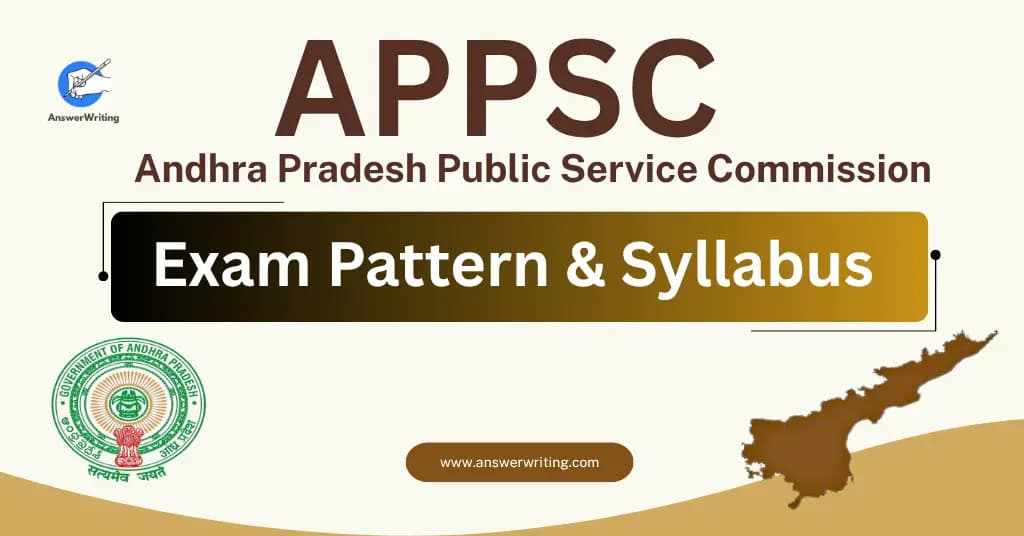
The APPSC Group-1 exam recruits candidates for various administrative roles in the Andhra Pradesh government through 3 stages: Preliminary Examination, Mains Examination, and Interview/Personality Test.
Note: The interview round has been discontinued for all upcoming AP recruitments.
Stage I: Preliminary Examination (Total: 240 Marks)
A screening test with two objective-type papers, each of 120 marks and 2 hours duration. Both papers carry 1/3rd negative marking per wrong answer.
| Feature | Paper I | Paper II |
| Questions | 120 | 120 |
| Marks | 120 | 120 |
| Duration | 2 hours | 2 hours |
| Subject | General Studies | General Aptitude |
| Negative Marking | 1/3rd per wrong answer | 1/3rd per wrong answer |
Paper I: General Studies Syllabus
A. History & Culture
- Ancient India: Indus Valley Civilisation, Vedic Age, Mahajanapadas, rise of Jainism and Buddhism, Mauryan Empire, foreign invasions, Kushans, Satavahanas, Sangam Age, Sungas, and the Gupta period covering administration, society, religion, arts, and science
- Medieval South India: Kanauj, Badami Chalukyas, Eastern Chalukyas, Rashtrakutas, Kalyani Chalukyas, Cholas, Hoysalas, Yadavas, Kakatiyas, and Reddis
- Medieval India: Delhi Sultanate, Vijayanagara and Mughal Empires, Bhakti movement, and Sufism including administration, economy, arts, and literature
- Colonial period: European trading companies, their rivalry in Bengal, Bombay, Madras, Mysore, Andhra and Nizam regions; role of Governor-Generals and Viceroys
- 1857 uprising causes, nature, consequences, and significance; 19th century religious and social reform movements; India’s freedom movement and revolutionary activities
- Mahatma Gandhi’s philosophy and key Satyagrahas; contributions of Sardar Patel and Subhash Chandra Bose; Dr. B.R. Ambedkar’s role in Constitution-making; post-independence reorganisation of states
B. Constitution, Polity, Social Justice & International Relations
- Indian Constitution: its evolution, core features, Preamble, Fundamental Rights, Duties, Directive Principles, amendments, and basic structure
- Union and State roles, Parliament and State Legislatures, federal challenges, and devolution of power and finances to local bodies
- Constitutional authorities, Panchayati Raj, public policy, and governance; impact of liberalisation, privatisation, and globalisation; statutory and quasi-judicial bodies
- Rights issues: human rights, women’s rights, SC/ST and child rights; India’s foreign policy, international relations, key global institutions, and central and state government schemes
C. Indian & Andhra Pradesh Economy and Planning
- India as a developing economy: growth since independence, NITI Aayog, Human Development Index, sustainable development, and environmental policy
- National income, demographic challenges, poverty, unemployment, rural and urban development, and employment schemes
- Agriculture: irrigation, inputs, agricultural policy, agrarian crisis, land reforms, MSP, food security, Make-in-India, SEZs, industrial corridors, energy policy, economic reforms, and India-WTO relations
- Financial system: RBI, monetary policy, banking reforms, NPAs, stock markets, SEBI, GST, taxation, fiscal policy, Centre-State financial relations, and public debt
- Andhra Pradesh post-2014 bifurcation: impact on natural resources and revenue, water-sharing disputes, infrastructure development, IT and e-governance, skill development, smart cities, and welfare programmes
- AP Reorganisation Act 2014: economic consequences, Central assistance for new capital, backward district development, and key infrastructure issues like Vizag railway zone and Kadapa steel plant
D. Geography
- General: Earth’s position in the solar system, landforms, atmosphere, climate, oceans, and hydrological disasters
- Physical: Major physical divisions of India and the world, earthquakes, landslides, drainage, monsoon, vegetation, soil types, rocks, and minerals
- Social: Population distribution, density, literacy, sex ratio, occupational structure, tribal and religious groups, urbanisation, and migration
- Economic: Key economic sectors agriculture, industry, and services; agro-based, mineral, forest, and fuel industries; transport and trade patterns
Paper II: General Aptitude Syllabus
A. General Mental & Psychological Abilities Covers logical reasoning, analytical thinking, number series, coding-decoding, Venn diagrams, clock and calendar problems, ratio and proportion, averages, percentages, profit and loss, time-work-distance, geometry, algebra (BODMAS), data interpretation, probability, emotional intelligence, social intelligence, interpersonal skills, decision-making, critical thinking, and personality assessment.
B. Science & Technology
- Science and its relevance to everyday life; India’s national science policy; key scientific institutions and prominent Indian scientists
- ICT: its scope, role in governance, e-governance programmes, cyber security, and national cybercrime policy
- Space and defence: ISRO’s achievements, satellite programmes (telecom, navigation, remote sensing, defence, and education), and DRDO’s vision and activities
- Energy: India’s energy needs, resources, dependency, and policy; solar, wind, and nuclear energy
- Environment: pollution, climate change, biodiversity, international environmental treaties, forest and wildlife laws, global warming, disaster management, biotechnology, nanotechnology, genetic engineering, and health-environment linkages
C. Current Events Regional, national, and international current affairs of importance.
APPSC Group-1 Mains Examination
Exam Pattern (Total: 1050 Marks for Merit Papers)
| Paper | Subject | Marks | Duration |
| Qualifying Paper I | English | 150 | 2.5 hours |
| Qualifying Paper II | Telugu | 150 | 2.5 hours |
| Merit Paper I | General Essay | 150 | 2.5 hours |
| Merit Paper II | History, Culture & Geography of India and AP | 150 | 2.5 hours |
| Merit Paper III | Polity, Constitution, Governance, Law & Ethics | 150 | 2.5 hours |
| Merit Paper IV | Economy & Development of India and AP | 150 | 2.5 hours |
| Merit Paper V | Science & Technology | 150 | 2.5 hours |
Qualifying papers are in English and Telugu respectively; merit papers can be written in English or Telugu. Qualifying paper scores do not count toward final ranking.
Merit Paper I: General Essay (150 Marks)
Candidates write three essays (one from each of three sections), around 800 words each. Topics span current affairs, socio-political, socio-economic, and socio-environmental issues, cultural and historical themes, civic awareness, and reflective subjects. Marks are awarded for logical structure, grammatical accuracy, and originality of thought.
Merit Paper II: History, Culture & Geography of India and Andhra Pradesh (150 Marks)
A. History & Culture of India
- Ancient India: Indus Valley Civilisation, Vedic Age, Mahajanapadas, rise of Jainism and Buddhism, Mauryan Empire, Ashoka’s Dharma, foreign invasions, Kushans, Satavahanas, Sangam Age, Sungas, Guptas, and Kanauj , covering administration, society, arts, science, and early educational institutions
- South Indian Dynasties and Medieval India: Pallavas, Badami and Eastern Chalukyas, Rashtrakutas, Kalyani Chalukyas, Cholas, Kakatiyas, Vijayanagara, Bahmanis, and Qutubshahis their cultural, literary, and architectural contributions; arrival of Islam; Bhakti and Sufi movements
- Mughal period: administration, social and religious life, cultural developments; rise of Marathas; European arrival, East India Company’s dominance, and the role of Christian missionaries
- British rule (1757–1856): land revenue systems, 1857 Revolt and its impact; 19th century social reform movements Raja Ram Mohan Roy, Vivekananda, Dayananda Saraswathi, Annie Besant, Sir Syed Ahmad Khan; rise of nationalism, Home Rule Movement, Self Respect Movement; role of Gandhi, Bose, Patel, Dr. Ambedkar; Quit India Movement
- India’s freedom struggle in three phases (1885–1947): peasant, women, tribal, and workers’ movements; partition of India; post-independence rehabilitation, linguistic reorganisation, and integration of states; early economic and foreign policy
B. History & Culture of Andhra Pradesh
- Ancient AP: Satavahanas, Ikshvakus, Salankayanas, Pallavas, Vishnukundins their social, economic, religious, and cultural life; Telugu language, literature, art and architecture; Eastern Chalukyas, Rashtrakutas, and Renati Cholas
- Medieval AP (1000–1565 AD): Telugu language and literature growth; arts and architecture under Kakatiyas, Reddis, Gajapatis, and Vijayanagara rulers; Qutubshahi contribution to Andhra history and culture
- Modern AP: European trade; Company rule; social reformers like Gurajada Apparao, Kandukuri Veeresalingam, Gidugu Ramamurthy; library movement; folk and tribal culture; role of women
- Nationalist movement in AP: Andhra leaders, Justice Party, Non-Brahmin Movement, Andhra Mahasabhas; freedom fighters like Alluri Sitaramraju; Potti Sreeramulu; formation of Andhra State (1953) and Andhra Pradesh (1956); bifurcation in 2014
- Post-bifurcation AP: administrative, economic, social, cultural, and legal consequences; loss of capital city; new capital construction; impact on trade, industry, river water sharing, and state finances; AP Reorganisation Act 2014
C. Geography of India and Andhra Pradesh
- Physical: landforms, climate, soil types, rivers, forests, mineral resources, rocks and metals; hills, plateaus, and vegetation classification
- Economic: agriculture, livestock, forestry, fishery, mining, industries (agro, mineral, forest, fuel, manpower-based), trade, transport, and communication
- Social: population distribution and density, sex ratio, literacy, rural-urban dynamics, caste, tribe, religion, and linguistic composition; migration and urbanisation
- Fauna & Flora: wildlife, birds, reptiles, mammals, trees, and plants
- Environmental: sustainable development, climate change, natural hazards (earthquakes, floods, cyclones, landslides, cloud bursts), disaster management, pollution, and environmental impact assessment
Merit Paper III: Polity, Constitution, Governance, Law & Ethics (150 Marks)
A. Indian Polity & Constitution
- Core constitutional features: Preamble, Fundamental Rights, Directive Principles, Fundamental Duties, amendments, and basic structure
- Union-State relations and federal challenges; distribution of legislative powers; role of the Governor
- Rural and urban local self-governance under the 73rd and 74th Constitutional Amendments
- Parliament and State Legislatures: structure, powers, and privileges
- Judiciary: structure, emergency provisions, constitutional amendments, judicial review, and Public Interest Litigation
B. Public Administration & Governance
- Evolution of public administration in India; ideas from Kautilya’s Arthashastra, Mughal administration, and British legacy
- Government development policies and implementation challenges; role of NGOs, civil society, and SHGs
- Statutory and quasi-judicial bodies; role of civil services in a democracy
- Good governance and e-governance: transparency, accountability, RTI, Citizen’s Charter, Public Service Act, and social audit
C. Ethics in Public Service & Law
- Ethics in human life: its dimensions, consequences, and role in public and private relationships; integrity and accountability in public service
- Human values: harmony in relationships, gender equity, role of family, society and educational institutions; lessons from great leaders and reformers
- Attitude: its structure, influence on behaviour, moral and political dimensions; emotional intelligence in governance
- Public service ethics: codes of conduct, RTI, leadership ethics, Lokpal, Lokayukta, and anti-corruption measures
- Basic laws: Constitutional provisions (Fundamental Rights, legislative lists, powers of judiciary, executive, and legislature); civil and criminal court hierarchy; Nirbhaya Act; Labour Law; Cyber Law (IT Act, cybercrime, jurisdiction); Tax Laws (income tax, GST, corporate tax)
Merit Paper IV: Economy & Development of India and Andhra Pradesh (150 Marks)
- Major economic challenges: slow growth in agriculture and manufacturing, inflation, current account deficit, NPAs, black money, capital deficiency, and lack of inclusive and sustainable growth
- Resource mobilisation: tax and non-tax revenues, public debt, foreign investment (FDI and FII), monetary and fiscal policies, energy and physical resources
- Resource mobilisation in AP: budgetary constraints post-bifurcation, Central assistance, mineral and forest resources, water disputes with neighbouring states
- Government budgeting: budget structure, types of deficits, GST, Finance Commission recommendations, Central assistance to states; AP’s budget analysis and local finance
- Inclusive growth: poverty alleviation, health and education, women’s empowerment, food security, rural development, financial inclusion, DWCRA, and AP’s welfare schemes
- Agricultural development: role in GDP, green revolution, dryland and organic farming, MSP, Swaminathan Commission, and AP’s focus on horticulture, fisheries, and dairying
- Industrial development: industrial policy since independence (1991 reforms), public sector, liberalisation, privatisation, MSMEs, Make-in-India, SEZs, NIMZs, industrial corridors; AP’s industrial incentives and power projects
- Infrastructure: transport (ports, roads, railways, airports), IT, e-governance, Digital India, energy and power, smart cities, solid waste management, disaster management, and AP’s infrastructure bottlenecks and ongoing projects
Merit Paper V: Science & Technology (150 Marks)
- Science, Technology & Innovation: role in everyday life; national science policy; India’s scientific achievements; key research institutions in India and AP; indigenous technology development
- ICT: importance, e-governance in India, cyber crime and cybersecurity policies; IT development in AP and India
- Indian Space Programme: ISRO’s past and present achievements; satellite applications in health, education, weather, communication, and defence; DRDO’s role
- Energy: India’s energy needs and resources; conventional and non-conventional energy (solar, wind, bio, geothermal, tidal, nuclear); energy policy and security; India’s nuclear policy and international commitments
- Environment vs. Development: natural resource depletion; conservation; climate change and its global effects; environmental impact assessment; natural disasters (cyclones, earthquakes, tsunamis, landslides); social forestry; afforestation; deforestation in AP; types of natural resources (forests, fisheries, fossil fuels, minerals, water, land)
- Environmental pollution and solid waste: air, water, soil, and noise pollution; solid waste management; soil and coastal erosion; global warming; ozone depletion; acid rain
- Environmental legislation: Montreal and Kyoto Protocols, UNFCCC, CITES, Environment Protection Act 1986, Forest Conservation Act, Wildlife Protection Act, Biodiversity Bill, SDGs, National Disaster Management Policy 2016
- Biotechnology & Nanotechnology: scope, applications, ethical and legal concerns, genetic engineering, biodiversity, fermentation, and immunodiagnostics; White Revolution, Green Revolution, Green Pharmacy
- Human diseases: microbial infections (bacterial, viral, protozoan, fungal); common diseases like cholera, malaria, tuberculosis, HIV, dengue, bird flu; vaccines, tissue culture, GM crops, bio-pesticides and bio-fertilisers
- Intellectual Property Rights in science and technology; promotion of science in AP and India
Stage III: Interview / Personality Test
This is the concluding stage of the APPSC Group-1 Civil Services selection process, carrying 75 marks.
What is Evaluated:
The panel assesses candidates holistically – going well beyond subject knowledge to examine:
- Communication & awareness – how clearly the candidate expresses ideas and stays current with affairs
- Intellectual calibre – mental sharpness, ability to process and analyse information logically
- Cultural knowledge – familiarity with Andhra Pradesh’s customs, traditions, manners, and dialects
- Judgment – ability to balance competing perspectives and arrive at sound conclusions
- Social qualities – leadership potential, capacity for teamwork and social cohesion
- Character – intellectual honesty and moral integrity
Final Merit Calculation:
Interview marks (out of 75) are added to Mains marks (out of 750) for a grand total out of 825.
Important Note: The interview/personality test has been abolished for all upcoming Andhra Pradesh recruitments. As a result, the final total marks will be 750 (Mains only), without any interview component.