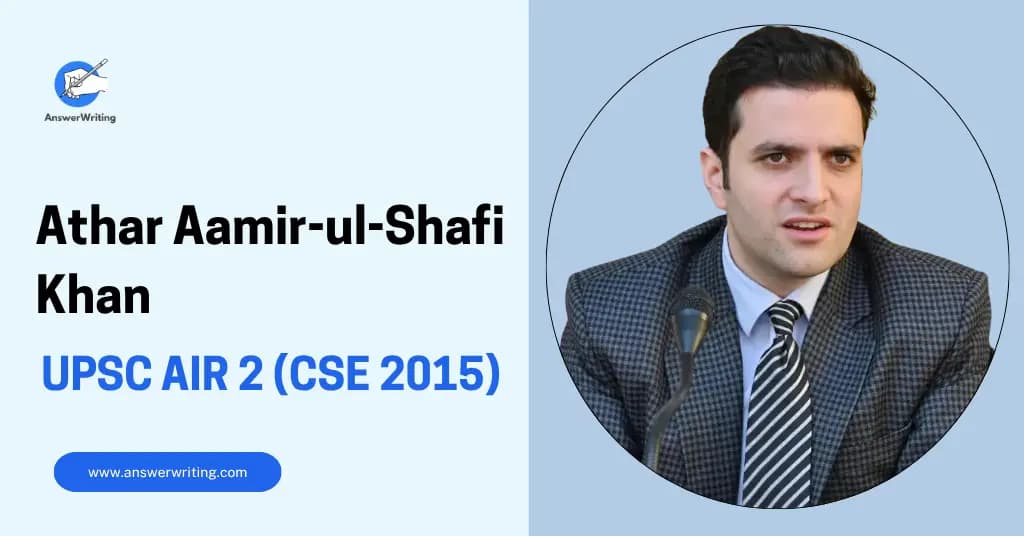
Athar Aamir Khan (full name Athar Aamir-ul-Shafi Khan) secured All India Rank 2 in UPSC CSE 2015 at the age of 23, in his second attempt. An electrical engineer from IIT Mandi and the son of a schoolteacher from Anantnag in Kashmir, he had cleared the exam a year earlier and joined the Indian Railway Traffic Service, then went back and moved into the top two.
Here is his background, what his result tells us, and the practical lessons aspirants can take from his path.
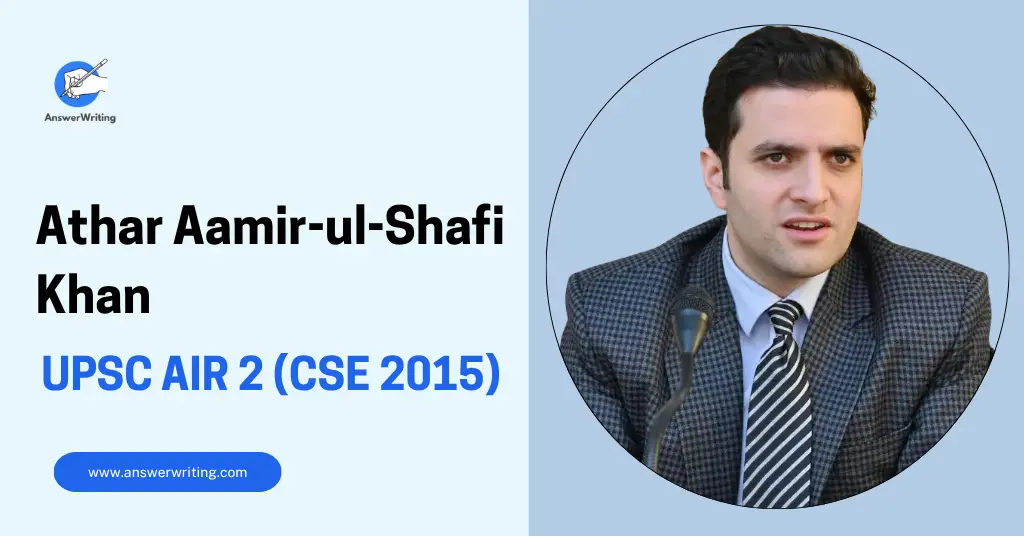
Athar Aamir Khan: Profile at a Glance
| Detail | Information |
|---|---|
| Full name | Athar Aamir-ul-Shafi Khan |
| Home | Devipora-Mattan, Anantnag district, Jammu and Kashmir |
| Born | 1992 |
| Education | B.Tech, Electrical Engineering, IIT Mandi |
| First attempt | CSE 2014, selected for the Indian Railway Traffic Service (IRTS) |
| Rank | AIR 2, CSE 2015 (second attempt) |
| Reported final marks | 1,018 out of 2,025 (written 825, interview 193) |
| Optional subject | Philosophy (as widely reported) |
| Service and batch | IAS, 2016 batch |
| Cadre | Rajasthan, on deputation to Jammu and Kashmir since February 2021 |
Early Life and Education
Athar grew up in Devipora-Mattan in Anantnag district. His father, Muhammad Shafi Khan, is a teacher, and Athar became the first civil servant in the family. He went to school in Anantnag and Srinagar before joining IIT Mandi in Himachal Pradesh, where he completed a B.Tech in Electrical Engineering.
His result in 2016 came from a region that had seen years of unrest, and it made him one of the most talked-about toppers of that cycle. He finished just behind Tina Dabi, who topped UPSC CSE 2015.
From IRTS to AIR 2: How Many Attempts Did He Take?
Athar took two attempts. In CSE 2014 his rank got him the Indian Railway Traffic Service. Instead of settling, he appeared again in CSE 2015 and secured AIR 2, which brought him the IAS.
The jump from a service-level rank to the top two in one year is the most useful part of his story. It shows that the gap between “selected” and “top rank” is rarely about reading more. It is usually about writing better answers, scoring more evenly across papers and preparing seriously for the interview.
Athar Aamir Khan’s Marks: What the Numbers Show
Reports at the time put his final score at 1,018 marks, about 50% of the total 2,025. Of this, 825 came from the written Mains and 193 from the Personality Test.
- About 50% is enough for a top rank. UPSC marks strictly. Aspirants who expect 70% or 80% often under-practise; the real target is consistent, above-average answers in every paper.
- The interview mattered. 193 out of 275 is a strong score. At the top of the list, the interview often decides the order.
Optional Subject: An Engineer Who Chose Philosophy
Athar is widely reported to have taken Philosophy as his optional, even though he was an engineer. Philosophy has a compact syllabus, overlaps with the Ethics paper (GS IV) and the Essay, and rewards clear reasoning, which can suit candidates from a technical background.
The lesson is not “choose Philosophy”. It is to choose an optional you can write well in for 500 marks, not just the subject of your degree. Our guide to choosing among UPSC optional subjects walks through syllabus size, overlap with GS and scoring trends.
Lessons for Aspirants from Athar Aamir Khan’s Journey
1. Treat a first result as feedback
A selection with a low rank tells you exactly where you stand. Get your marksheet, compare paper-wise scores and find the two or three papers where marks leaked. For most candidates, it is GS answers that were too thin or poorly structured, or an Essay that drifted.
2. Aim for even scores across all papers
Top ranks rarely come from one brilliant paper. They come from avoiding a weak one. Practise every GS paper and the Essay regularly, not only your favourite.
3. Write simply and in a structure the examiner can scan
An examiner spends only a few minutes on each answer. A short introduction, a body arranged under clear sub-points and a balanced conclusion score better than dense paragraphs. These UPSC answer writing tips show how to build that habit.
4. Prepare for the interview like a paper
Prepare your DAF thoroughly: your home district, your degree, your hobbies and your service preferences. A candidate from Kashmir with an engineering degree can expect questions on the region, on technology in governance and on why he wants the civil services. Have calm, balanced answers ready.
Career After UPSC
Athar joined the IAS in the 2016 batch and was allotted the Rajasthan cadre. In February 2021 he went on deputation to his home region, Jammu and Kashmir, and the deputation has since been extended. There he has served as Commissioner of the Srinagar Municipal Corporation and, as reported in early 2025, as District Magistrate and District Development Commissioner of Kulgam. Postings change often, so check the latest government orders for his current role.
Key Takeaways
- Athar Aamir Khan secured AIR 2 in UPSC CSE 2015, in his second attempt, at 23.
- His first attempt (CSE 2014) got him the IRTS. He improved to AIR 2 within a year.
- His reported total was 1,018 marks: 825 written and 193 in the interview.
- He is a 2016-batch IAS officer of the Rajasthan cadre, serving in Jammu and Kashmir on deputation.
- The main lesson: better answer writing and a strong interview turn a selection into a top rank.
FAQs About Athar Aamir Khan
What was Athar Aamir Khan’s rank in UPSC?
All India Rank 2 in the Civil Services Examination 2015, the results of which were declared in 2016.
How many attempts did Athar Aamir Khan take?
Two. He was selected for the IRTS in CSE 2014 and secured AIR 2 in CSE 2015.
Which cadre is Athar Aamir Khan in?
He belongs to the Rajasthan cadre and has been serving in Jammu and Kashmir on deputation since 2021.
Where is Athar Aamir Khan from?
He is from Devipora-Mattan in Anantnag district of Jammu and Kashmir.
Turn Your Next Attempt into a Better Rank
If your marksheet shows Mains as the weak link, practise the way the exam is marked. Write an answer, then get your answers evaluated by AI on AnswerWriting for feedback on structure, content and presentation, with a model answer to compare. You can also review the full UPSC CSE answer writing practice page for GS, Essay and optional papers.