Tina Dabi: UPSC AIR 1 (CSE 2015), Strategy, and the Making of a Historic Rank
What does it take to top India’s hardest exam at 22, in your very first attempt, as the first Dalit woman in history to ever do so? For Tina Dabi, the answer turned out to be less about extraordinary intelligence and more about a very specific, very disciplined kind of preparation that she began in the first year of her undergraduate degree.
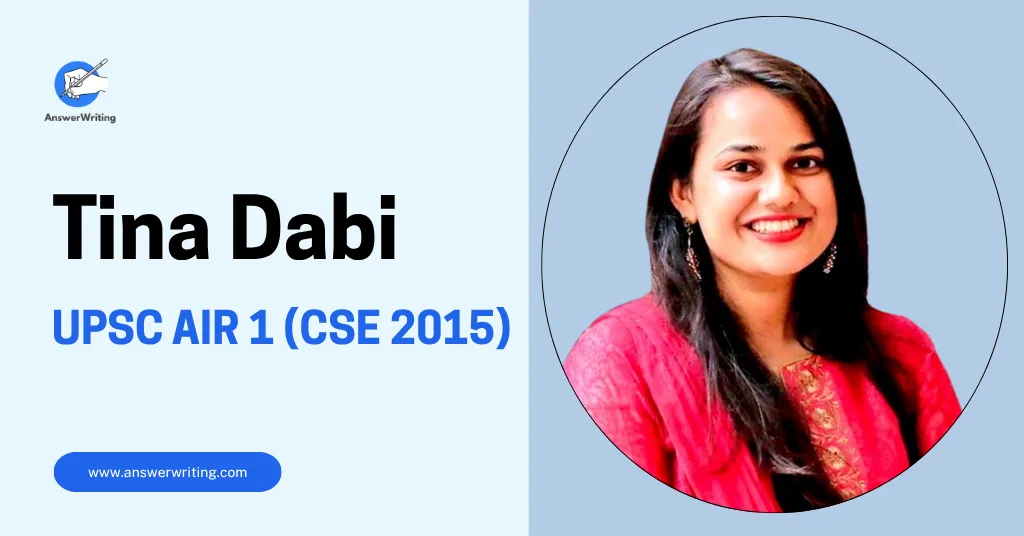
She did not score unusually high marks. Her total was 1063 out of 2025, which is 52.49%. She topped the country with just over half the available marks.
That number is the most important thing this article can tell a UPSC aspirant. The exam does not reward the most knowledgeable candidate. It rewards the most strategically prepared one.
Who Is Tina Dabi?
| Parameter | Details |
|---|---|
| Full Name | Tina Dabi |
| AIR | 1 |
| Exam Year | UPSC CSE 2015 |
| Total Score | 1063 out of 2025 (52.49%) |
| Number of Attempts | 1 (first attempt) |
| Optional Subject | Political Science and International Relations (PSIR) |
| Medium | English |
| Date of Birth | November 9, 1993 |
| Age at Result | 22 years |
| Birthplace | Bhopal, Madhya Pradesh |
| Service Allotted | IAS, Rajasthan cadre |
| Historic Distinction | First Dalit (SC category) woman to secure AIR 1 in UPSC CSE |
| LBSNAA | President’s Gold Medal for outstanding performance during IAS training |
Her parents are both qualified engineers who cleared their own competitive examinations (IES). Her mother retired early from service to support Tina’s preparation at home. That kind of family investment in education created the foundation her preparation was built on.
Her current posting is as District Collector and Magistrate, Jaisalmer, Rajasthan (as per latest available reports). She is one of the most searched UPSC names in India, a full decade after her result.
Tina Dabi UPSC Marksheet and Score Details
| Component | Marks |
|---|---|
| Essay | 145 |
| General Studies Paper 1 | 119 |
| General Studies Paper 2 | 84 |
| General Studies Paper 3 | 111 |
| General Studies Paper 4 | 110 |
| GS Total | 424 |
| PSIR Paper 1 | 128 |
| PSIR Paper 2 | 171 |
| Optional Total | 299 out of 500 |
| Written Total | 868 |
| Interview (Personality Test) | 195 out of 275 |
| Grand Total | 1063 |
Two numbers stand out here. Her Essay score of 145 is exceptional and reflects a candidate who had practiced structured long-form writing extensively. Her GS Paper 2 score of 84 is the lowest across her GS papers, a reminder that even AIR 1 candidates have uneven paper-wise performances.
The lesson is practical. You do not need to be perfect across every paper. You need to be consistently strong and avoid catastrophic scores in any single component.
Cross-check paper-wise figures from official UPSC publications, as individual scores are not formally disclosed by UPSC for all candidates.
Educational Background and Early Life
Tina was born in Bhopal, Madhya Pradesh, and moved to Delhi with her family when she was in Class 7. She completed her schooling from Convent of Jesus and Mary, New Delhi, one of the city’s well-regarded convent schools.
She scored approximately 93% in Class 12 (as per available reports) and secured admission to Lady Shri Ram College, University of Delhi, for a B.A. in Political Science. LSR is consistently ranked among India’s top colleges for humanities, and its faculty and peer environment directly supported the kind of analytical thinking UPSC Mains demands.
She began UPSC preparation in her first year of graduation itself. That early start gave her three full years to build her foundation before she sat for the exam in 2015.
Both her parents cleared competitive national examinations, her father and mother are IES (Indian Engineering Services) officers. Her mother retired early specifically to be present at home during Tina’s preparation period. That decision allowed Tina to focus entirely on her studies without domestic or logistical distractions.
The environment she prepared in was structured, supportive, and intellectually engaged. That context shaped both the quality and the consistency of her preparation.
How Many Attempts Did Tina Dabi Take?
Tina Dabi cleared UPSC CSE in her very first attempt.
She was 22 years old when the results came out. She had not yet completed her graduation when she began preparing, which means her UPSC preparation and her undergraduate education ran in parallel for the first three years.
This is a significant strategic point. She did not wait to finish her degree and then start preparing. She integrated both simultaneously. Her Political Science graduation directly fed into her PSIR optional preparation, reducing the duplication of effort significantly.
By the time she appeared for the exam, she had been preparing with structure and intention for nearly three years. The “first attempt” label can mislead aspirants into thinking she had less time invested. She had more time invested than many candidates who appear in their third or fourth attempt, precisely because she started earlier.
The takeaway is clear: when you start matters as much as how you prepare.
Tina Dabi’s Optional Subject: PSIR and Why It Was the Right Choice
Political Science and International Relations is one of the most popular optional subjects in UPSC CSE, and Tina Dabi’s AIR 1 is one of the primary reasons it became so sought after in the years that followed her result.
Her choice was not driven by trend. It was driven by alignment. She was studying Political Science at Lady Shri Ram College. Her graduation curriculum and her optional preparation were essentially the same subject. That overlap eliminated the need to study two entirely separate bodies of knowledge simultaneously.
PSIR also connects directly to multiple GS papers. GS Paper 2 covers governance, polity, and international relations, all of which are core PSIR syllabus areas. GS Paper 4 on ethics overlaps with political philosophy, another PSIR strength area. Her optional preparation was, in effect, also her GS2 preparation. That kind of synergy is what makes PSIR one of the most strategically efficient optional choices for humanities graduates.
Her combined PSIR score of 299 out of 500 (Paper 1: 128, Paper 2: 171) is strong, particularly Paper 2, which covers comparative politics and international relations. That score reflects depth of analysis, not just content coverage.
Standard books that aspirants use for PSIR optional, and which align with the preparation approach Tina followed, include:
- M. Laxmikanth’s Indian Polity for the foundational GS and polity layer
- B.L. Fadia for Indian Government and Politics
- Norman Barry and Andrew Heywood for political theory and ideologies
- Mohit Bhattacharya and Rumki Basu for public administration overlap areas
- Previous years’ UPSC PSIR papers for answer pattern understanding
The key insight from her optional choice: when your graduation subject and your optional subject are the same, you do not divide your preparation time, you multiply its output.
UPSC Preparation Strategy of Tina Dabi
Tina’s preparation was built on four pillars: an early start, strict source limitation, a structured daily timetable, and a three-time revision rule.
Start early and stay consistent. She began in her first year of college. That three-year runway allowed her to build her foundation slowly and revise repeatedly without the panic that late starters experience.
Limit your sources. She did not chase multiple books for every subject. She picked a limited set of reliable sources and mastered them completely. In UPSC preparation, reading ten books once is almost always less valuable than reading two books five times.
The three-time revision rule. Every topic she studied was revised at least three times before the exam. This is the most cited element of her preparation strategy, and for good reason. UPSC tests retention and application, not first-read recognition. Three revisions convert information from short-term recall into long-term retrieval.
Structured daily timetable. Her daily schedule was divided into three blocks: a large block for new content, a medium block for current affairs and newspaper reading, and a shorter block for revision of previously covered material. She followed The Hindu daily and made notes organized by GS papers. This structure prevented the common problem of preparing new content endlessly without ever consolidating what had already been studied.
No classroom coaching. Tina primarily prepared through self-study. She did not rely on full-time classroom coaching. She used standard reference books, NCERTs, and newspapers as her core resources. Her preparation was self-directed throughout.
Books and Resources Recommended by Tina Dabi
| Subject | Book / Resource | Author / Source |
|---|---|---|
| Indian Polity | Indian Polity | M. Laxmikanth |
| Modern History | India’s Struggle for Independence | Bipan Chandra |
| Ancient and Medieval History | NCERT Class 6 to 12 | NCERT |
| Geography | Certificate Physical and Human Geography | G.C. Leong |
| Indian Economy | Indian Economy | Ramesh Singh |
| Environment and Ecology | Shankar IAS Environment | Shankar IAS |
| Ethics (GS4) | Lexicon for Ethics | Chronicle Publications |
| Current Affairs | The Hindu (daily) | Newspaper |
| PSIR Optional | Indian Polity | M. Laxmikanth |
| PSIR Optional | Political Theory and Ideologies | Andrew Heywood |
| PSIR Optional | Indian Government and Politics | B.L. Fadia |
| PSIR Optional | Previous Years UPSC PSIR Papers | UPSC |
| General Revision | NCERTs across subjects | NCERT |
Cross-check this list against her published interviews, as specific recommendations may vary by paper and preparation phase.
Mains Answer Writing Approach
Tina’s Essay score of 145 is the single most telling number in her marksheet for answer writing aspirants. That score does not come from knowing more than other candidates. It comes from writing better than them.
Her answer writing approach was structured around three habits. First, she practiced writing full-length answers under timed conditions throughout her preparation, not just in the weeks before Mains. Second, she followed a consistent format: an introduction that directly addresses the question, a body with organized arguments supported by data or policy references, and a conclusion that connects to values or governance outcomes. Third, she revised her written answers for clarity and precision, not just for content.
For Essay specifically, she worked on developing a clear argument from the very first paragraph and sustaining it across the full length of the essay. Most candidates drift in their essays, covering adjacent topics without building a central argument. Her 145 suggests she avoided that trap consistently.
Her Essay performance is a reminder that the Essay paper rewards writing quality as much as subject knowledge. Aspirants who want to build that writing quality systematically can use AnswerWriting.com’s Essay Evaluator, which provides in-depth evaluation of full-length essays with specific improvement suggestions. Getting external feedback on complete essays, rather than only individual GS answers, is a habit that high essay scorers tend to share.
She used diagrams selectively in GS papers where visual representation added clarity, particularly in GS3 topics covering infrastructure, economy, and disaster management. She did not use diagrams as filler.
Interview (Personality Test) Experience
Tina scored 195 out of 275 in the Personality Test, a strong performance that reflects thorough DAF preparation and confident, grounded communication.
Her DAF at the time of the 2015 interview presented a specific profile: a 22-year-old Political Science graduate from Lady Shri Ram College, Dalit category, daughter of two IES officers, with an interest in Madhubani painting and fiction reading. Each of those threads offered the board multiple directions to probe.
She prepared by anticipating questions from every angle her DAF could generate. Why Political Science, not engineering like your parents? What does the SC reservation mean to you personally? How does Madhubani painting connect to governance? These are the kinds of questions that require honest, considered answers, not rehearsed scripts.
She gave multiple mock interviews before the actual board appearance (as per available reports), using feedback from each session to sharpen her communication and reduce filler language.
Her 195 score reflects a candidate who was self-aware, articulate, and consistent across the length of the interview. The Personality Test rewards authenticity and clarity of thought. Both can be prepared for, and both require deliberate practice.
Service and Cadre Allotted to Tina Dabi
Tina Dabi was allotted the IAS with the Rajasthan cadre following her AIR 1 in UPSC CSE 2015.
At the Lal Bahadur Shastri National Academy of Administration (LBSNAA), Mussoorie, she received the President’s Gold Medal for outstanding performance during the Foundation Course training. That recognition placed her among the top performers even within the IAS batch itself.
Her career postings in Rajasthan have included roles from Sub-Divisional Magistrate to District Collector. As per latest available reports, she serves as District Collector and Magistrate, Jaisalmer, one of Rajasthan’s largest and most challenging districts by geography. Readers should cross-check current posting details from official government sources.
Key Lessons Every UPSC Aspirant Can Take from Tina Dabi
- A total score of 52.49% topped the country. UPSC is not a marks race. It is a strategy race. You do not need to be perfect. You need to be consistently strong across all components while avoiding catastrophic lows in any single paper. Tina’s marksheet proves this conclusively.
- Start early and let time do the work. She began preparing in her first year of college. Three years of consistent, structured preparation is a fundamentally different animal from three months of panic revision. If you are in your first or second year of graduation and considering UPSC, the right time to start is now.
- Choose an optional that aligns with what you already know. Her graduation subject and her optional were the same. That alignment meant her college education was simultaneously UPSC preparation. Before choosing your optional, map it against what your degree has already taught you. The overlap may be more valuable than you realize.
- Three revisions beat ten books. The most cited element of her strategy is her three-time revision rule. Reading a topic once and moving on leaves it in short-term memory. Three revisions anchor it. Fewer sources revised more often is almost always the better approach.
- Essay is a scoreable paper, not a random one. Her Essay score of 145 was not luck. It was the product of structured practice, clear argumentation, and consistent writing habits built over years. Essay is one of the most neglected papers in UPSC preparation. Candidates who practice it seriously gain a significant advantage.
FAQs About Tina Dabi
What is Tina Dabi’s UPSC rank? She secured AIR 1 in UPSC Civil Services Examination 2015, becoming the first Dalit woman to top the exam in its history.
What was Tina Dabi’s optional subject in UPSC? Her optional subject was Political Science and International Relations (PSIR).
How many attempts did Tina Dabi take to clear UPSC? She cleared UPSC CSE in her very first attempt, at age 22.
What is Tina Dabi’s total UPSC score? Her total score was 1063 out of 2025, which is 52.49%. Written total was 868 and Interview score was 195.
Which cadre was Tina Dabi allotted? She was allotted the IAS with the Rajasthan cadre. She also received the President’s Gold Medal at LBSNAA for outstanding performance during foundation training.
Which college did Tina Dabi attend? She studied B.A. Political Science at Lady Shri Ram College, University of Delhi.
Did Tina Dabi attend coaching for UPSC? She primarily prepared through self-study and did not rely on full-time classroom coaching, as per available reports. Her preparation was self-directed using standard reference books, NCERTs, and newspapers.