Uttar Pradesh history is asked in both UP PCS Prelims and Mains. In 2025, the Prelims paper asked which Indus Valley sites lie in present-day UP, and the Mains GS V paper asked about Ayodhya in ancient literature, Jain sites in the Braj region, Agra’s Indo-Islamic architecture, and the role of Meerut, Lucknow, Kanpur and Jhansi in the Revolt of 1857. This post covers UP’s history from the earliest sites to independence, in simple language, with the exam angle for each period.
The main facts here come from the history and culture pages of the official Uttar Pradesh state portal and the official 2025 UP PCS papers.
UP’s History at a Glance
Early Times
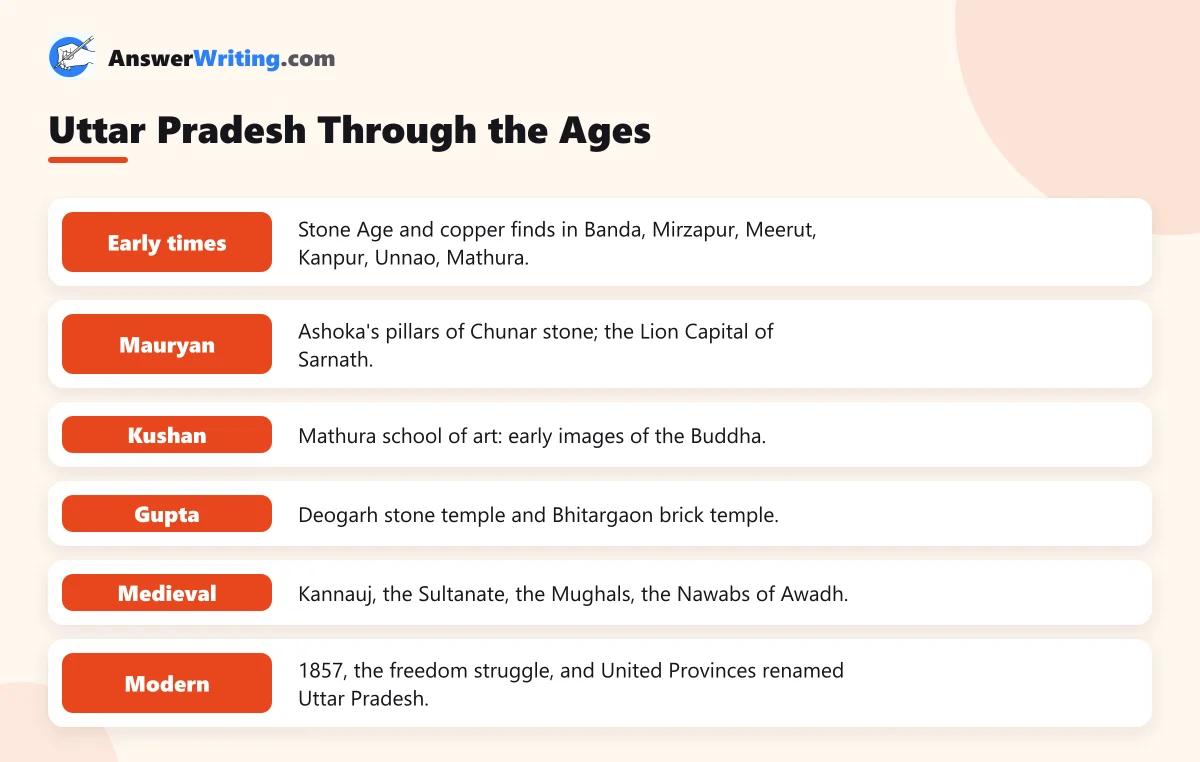
The state portal notes that no Harappa or Mohenjo-daro has been found in UP, but antiquities from Banda in Bundelkhand, Mirzapur and Meerut link the region to the early Stone Age and the Harappan era. Rock drawings are found in the Vindhyan ranges of Mirzapur district. Copper objects have been found in Kanpur, Unnao, Mirzapur and Mathura, and early pottery at sites such as Atranjikhera, Kaushambi, Rajghat and Sonkh.
Exam angle: Prelims 2025 asked which Indus Valley sites are in present-day UP. Keep a short list of UP’s Harappan and copper-age sites with their districts.
The Vedic Age and Early Kingdoms
UP was at the centre of the later Vedic culture and of several of the sixteen mahajanapadas, including Kosala, Kashi, Vatsa, Panchala and Shurasena. Cities like Ayodhya, Kashi (Varanasi), Kaushambi and Shravasti grew in this period.
The region also has a deep place in Indian tradition. The portal notes that Ayodhya is linked to Lord Rama and Mathura to Lord Krishna. In 2025, GS V asked about the cultural significance of Ayodhya on the basis of ancient literature.
Buddhism and Jainism
The Buddha gave his first sermon at Sarnath near Varanasi and attained parinirvana at Kushinagar. Shravasti and Kaushambi were important centres in his life. Mathura was a major centre of Jainism; in 2025, GS V asked about Jain archaeological sites in the Braj region.
Mauryan Art
According to the state portal, Ashoka is said to have visited Sarnath and Kushinagar. Remains of Mauryan stone pillars have been found at Sarnath, Prayagraj (Allahabad), Meerut, Kaushambi, Sankisa and Varanasi, and the Ashokan pillars were made of Chunar stone. The Lion Capital of Sarnath is the finest example of Mauryan art, and it is the source of India’s national emblem.
The Kushan Period and the Mathura School
The Mathura school of art reached its peak under the Kushans. The portal notes that one of its most important works was the human image of the Buddha, who had earlier been shown only through symbols. Images of Jain Tirthankaras and Hindu deities were also made in Mathura, and statues of Kushan rulers have been found at Mat in Mathura district.
The Gupta Age
The Gupta period is called the golden age of Indian art. Two UP temples are standard exam facts:
| Temple | Place | Material |
|---|---|---|
| Dashavatara temple, Deogarh | Lalitpur district (earlier part of Jhansi) | Stone |
| Bhitargaon temple | Kanpur district | Brick |
The portal also mentions terracotta finds of this period from Rajghat (Varanasi), Sahet-Mahet (Gonda-Bahraich), Bhitargaon and Ahichchhatra (Bareilly).
The Medieval Period
After the Guptas, Kannauj became the most important city of north India, first under Harsha and later as the prize fought over by the Gurjara-Pratiharas, Palas and Rashtrakutas. Under the Delhi Sultanate and the Mughals, the region was central to the empire. The Mughal style reached its height in the Taj Mahal at Agra; Akbar’s buildings at Fatehpur Sikri, including the Buland Darwaza, are also in UP.
After the Mughals, the Nawabs of Awadh kept the building tradition alive in Lucknow. The portal highlights the Bara Imambara built by Asaf-ud-Daula, whose vaulted hall is a fine example of the Lucknow style.
The Revolt of 1857
UP was the main centre of the Revolt of 1857:
- Meerut: the revolt began here among the sepoys in May 1857.
- Lucknow: Begum Hazrat Mahal led the resistance in Awadh.
- Kanpur: Nana Saheb led the revolt.
- Jhansi: Rani Lakshmibai fought the British.
In 2025, GS V asked how Meerut, Lucknow, Kanpur and Jhansi contributed to the revolt and what the key events were in the state.
The Freedom Struggle
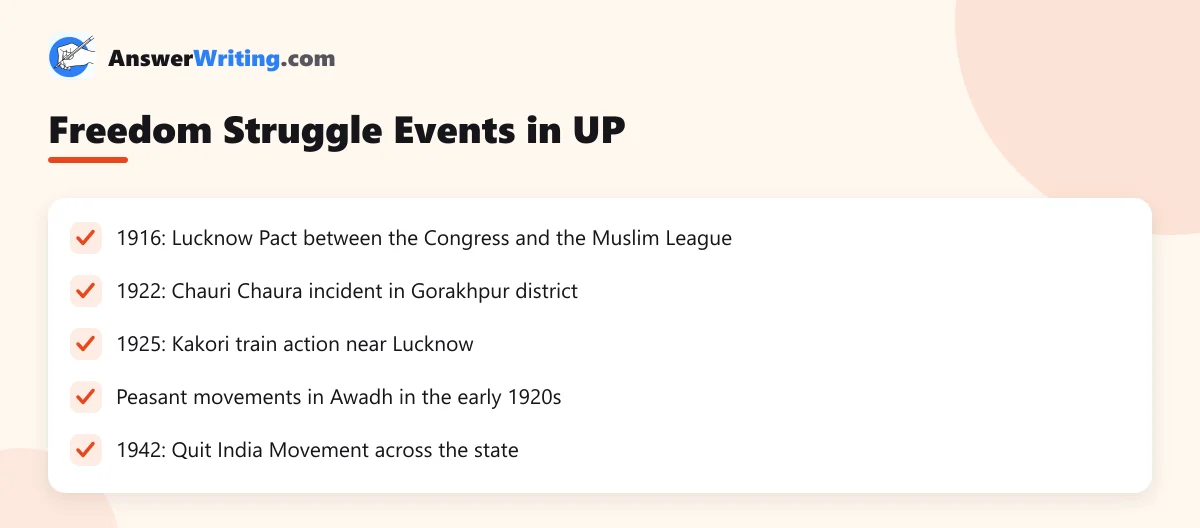
After the Chauri Chaura incident of 1922, Gandhi called off the Non-Cooperation Movement. Under British rule the region was called the United Provinces; after independence, as the state portal notes, it was renamed Uttar Pradesh. The new name took effect on 24 January 1950, which is now celebrated as UP Diwas.
How to Revise UP History
- Make one table per period: site, district, ruler or leader, and one fact.
- Mark every site on a blank UP map.
- Learn events in order, because UP PCS often asks chronological-order questions.
- For Mains GS V, prepare short notes on Ayodhya, Mathura, Sarnath, Agra, Lucknow and the 1857 centres.
For the full list of what to study on Uttar Pradesh, see our UP GK guide for UP PCS.
The architecture of each period is explained in UP art and culture for UP PCS.
Key Takeaways
- UP has early Stone Age, Harappan-era and copper-age links in sites across Banda, Mirzapur, Meerut and other districts.
- Mauryan pillars of Chunar stone and the Sarnath Lion Capital are key Mauryan facts.
- The Mathura school under the Kushans and the Gupta temples of Deogarh and Bhitargaon are standard questions.
- The Mughals and the Nawabs of Awadh left the Taj Mahal, Fatehpur Sikri and Lucknow’s Imambaras.
- 1857 centres (Meerut, Lucknow, Kanpur, Jhansi) and events like Chauri Chaura and Kakori are asked often.
Practise UP History Answers
GS V asks UP history questions of 125 and 200 words. Write one answer a day and get it checked with the UP PCS answer evaluator on AnswerWriting, in Hindi or English, with a model answer. Your first three evaluations are free.
Related Reading
FAQs
Is UP history important for UP PCS?
Yes. It comes in Prelims and in Mains GS V. In 2025, questions covered Indus sites in UP, Ayodhya, Jain sites in Braj, Agra’s architecture and the 1857 revolt.
Where did the Revolt of 1857 begin?
At Meerut, in May 1857.
Which Gupta temples are in Uttar Pradesh?
The stone Dashavatara temple at Deogarh in Lalitpur district and the brick temple at Bhitargaon in Kanpur district.
When was the United Provinces renamed Uttar Pradesh?
The name Uttar Pradesh took effect on 24 January 1950, celebrated as UP Diwas.
What stone were Ashoka’s pillars made of?
Chunar stone, as noted on the official UP state portal.