
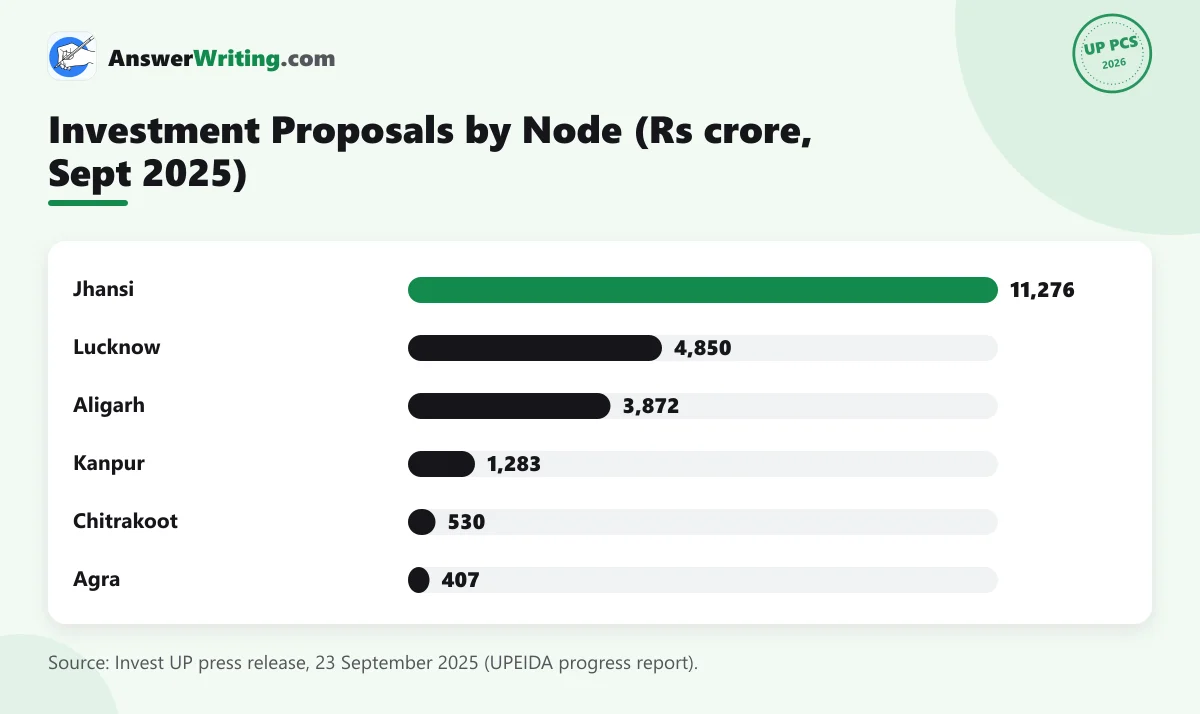
The Uttar Pradesh Defence Industrial Corridor (UPDIC) is a set of six industrial areas, or nodes, at Kanpur, Jhansi, Lucknow, Aligarh, Agra and Chitrakoot, where companies make defence and aerospace equipment. It was announced in 2018 and is developed by UPEIDA (the Uttar Pradesh Expressways Industrial Development Authority). By September 2025, according to an official Invest UP press release, it had received investment proposals worth about Rs 33,896 crore, and nine units had started operations.
UP PCS GS 6 asked about it in 2025: “Analyse in detail the role of the Defence Industrial Corridor in promoting industrial and regional development in Uttar Pradesh.” This post gives you the facts and a ready structure for that kind of question.
The Corridor at a Glance
| Point | Detail |
|---|---|
| Announced | 2018, by the Prime Minister |
| Developed by | UPEIDA |
| Nodes | Kanpur, Jhansi, Lucknow, Aligarh, Agra, Chitrakoot |
| Aim | Defence self-reliance, industry, jobs, and development of backward regions |
| Investment proposals | About Rs 33,896 crore (September 2025) |
| Land | 2,040 hectares procured; about 977.5 hectares allotted to industries |
| Companies | 62 companies allotted land; nine units operational |
| Linked state policy | UP Defence and Aerospace Unit and Employment Promotion Policy 2022 |
The figures come from the Invest UP press release of 23 September 2025, based on UPEIDA’s progress report. News reports in 2026 give higher totals as more proposals came in, so check the latest official release before your exam.
What Is Being Made There
The official release names several units already in production:
- Kanpur: an ammunition plant by Adani Defence Systems and Technologies (Rs 1,500 crore, the corridor’s largest single investment so far), plus ballistic materials and defence textiles.
- Lucknow: the BrahMos Aerospace facility for the BrahMos NG missile system (Rs 300 crore), and titanium casting by Aerolloy Technologies.
- Aligarh: electronic warfare systems and satellite technology, small arms, and precision arms parts.
You do not need to remember every company. Remember one example per node, such as BrahMos at Lucknow.
Why It Matters for Uttar Pradesh
Industrial development
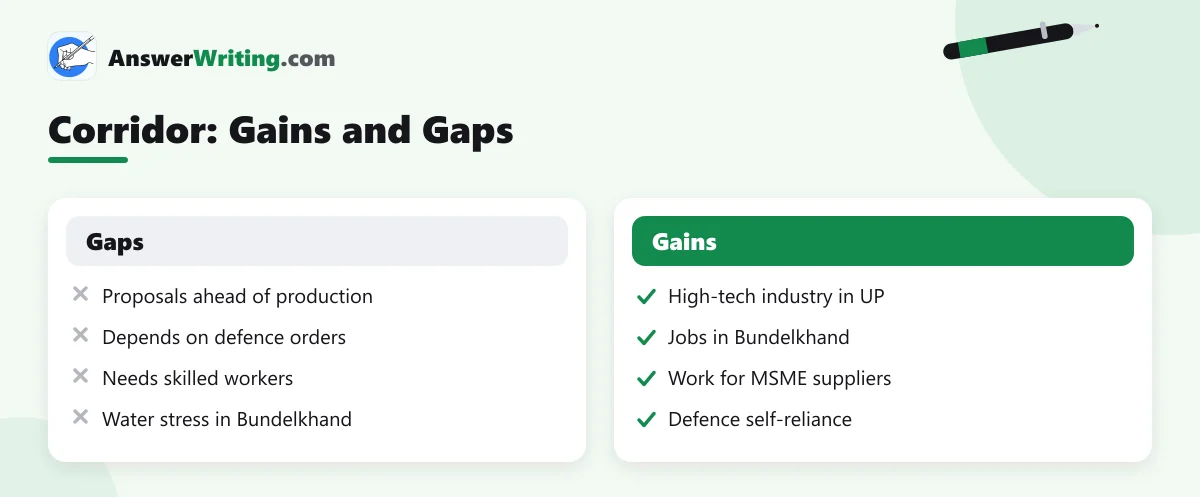
- It brings high-technology manufacturing to the state.
- Small firms (MSMEs) can supply parts to big defence companies.
- It supports India’s push for self-reliance in defence production.
Regional development
- Two nodes, Jhansi and Chitrakoot, are in Bundelkhand, one of UP’s most backward regions. Jhansi drew the most proposals in 2025.
- Expressway links, such as the Bundelkhand Expressway, connect the nodes to markets.
- It creates jobs and skill training near the nodes, which can reduce migration.
Challenges
- Only nine units were operational by September 2025, against 62 land allotments, so many proposals are still on paper.
- Defence manufacturing depends on orders from the armed forces and approvals from the Centre.
- It needs skilled workers, testing facilities and research links, which take time to build.
- Bundelkhand faces water shortage, which can slow large industries.
A Sample 200-Word Answer
Question (GS 6, 2025): Analyse in detail the role of the Defence Industrial Corridor in promoting industrial and regional development in Uttar Pradesh. (12 marks)
Answer: The UP Defence Industrial Corridor, announced in 2018 and developed by UPEIDA, has six nodes: Kanpur, Jhansi, Lucknow, Aligarh, Agra and Chitrakoot. By September 2025 it had drawn investment proposals of about Rs 33,896 crore, with nine units operational.
Industrial development:
- High-technology units, such as the BrahMos facility in Lucknow and an ammunition plant in Kanpur.
- Linkages for MSMEs as suppliers of parts and services.
- Support for national self-reliance in defence.
Regional development:
- Jhansi and Chitrakoot bring industry to backward Bundelkhand; Jhansi received the largest share of proposals.
- Expressway connectivity links the nodes to markets.
- Local jobs and skilling can reduce distress migration.
Challenges: only nine units were running against 62 land allotments; dependence on defence orders; a shortage of skilled labour; and water stress in Bundelkhand.
Way forward: faster approvals, skill centres linked to the nodes, testing facilities and water planning for Bundelkhand can turn proposals into production and make the corridor an engine of balanced growth.
Key Takeaways
- The UP Defence Industrial Corridor has six nodes: Kanpur, Jhansi, Lucknow, Aligarh, Agra, Chitrakoot.
- It was announced in 2018 and is developed by UPEIDA.
- By September 2025: about Rs 33,896 crore in proposals, 62 companies allotted land, nine units operational.
- Jhansi and Chitrakoot bring industry to Bundelkhand.
- In answers, cover both gains and gaps, with one example per node.
Practise This Question
Write the 2025 question above in your own words and get it evaluated on AnswerWriting’s UP PCS page, in Hindi or English, with a model answer. Your first three evaluations are free.
Related Reading
FAQs
What are the six nodes of the UP Defence Industrial Corridor?
Kanpur, Jhansi, Lucknow, Aligarh, Agra and Chitrakoot.
Which agency develops the UP Defence Industrial Corridor?
UPEIDA, the Uttar Pradesh Expressways Industrial Development Authority.
When was the UP Defence Corridor announced?
In 2018.
How much investment has the corridor attracted?
About Rs 33,896 crore in proposals by September 2025, according to an Invest UP press release. Later reports give higher figures.
Which other state has a defence industrial corridor?
Tamil Nadu. India has two defence industrial corridors, in Uttar Pradesh and Tamil Nadu.