How to solve Statement based Questions in UPSC Prelims?
In UPSC Prelims 2023, close to 35 out of 100 questions were statement-based. That is roughly 70 marks sitting behind a question format that most aspirants tackle with guesswork rather than method.
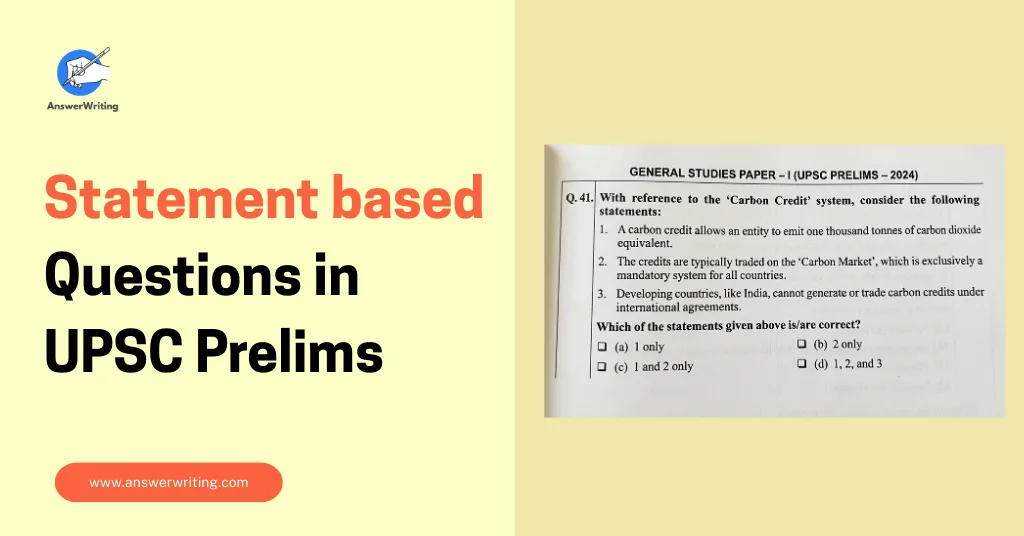
Statement-based questions are not harder than other questions. They just require a different approach. Candidates who have a clear framework for these questions gain a significant scoring advantage over those who rely on gut feeling.
Here is the complete method.
Why Statement-Based Questions Are Designed to Trick You
UPSC uses statement-based questions for a specific reason. They are not testing whether you memorised a fact. They are testing whether you understand a concept well enough to judge it as true or false under pressure.
A straightforward question like “Which Article deals with the Right to Equality?” rewards memorisation. A statement-based question forces you to evaluate nuance. It can take a fact you know and present it with one word changed, one condition reversed, or one exception removed.
The confidence trap is the real danger here. You recognise the topic. You feel you know it. So you answer quickly without reading carefully. That is exactly what UPSC wants you to do. The question is designed to punish surface-level familiarity and reward deep understanding.
The Four Types You Will Face
Not all statement-based questions work the same way. Recognising the type before you start solving saves time and reduces errors.
| Type | Format | What It Tests | Frequency |
|---|---|---|---|
| Which is/are correct | 2 to 3 statements, choose correct ones | Factual accuracy | Very High |
| How many are correct | 3 to 4 statements, count correct ones | Precision across all statements | High (rising trend) |
| Assertion-Reason | Statement A + Reason R, judge relationship | Conceptual understanding | Moderate |
| Correct sequence/order | Statements arranged in order, judge accuracy | Chronological or logical clarity | Moderate |
The “How many are correct” format has increased sharply in recent years. UPSC introduced it to counter elimination strategies. More on how to handle it shortly.
The 3-Step Solving Framework
Step 1: Anchor on What You Know With Certainty
Read all statements before touching the options. Do not jump to the answer choices yet.
As you read each statement, mentally tag it. Mark it as True, False, or Unsure. Be honest with your tags. Do not pretend a statement is true simply because you want it to be.
Now look for your anchor. An anchor is any statement you can confidently call true or false with near-certainty. This is your starting point for elimination.
If Statement 1 is definitely false, every option that includes Statement 1 as correct gets eliminated immediately. You have just narrowed four options to two without needing to evaluate everything.
This single habit, anchoring on certainty before evaluating uncertainty, is the foundation of smart statement-question solving.
Step 2: Eliminate, Don’t Confirm
Most aspirants try to confirm the right answer. Smart aspirants try to eliminate the wrong ones.
These are not the same thing. Confirmation requires you to be certain about everything. Elimination only requires you to be certain about one thing.
If you can confidently eliminate two options, you are left with a 50/50 choice. At that point, the negative marking math changes in your favour. A 50/50 attempt is worth taking. A 1-in-4 guess is not.
Work through the statements from your most certain to your least certain. Each confirmed false statement chips away at the available options. By the time you reach your unsure statements, you often do not need to resolve them at all.
Step 3: Handle “How Many Are Correct” Differently
The “How many are correct” format breaks the standard elimination method. Here, you cannot eliminate options based on a single statement. You need to evaluate all statements because the answer depends on the total count.
For this type, slow down deliberately. Read every statement with equal attention. Use your True, False, Unsure tags as before. Then count your confirmed True statements.
If you tagged two statements as definitely True and one as Unsure, your answer is either 2 or 3. Check the options. If the choices are “Only one,” “Only two,” “Only three,” and “All four,” you can now eliminate “Only one” and “All four” with confidence.
Do not rush this type. It is designed to reward patience.
Subject-Wise Traps to Watch Out For
UPSC uses specific tricks in specific subjects. Knowing these in advance removes the element of surprise.
Polity:
- Statements often swap the roles of the President and Governor, or Lok Sabha and Rajya Sabha
- Watch for statements about “exclusive” powers. Very few constitutional powers are truly exclusive to one body
- Statements about constitutional bodies often contain a subtle error in appointment procedure or tenure
History:
- Medieval History statements frequently reverse the achievements of rulers or attribute one ruler’s work to another
- Statements about socio-religious reform movements often mix up the founders, the year of establishment, or the region
- Art and Architecture statements swap dynasty names with monument names
Environment:
- Statements about international conventions often contain errors in the year of adoption or the specific scope of the agreement
- Biodiversity statements frequently confuse endemic species with endangered species, or hotspots with biosphere reserves
- Statements about national parks and wildlife sanctuaries often swap their host states
The Language Traps UPSC Hides in Statements
Beyond factual errors, UPSC embeds language traps in statements. These are designed to catch candidates who read too fast.
Absolute words are the most common trap. Words like “only,” “always,” “never,” “all,” and “exclusively” make a statement much harder to be true. If a statement says “The President can only act on the advice of the Council of Ministers in all matters,” that absolute claim is likely false because there are exceptions. Be suspicious of absolutes.
Half-truths are more dangerous. A half-truth statement contains a correct fact paired with an incorrect conclusion or condition. The first half lulls you into agreement. The second half contains the error. Always read statements to the very end before tagging them.
Reversed causality appears frequently in Economy and Environment questions. A statement might correctly identify two connected events but reverse which one caused the other. The facts are right. The relationship is wrong.
Omitted exceptions are subtle. A statement about a constitutional provision may be perfectly accurate for the general rule but omit a critical exception. Without knowing the exception, the statement appears true.
Assertion-Reason Questions: A Special Case
Assertion-Reason questions require a two-level evaluation. First, judge whether the Assertion (A) is true or false. Second, judge whether the Reason (R) is true or false. Third, and most critically, judge whether R actually explains A, even if both are independently true.
This third step is where most candidates lose marks. They confirm that both A and R are true and select the option that says “Both A and R are true and R is the correct explanation.” But UPSC frequently presents two true statements that are unrelated to each other. R may be a correct fact without being the reason for A.
Always ask: “Does R explain A, or does it merely accompany it?” These are very different things.
When to Attempt and When to Skip
Not every statement-based question deserves an attempt. Apply this quick filter before committing:
Attempt if you can confidently tag at least one statement as definitely true or definitely false. That anchor gives you a fighting chance through elimination.
Skip if every statement feels uncertain and you cannot eliminate any option. A blind attempt on a statement question with four options costs you 0.33 marks on a wrong answer. Over 10 such questions, that is over 3 marks lost. Those marks matter at a cut-off of 98.
The discipline to skip is as important as the skill to solve.
Frequently Asked Questions
Q1. Should I attempt statement-based questions first or save them for later in the exam?
Attempt them in the order they appear, but flag the ones that require deep thinking and return to them. Do not spend more than 90 seconds on any single question in your first pass. Statement questions that need careful elimination can be revisited once you have secured the easier marks.
Q2. How do I improve at statement-based questions during preparation?
Solve previous year Prelims papers and specifically isolate all statement-based questions. For every question you got wrong, identify which trap caught you: was it an absolute word, a half-truth, or a subject-specific swap? Tracking your error patterns over 10 to 15 papers will reveal exactly which traps you fall for repeatedly.
Q3. Is it possible to solve statement questions without knowing the topic at all?
Partially. Language analysis can help you eliminate one or two options based on absolute words or structural clues. But this should be a last resort, not a strategy. Deep subject knowledge combined with the elimination method is what consistently produces correct answers.
Final Word
Statement-based questions are not a lottery. They are a skill. And like every skill, they improve with deliberate practice and honest error analysis.
Build your anchor habit. Eliminate before you confirm. Learn the subject-wise traps. Read every word, especially the last one. And develop the discipline to skip when the ground beneath a question feels completely uncertain.
The candidates who crack Prelims are not the ones who knew every statement was true or false. They are the ones who knew enough to make the right call, more often than not.
That is a trainable skill. Start training it today.