


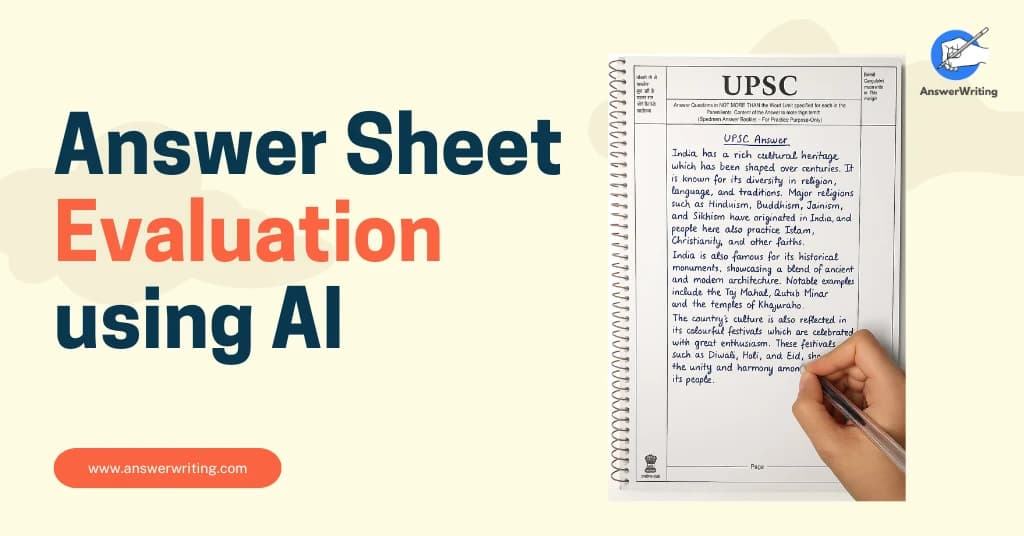
Answer sheet evaluation using AI means uploading a handwritten or typed descriptive answer and getting it marked and explained by an AI system in seconds instead of days. For UPSC and State PCS aspirants, this makes daily Mains practice practical: you write, upload, see where you lost marks, rewrite and improve, all on the same day.
Here is how AI evaluation of descriptive answers works, what it checks, where its limits are, and how to use it well.

How AI Answer Sheet Evaluation Works
- Reading the answer: the system converts your handwritten pages into text, so handwriting practice counts.
- Understanding the question: it identifies the directive word (discuss, examine, analyse, comment) and the parts the question asks for.
- Checking content: it compares the dimensions you covered with what a complete answer needs, and looks for relevant examples, data, committees, judgments and schemes.
- Checking structure: it reviews the introduction, the flow of the body, the use of headings or points, and the conclusion.
- Scoring and feedback: it gives a score with section-wise comments and a model answer you can compare against.
What a Good AI Evaluation Checks
| Area | Questions it answers |
|---|---|
| Introduction | Does it define the issue and respond to the demand of the question? |
| Body | Are all parts of the question covered? Are there multiple dimensions (social, economic, political, environmental)? |
| Substantiation | Are there examples, data, reports or case laws to support points? |
| Conclusion | Does it give a balanced way forward rather than repeating the body? |
| Presentation | Is it readable, within the word limit, with clear points or a diagram where useful? |
Benefits of AI Evaluation for Aspirants
- Speed: feedback in about a minute instead of a week, so you can rewrite while the topic is fresh.
- Consistency: the same criteria every time, which makes it easier to see real progress.
- Volume: you can practise daily, which is what Mains preparation needs.
- Language: practise in your exam medium; AnswerWriting supports English, Hindi and 22 other Indian languages.
- Coverage: GS, Essay and optional subjects, including subjects like Anthropology answer evaluation.
What Changes by Paper Type
- GS Papers I to III: the focus is coverage of dimensions, relevant examples and data, and a balanced conclusion within 150 or 250 words.
- GS Paper IV (Ethics): definitions of values, use of thinkers or real examples, and, in case studies, a clear list of stakeholders, options and a justified decision.
- Essay: a clear thesis, logical flow across sections, use of multiple perspectives, and coherence from introduction to conclusion over 1,000 to 1,200 words.
- Optional papers: subject depth, correct terminology, theories, diagrams and case studies specific to the discipline.
Knowing what is checked in each paper helps you read your feedback correctly. A low score in an Ethics answer may be about missing stakeholders rather than weak language.
Limits of AI Evaluation, and How to Handle Them
No evaluator, human or AI, can predict your exact UPSC marks. Treat the score as a guide to relative improvement, not a promise. Very unclear handwriting can also be misread, so write legibly, as you must in the exam anyway. And for personal guidance on strategy, combine AI feedback with your own review and occasional mentor input. Our guide to UPSC answer checking compares these methods.
A Simple Routine Using AI Evaluation
- Choose one previous year question from the syllabus topic you studied today.
- Write it by hand in the time limit: about 7 minutes for 150 words, 11 minutes for 250.
- Upload it and read every comment, not just the score.
- Compare your answer with the model answer and note one improvement.
- Rewrite the weakest section and re-evaluate.
Done daily, this routine builds the writing skill Mains rewards. For the bigger picture of how AI fits into preparation, read UPSC Mains preparation with AI, and for writing technique see our guide to Mains answer writing.
Key Takeaways
- AI answer sheet evaluation reads handwritten answers and gives scores, section-wise feedback and model answers.
- It checks introduction, coverage, substantiation, conclusion and presentation.
- Its biggest benefit is making daily feedback possible.
- Use scores to track improvement, and pair AI feedback with self-review.
FAQs on AI Answer Sheet Evaluation
Can AI read handwritten answer sheets?
Yes, as long as the handwriting is reasonably legible. Upload a clear photo or PDF for best results.
Is AI evaluation accurate for UPSC answers?
It is a reliable guide to what your answer covers and misses, and its consistency makes progress easy to track. No tool can predict exact UPSC marks.
How long does AI evaluation take?
Usually under a minute for a single answer on AnswerWriting.
Can I evaluate a full answer booklet?
Yes. AnswerWriting also has a full paper evaluator that gives paper-level feedback on a complete test.
Try It on Today’s Answer
Write one Mains answer by hand and upload it for AI feedback on structure and content. You will get a scorecard, section-wise comments and a model answer within about a minute.